Side-by-side or overlay PDF diff driven by one engine that reads each file into a structured model — text, vector geometry, images, form fields, annotations — and compares the models. Moves show as moves, edits show only where they happened, and any PDF type works without picking a mode.
Open a STEP / STP part and it measures itself — volume, thinnest wall, draft and undercut checks on load, plus hole detection with a BOM. Measure, section, export STL. Rust + WASM B-rep kernel, runs in your browser.
Thua nao is northern Thailand's sticky, alkaline fermented soybean. Soaked soybeans are boiled for hours, packed into a bamboo basket lined with banana leaves and left warm for two to three days while Bacillus bacteria ferment them. The beans are mashed into a paste that is steamed or roasted in leaves, or pressed into thin discs and sun-dried for longer storage.
Fully documentedSoy and legumes2.1 days – 3.2 days
spontaneous (bamboo basket and banana leaves); commercial Bacillus subtilis starters used in studies
Total time across the recorded steps: 2.1 days – 3.2 days
Start
Drag the bar or press Play
What changes:Soybeans are washed and soak overnight
Step 1 of 5
Wash and soak overnight
Time
Soaked overnight (Shan practice; Karen and Lawa skip soaking)
Reported
Temperature
Not documented
Salt
None given
Acidity
Not documented
Which microbes the steps name, step by step
Bacillus subtilis
Output: soaked beans.
Flavour
Not documented
Texture
swollen
Colour
Not documented
Microbes at work in this step
Not documented for this step.
Method
Measured measured in a studySet fixed by a specification or tested recipeReported one source reports itTypical a general value, not sourced for this fermentUnconfirmed not yet checked against a source
At a glance
Thua nao is northern Thailand's sticky, alkaline fermented soybean. Soaked soybeans are boiled for hours, packed into a bamboo basket lined with banana leaves and left warm for two to three days while Bacillus bacteria ferment them. The beans are mashed into a paste that is steamed or roasted in leaves, or pressed into thin discs and sun-dried for longer storage. Made in 5 steps over 2.1 days – 3.2 days. The longest step, ferment in a banana-leaf-lined bamboo basket, takes 2–3 days (Suriyanoi K 2018) and runs at 37–42 °C (Shurtleff W 1970). Bacillus, 82.7–86.8 % of bacteria in Shan thua nao and Bacillus subtilis, the naturally occurring bacterium that activates the fermentation do most of the fermenting.
Thua nao is a natto-type Bacillus ferment, but it is fermented in banana leaves in a bamboo basket rather than in rice straw, and most of it is mashed and cooked or dried into discs instead of eaten as whole sticky beans.
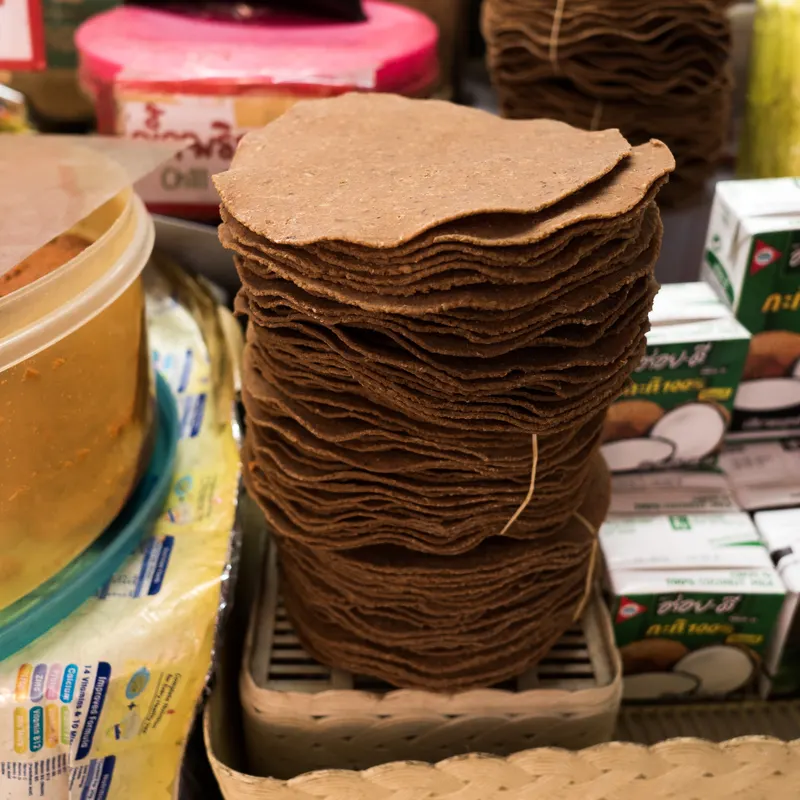
Thua nao kab (dried discs)Paste pressed into paper-thin 3-inch rounds and sun-dried; Shurtleff and Aoyagi say they keep about 6 months.
Thua nao powderDried thua nao sold as a powder; Suriyanoi et al. (2018) say this post-fermentation step can prolong shelf life for several months.
Ferm-soy mix (1970)A nutrition-project mix of 60 % thua nao powder, 20 % fish meal and 6 % iodised salt, with chilli, garlic and onion powder.
Black soybean thua naoMade from black soybeans; drying method changes its aroma.
Safety
Market thua nao is often made without hygiene controls. In 24 market samples from Chiang Rai and Phayao, E. coli was found in 13, Salmonella in 3 and B. cereus in 2; S. aureus and C. perfringens were not found. The authors call these data preliminary. Fresh thua nao is steamed or roasted before eating; do not eat the fresh paste raw. No source we read shows that cooking makes contaminated thua nao safe. A 2022 review says mycotoxins have been detected in thua nao. The study it cites isolated one aflatoxin-producing Aspergillus flavus strain from soybean and fresh thua nao, and its abstract gives no toxin level in the food. Moulds were above 10^4 CFU/g in most market samples. Fresh paste keeps only about two days. Dried discs keep about 6 months, but dried samples also carried E. coli, Salmonella and B. cereus.
Hazards the sources name: Escherichia coli in 54.17 % of 24 market samples; Salmonella spp. and Bacillus cereus also detected; Proteus in Shan thua nao; One aflatoxin-producing Aspergillus flavus strain isolated from soybean and fresh thua nao; a 2022 review says mycotoxins have been detected in thua nao.
Thua nao is the Shan name; Karen and Lawa make their own versions, tor-nor-au and kuem. In 1970 Sundhagul and colleagues developed a dried thua nao powder for a nutrition mix.