Side-by-side or overlay PDF diff driven by one engine that reads each file into a structured model — text, vector geometry, images, form fields, annotations — and compares the models. Moves show as moves, edits show only where they happened, and any PDF type works without picking a mode.
Open a STEP / STP part and it measures itself — volume, thinnest wall, draft and undercut checks on load, plus hole detection with a BOM. Measure, section, export STL. Rust + WASM B-rep kernel, runs in your browser.
Young tea leaves are steamed or boiled, rolled and pressed under weight in a lined pit or tank for weeks to months, where naturally occurring lactic acid bacteria ferment them from green to golden-green. Lahpet is eaten as a salad, not brewed.
No fixed amounts recordedTraditional process with no fixed batch size or recipe amounts in the sources used here. The cited process descriptions put only the rolled leaf into the pit or tank.
Young tea leaves and buds
Tender young leaves and leaf buds of Camellia sinensis are chosen for fermenting[thar2016][wp]
No starter
Natural fermentation, with no external microbial inoculation added[kham2024]
Salt, oils, flavourings and nuts
Added by manufacturers to the finished pickled tea, after fermentation[thar2016]
Garlic, chilli, salt, lemon or lime juice, and peanut or sesame oilto taste
To flavour the finished lahpet; Wikipedia lists minced garlic, ground chilli, salt, lemon juice and peanut oil, and the thesis names sesame oil in the lacquer tray and lime in the salad[wp][thar2016]
Starter
spontaneous
Total time across the recorded steps: 14 days – 12 months
Start
Drag the bar or press Play
What changes:Starting material: young tea leaves and buds
Step 1 of 6
Pick the young flush
Time
Not documented
Temperature
Not documented
Salt
None given
Acidity
Not documented
Which microbes the steps name, step by step
Lactic acid bacteria
Picked by hand in five picking seasons from mid-March to mid-November. The best leaf is the first harvest, from mid-March to early April. Output: young leaves and buds.
Flavour
Not documented
Texture
Not documented
Colour
Not documented
Microbes at work in this step
Not documented for this step.
Method
Measured measured in a studySet fixed by a specification or tested recipeReported one source reports itTypical a general value, not sourced for this fermentUnconfirmed not yet checked against a source
At a glance
Young tea leaves are steamed or boiled, rolled and pressed under weight in a lined pit or tank for weeks to months, where naturally occurring lactic acid bacteria ferment them from green to golden-green. Lahpet is eaten as a salad, not brewed. Made in 6 steps over 14 days – 12 months. The longest step, pack into a lined pit and weigh down, takes 14 days – 12 months (Thar S.P. 2016). Lactobacillus and Acetobacter do most of the fermenting.
Lahpet is one of the few teas that is eaten, not drunk. Unlike miang it is pressed in a pit or tank under weight, and the sources used here describe nothing added to the pit; the garlic, chilli, salt, citrus and oil come when it is seasoned.
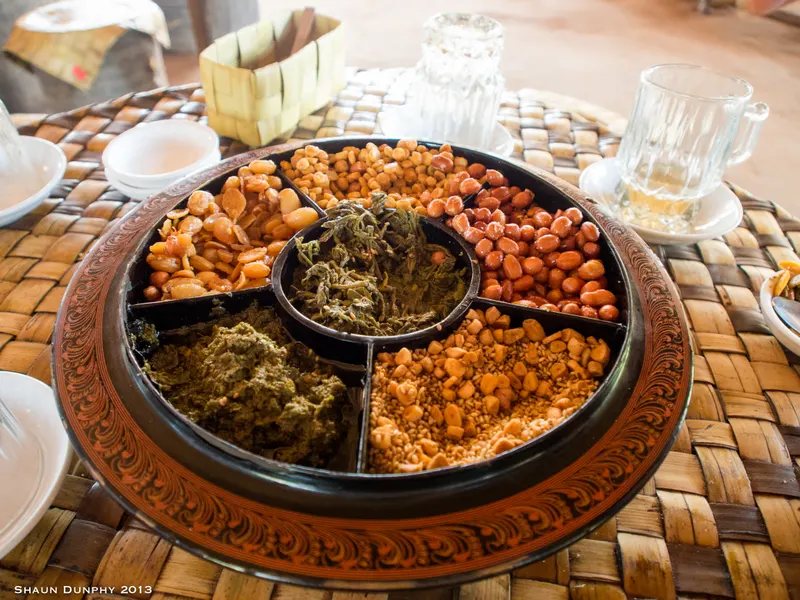
A-hlu lahpet, MandalayServed on a lacquer tray with fried garnishes.
Zayan lahpetLahpet mixed with star fruit, with pickled young leaves cut together with coarse leaves.
Mogok lahpetMany prefer it because it uses only young tea leaves.
Pickled sun-dried green teaLow-quality pickled leaf put back under pressure in bags, tanks or pits for about six to seven months, then sun-dried and used for drinking; popular in Ayeyarwady.
Taw lahpet (Pyay)Fermented from the leaves of the naywe tree or of kyettet (Combretum pilosum), not tea, then soaked in regularly changed water for up to two years.
Three finished brands tested pH 4.35, 4.45 and 4.7. New Zealand's Ministry of Primary Industries uses pH 4.6 as its limit for Clostridium botulinum, so the pH 4.7 brand could not legally have been used for taste testing there. The thesis adds that this brand had been held at room temperature since picking and had not had a full heat process against the bacterium. In 2009 Myanmar authorities found Auramine O, a dye not permitted in food, in 253 of 458 market samples; a retest of 667 samples that September was negative.
Hazards the sources name: Auramine O, a dye not permitted in food, found by Myanmar authorities in 253 of 458 market samples in 2009; Clostridium botulinum (precaution only; one of three imported brands had pH 4.7, above New Zealand's pH 4.6 limit).
Burmese folklore credits King Alaungsithu of Pagan (1112–1167) with giving tea seeds to the people. Wikipedia says lahpet was a symbolic peace offering between warring kingdoms before the colonial era, and was served after a civil court verdict to show acceptance of it. By the late 1700s tea was a significant export, largely grown in the Palaung principality of Tawngpeng. On 12 March 2009 Myanmar's Ministry of Health announced that 43 brands of lahpet contained Auramine O, a dye not permitted in food.