Side-by-side or overlay PDF diff driven by one engine that reads each file into a structured model — text, vector geometry, images, form fields, annotations — and compares the models. Moves show as moves, edits show only where they happened, and any PDF type works without picking a mode.
Open a STEP / STP part and it measures itself — volume, thinnest wall, draft and undercut checks on load, plus hole detection with a BOM. Measure, section, export STL. Rust + WASM B-rep kernel, runs in your browser.
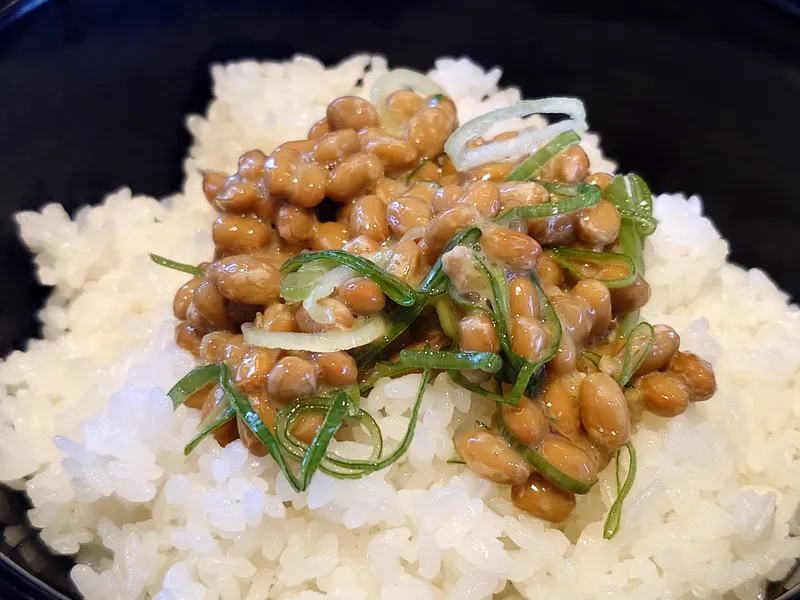
Whole soybeans are soaked, steamed under pressure and sprayed while hot with Bacillus subtilis var. natto, then kept about 15–20 h in a room near 40 °C. The bacteria coat each bean in a sticky, stringy film made of a glutamic-acid polymer. Cooling stops the fermentation.
Fully documentedSoy and legumes2.3 days – 2.7 days
defined-culture (Bacillus subtilis var. natto) since Hanzawa 1919; historically the bacteria on rice straw
Total time across the recorded steps: 2.3 days – 2.7 days
Start
Drag the bar or press Play
What changes:Water soaks into the beans until they swell and the two halves close up
Step 1 of 5
Wash and soak
Time
16–20 h
Reported
Temperature
up to 20 °C
Reported
Salt
None given
Acidity
Not documented
Which microbes the steps name, step by step
Bacillus subtilis
B. subtilis
In an Ibaraki trial, beans soaked under 8 h gave harder natto with thinner threads; at least 8 h was needed for a saleable product. Warm, over-long soaking lets other bacteria grow and sours the beans. Lactobacilli added to cooked beans did not harm the ferment in another trial, so the risk is acid formed during the soak. Output: soaked beans.
Flavour
Not documented
Texture
beans swell until no gap is left between the two halves
Colour
Not documented
Microbes at work in this step
washing removes soil microbes; in warm water lactic acid forms and later stops the natto bacteria
Method
Measured measured in a studySet fixed by a specification or tested recipeReported one source reports itTypical a general value, not sourced for this fermentUnconfirmed not yet checked against a source
At a glance
Whole soybeans are soaked, steamed under pressure and sprayed while hot with Bacillus subtilis var. natto, then kept about 15–20 h in a room near 40 °C. The bacteria coat each bean in a sticky, stringy film made of a glutamic-acid polymer. Cooling stops the fermentation. Made in 5 steps over 2.3 days – 2.7 days. The longest step, cool and mature, takes 24 h (Hasegawa H) and runs at 5–10 °C (Japan Natto Cooperative Society Federation (全…). Bacillus subtilis var. natto does most of the fermenting.
Natto has no salt and no koji. A single bacterium does the work in under a day, and it leaves the beans near-neutral or slightly alkaline instead of sour. Rice straw once carried the bacteria; since Hanzawa's pure starter of 1919 makers use a culture.
Mito nattosmall-seeded soybeans; modernised and sold commercially from the 1880s in Mito
Hikiwari nattosoybeans split and dehulled (in Aomori also roasted) before cooking, so the pieces are small and soft; steamed only 10–30 min
Wara-zuto natto (straw-wrapped)cooked beans packed in rice-straw bundles; the straw is both wrapper and inoculum; replaced by pure culture after 1919
Hoshi natto (dried natto)stringy natto apparently soaked in strong salt water or salted, left 15–20 h, perhaps floured, and sun-dried; machine-dried with 40 °C air to 8 % moisture or less. Said to have started in Kumamoto. The source says the exact method is not well known.
Yukiwari natto and Goto nattonatto fermented a second time with salt and rice koji (see separate entry)
Momen natto (Fukushima)beans in a cotton bag and reed mat, incubated inside a compost pile of straw and leaves
Higan natto (Fukushima)made in a hole under the snow, then hung under the eaves until the spring equinox
Higo natto (Kumamoto)incubated buried in earth; leftovers become hoshi natto
Hettsui natto (Saitama)incubated once a year in the still-warm cauldron after miso-making
Natto powder (UNICEF 1959 project)fermentation cut to 6–8 h, vacuum-dried to 4 % moisture or less, milled
Safety
The natto makers' federation says that over the past ten-odd years food poisoning has involved natto, but none was caused by natto itself. Factory steaming at 121 °C for 15 min or more brings pathogens on the raw beans under control, and with good general hygiene the starter and fermentation then largely hold back pathogen growth. That depends on pressure steam. Japan's farm ministry (MAFF) says normal cooking does not kill botulism spores and lists natto among soy foods linked to botulism abroad, and natto has no salt or acid to stop them. Rice-straw wrappers have caused poisoning when badly stored, so straw is steamed at 80 °C or more for 30 min before use. Keep natto at 10 °C or below.
Hazards the sources name: Bacillus cereus (survives as spores; reddish beans with an off smell); Clostridium (anaerobic spore-former; sewage-like smell when air runs short).
The word natto appears around 1068, but then it meant salted, mould-fermented soybeans, not sticky natto. Yabe published the first scientific report in 1894, Sawamura isolated Bacillus natto in 1905, and Hanzawa introduced a pure starter in 1919, soon followed by a warm room with a ceiling vent.