Side-by-side or overlay PDF diff driven by one engine that reads each file into a structured model — text, vector geometry, images, form fields, annotations — and compares the models. Moves show as moves, edits show only where they happened, and any PDF type works without picking a mode.
Open a STEP / STP part and it measures itself — volume, thinnest wall, draft and undercut checks on load, plus hole detection with a BOM. Measure, section, export STL. Rust + WASM B-rep kernel, runs in your browser.
Soy and legumes from Eastern Himalayas — Sikkim and Darjeeling in India, eastern Nepal and Bhutan
Kinemaकिनेमा
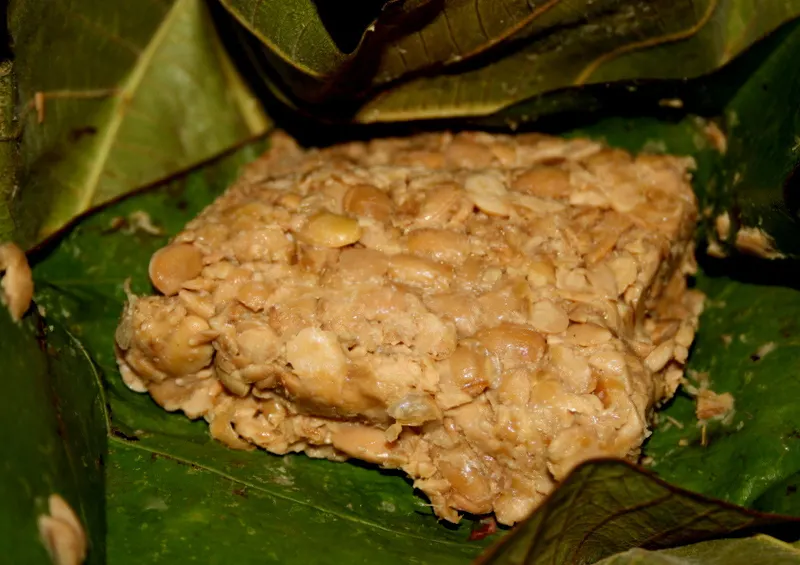
Kinema is the sticky fermented soybean of the eastern Himalayas. Soybeans are soaked overnight, boiled soft and drained, then wrapped in leaves in a bamboo basket above the kitchen and left to ferment naturally for one to three days. Bacillus bacteria coat the beans in a whitish, sticky film with a mild ammoniacal flavour, and kinema is eaten as a curry with rice.
Amounts from a sourceHousehold craft with no fixed amounts. The times, temperature and the 1 % firewood ash below come from one laboratory preparation (Khadka et al. 2024).
Mixed into the cracked beans in a laboratory preparation; the other sources do not give an amount[Khadka2024]
Starter
spontaneous; the microbes come from the soybeans, the equipment, the firewood ash and the wrapping materials
Total time across the recorded steps: 26 h – 3.1 days
Start
Drag the bar or press Play
What changes:Soybeans are washed and soak overnight
Step 1 of 6
Select, wash and soak the soybeans
Time
Overnight
Reported
Temperature
Not documented
Salt
None given
Acidity
Not documented
Which microbes the steps name, step by step
Bacillus
Output: soaked beans.
Flavour
Not documented
Texture
Not documented
Colour
Not documented
Microbes at work in this step
Not documented for this step.
Method
Measured measured in a studySet fixed by a specification or tested recipeReported one source reports itTypical a general value, not sourced for this fermentUnconfirmed not yet checked against a source
At a glance
Kinema is the sticky fermented soybean of the eastern Himalayas. Soybeans are soaked overnight, boiled soft and drained, then wrapped in leaves in a bamboo basket above the kitchen and left to ferment naturally for one to three days. Bacillus bacteria coat the beans in a whitish, sticky film with a mild ammoniacal flavour, and kinema is eaten as a curry with rice. Made in 6 steps over 26 h – 3.1 days. The longest step, wrap and ferment in a leaf-lined basket above the kitchen, takes 24 h – 3 days (Kharnaior P 2022) and runs at 28–32 °C (Khadka D 2024). Bacillus subtilis and Bacillus licheniformis and B. sonorensis do most of the fermenting.
Kinema is fermented naturally, without a starter. In one laboratory preparation the cracked beans were mixed with firewood ash and wrapped in leaves. Its stickiness is presumably poly-γ-glutamic acid made by Bacillus [Khadka2024, Chettri2016, Kharnaior2022].
Bacillus cereus is a food-borne pathogen whose effects range from harmless to lethal, and it was the abundant Bacillus in kinema from Bhutan [Kharnaior2022]. A metagenomic study of Sikkim kinema also detected B. cereus, Staphylococcus aureus and Proteus mirabilis in some seasons [Kumar2019]. The sources set no numerical limit.
Hazards the sources name: Bacillus cereus; Staphylococcus aureus and Proteus mirabilis (detected in some seasons by metagenomic sequencing).
Kharnaior and Tamang (2022) say kinema has been eaten in the eastern Himalayan regions of India, Nepal and Bhutan for more than 2,000 years, citing Tamang and Samuel (2010).