Side-by-side or overlay PDF diff driven by one engine that reads each file into a structured model — text, vector geometry, images, form fields, annotations — and compares the models. Moves show as moves, edits show only where they happened, and any PDF type works without picking a mode.
Open a STEP / STP part and it measures itself — volume, thinnest wall, draft and undercut checks on load, plus hole detection with a BOM. Measure, section, export STL. Rust + WASM B-rep kernel, runs in your browser.
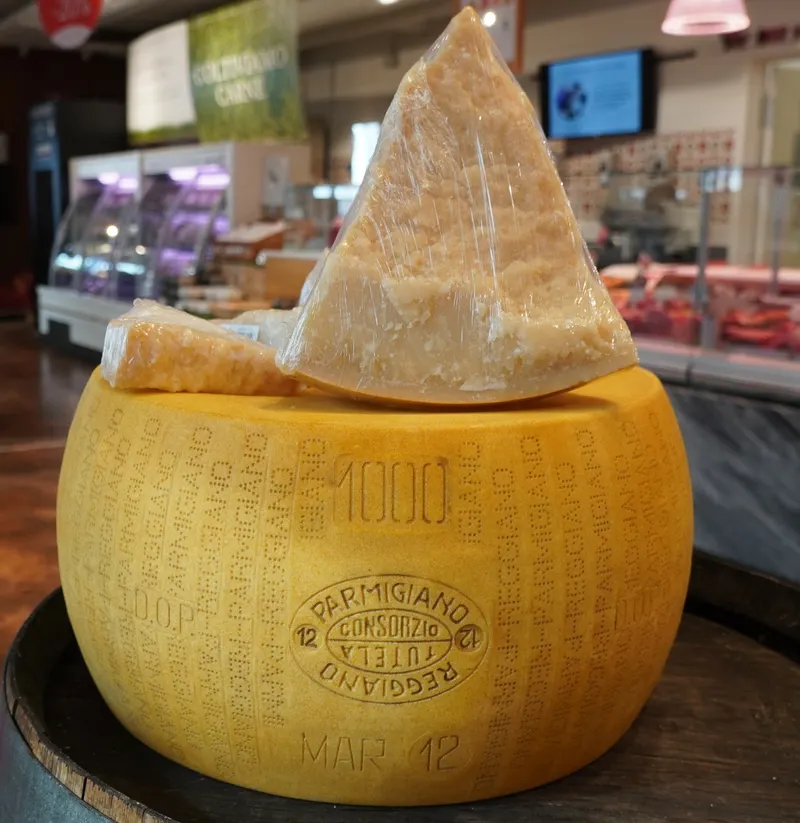
Raw cow milk, part-skimmed by letting the cream rise overnight, is set with yesterday's soured whey and calf rennet in copper vats, cooked to about 55 °C and moulded into twin wheels. The wheels float in brine for about three weeks and age for at least 12 months.
Amounts from a sourceThe rules fix the ingredients and steps but not the amounts. A vat makes up to two wheels of at least 30 kg each. The starter and rennet doses are those of one study's make (Franceschi et al. 2021).
Evening milk
Raw cow milk, part-skimmed by letting the cream rise overnight in open basins[pr-disc]
Morning milk
Raw cow milk, mixed in with the creamed evening milk the next morning (it may also be partly skimmed by natural creaming); no heat treatment or additives allowed[pr-disc]
Whey starter (siero-innesto)2.5–3 L per 100 kg milk
Yesterday's sweet whey, soured overnight; adding cultures or nutrients to it is banned[pr-disc][franceschi2021]
As brine, 260–280 g per litre in one study[coppola1997]
Starter
natural whey starter (siero-innesto) carried over from the previous day's make
Total time across the recorded steps: 13 months
Start
Drag the bar or press Play
What changes:Cream rises on the evening milk and is skimmed off
Step 1 of 7
Let the evening milk cream overnight
Time
12 h
Reported
Temperature
at least 18 °C
Set
Salt
None given
Acidity
Not documented
Which microbes the steps name, step by step
Lactobacilli
The morning milk is mixed in the next day and may also be skimmed a little the same way. Output: part-skimmed evening milk.
Flavour
Not documented
Texture
cream rises to the top
Colour
white
Microbes at work in this step
native raw-milk flora; the milk is never heated
Method
Measured measured in a studySet fixed by a specification or tested recipeReported one source reports itTypical a general value, not sourced for this fermentUnconfirmed not yet checked against a source
At a glance
Raw cow milk, part-skimmed by letting the cream rise overnight, is set with yesterday's soured whey and calf rennet in copper vats, cooked to about 55 °C and moulded into twin wheels. The wheels float in brine for about three weeks and age for at least 12 months. Made in 7 steps over 13 months. The longest step, age on wooden shelves, takes at least 12 months (Consorzio del Formaggio Parmigiano Reggiano) and runs at 16–18 °C (Coppola R 1997). Salt is 1.5–1.8 % (Coppola R 1997). Lactobacillus helveticus and Lactobacillus delbrueckii subsp. lactis do most of the fermenting.
The milk is raw and comes from two milkings, and the evening milk is skimmed only by letting the cream rise. The starter is the dairy's own soured whey with nothing added, calf rennet is the only coagulant, and no additives are allowed. Grana Padano, made in much the same way over a wider area, may add lysozyme and is aged for less time.
Wheel
PDO rules: 35–43 cm across, 20–26 cm high, at least 30 kg; rind about 6 mm
The milk is raw, so the process itself has to remove pathogens. A 2025 review of challenge tests, which add high doses of the organism, found that the cook at 53–56 °C and the drop to pH 5.2–5.4 cut Listeria, Salmonella, E. coli and S. aureus by more than 4 log within 24–48 h. Mycobacteria die more slowly and need the long ripening. EU rules do not treat this process as equal to pasteurisation. The UK NHS counts hard cheeses, including unpasteurised parmesan, as safe in pregnancy.
Hazards the sources name: Raw-milk pathogens (Listeria monocytogenes, Salmonella, Escherichia coli, Staphylococcus aureus); in challenge tests high added doses fell by more than 4 log within 24–48 h; Mycobacterium avium subsp. paratuberculosis; dies more slowly and needs the long ripening.
The Consorzio's news page dates the first evidence of trade to the 1200s, a notarial deed drawn up in Genoa in 1254 that names "caseus parmensis", the cheese of Parma. It says that in the 14th century the abbeys of the Benedictine and Cistercian monks still played a key part in shaping the making technique, and that medieval wheels were much smaller than today's. The name was registered as an EU PDO by Commission Regulation (EC) No 1107/96 of 12 June 1996.