Support

Browse by category

All categories
Home

Fish and seafood from Korea

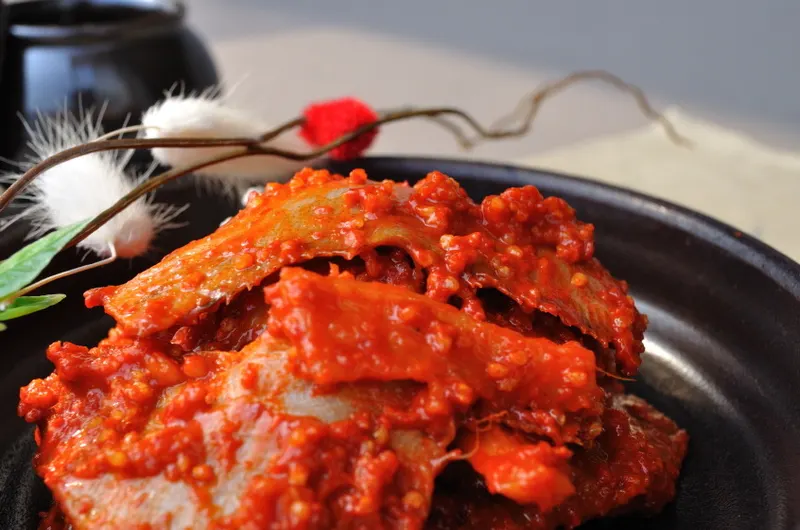
Sikhae식해

Sikhae is lightly salted fish packed with cooked millet or rice, malt powder, chilli, garlic and radish, then left to sour. Lactic acid bacteria feed on the grain sugars, and the pH falls to about 4.5 within days to a week at about 20 °C, more slowly in the cold. The flatfish form from Hamgyeong is gajami-sikhae.

Fully documentedFish and seafood20 days – 24 days

Recipe

Sikhae, a photo from Wikimedia Commons
Photo: kyungeun, CC BY 4.0, via Wikimedia Commons
Amounts from a sourceThe encyclopedia recipes give the method but no amounts; the cook sets the salt by how salty the fish already is. The salt figures come from an encyclopedia, one lab study and a review, and they disagree. The Korean Food Code requires jeotgal, sikhae included, to be at least 60 % seafood.
Yellow flatfish, gutted, head removed, lightly salted and cut up[ek-gajami][nfm-gajami-sikhae]
Cooked foxtail millet, made fairly firm (rice or barley outside Hamgyeong)[ek-gajami][nfm-gajami-sikhae][nfm-sikhae]
Malt powder (yeotgireum), sieved[ek-gajami][nfm-gajami-sikhae]
Red pepper powder, garlic and ginger[ek-gajami][nfm-gajami-sikhae]
Radish, cut in thick strips and lightly salted[ek-gajami][nfm-gajami-sikhae]
SaltAbout 10 % in one encyclopedia account; 4 % was best in a lab study; a review gives about 2 %[nfm-jeotgal][han2013][narzary2021]
Starterspontaneous (malt turns the grain starch to sugar, and lactic acid bacteria sour it)

Total time across the recorded steps: 20 days – 24 days

Start
Drag the bar or press Play
Close-up: salt moving into a fish

What changes: Light salt draws water out of the cleaned fish

Step 1 of 7
Clean and lightly salt the fish
Time
2 days
Reported
Temperature
Not documented
Salt
None given
Acidity
Not documented
Which microbes the steps name, step by step
Latilactobacillus sakei
L. plantarum
Levilactobacillus brevis
L. mesenteroides
Lactic acid bacteria

The flatfish is scaled, gutted and the head and tail cut off, then salted lightly. The cook adds less salt later if the fish is already salty. Output: lightly salted fish.

Flavour
Not documented
Texture
Not documented
Colour
Not documented

Microbes at work in this step

Not documented for this step.

Method

Measured measured in a studySet fixed by a specification or tested recipeReported one source reports itTypical a general value, not sourced for this fermentUnconfirmed not yet checked against a source

At a glance

Sikhae is lightly salted fish packed with cooked millet or rice, malt powder, chilli, garlic and radish, then left to sour. Lactic acid bacteria feed on the grain sugars, and the pH falls to about 4.5 within days to a week at about 20 °C, more slowly in the cold. The flatfish form from Hamgyeong is gajami-sikhae. Made in 7 steps over 20 days – 24 days. The longest step, ripen, takes 14 days (Lee C.H 1983) and runs at 10–23 °C (Han D.-W 2013). Salt is 2–10 % (An J.Y. (안정윤)). Latilactobacillus sakei and Lactiplantibacillus plantarum and Levilactobacillus brevis do most of the fermenting.

Key numbers
Main step14 daysReported[lee1983][han2013]Ripen
Temperature10–23 °CReported[han2013][lee1983]Ripen
Salt2–10 %Reported[nfm-jeotgal][han2013][narzary2021]Mix cooked millet with malt, chilli, garlic and ginger
AciditypH 6.3 → 4.5Measured[kim2022][lee1983]Ripen

What makes this one different

Sikhae uses less salt than other jeotgal and adds cooked grain and malt, so it sours by lactic fermentation in days. Most jeotgal are salted at about 20–30 % of the seafood weight and ripen for months with no grain.

Region
North of Gangneung, flatfish is made into sikhae; there the fish is half-dried first and left to ripen for 15 days or more
Season
Traditionally made in early winter at kimchi-making time and eaten over a short period; refrigeration now lets people make it all year
Ways of making
A 1987 survey sorted sikhae into 14 ways by grain (rice, millet, glutinous rice or wheat porridge), malt, radish and spices

Related ferments

Variants

  • Gajami-sikhae (flatfish)Made with millet in Hamgyeong and with rice or barley elsewhere on the east coast; the reference sikhae.
  • Dongtae-sikhae (pollock)Pollock instead of flatfish, made with rice, malt, radish and chilli as a local food of Gangwon and Gyeongsang (National Folk Museum, jeotgal entry).

Made the sikhae way

Other sikhae kinds

Made the same way, each with what its own sources record.

Chamssal sikhae참쌀식해

Fish and seafood from Korea — 1987 survey regions: Gwanbuk

Named for its grain, glutinous rice, rather than its seafood, which the survey does not identify.

Part used
Whole or flesh (1987 survey)

Sources: Suh H.K. and Yoon S.S. 1987

Dodari sikhae도다리식해

Fish and seafood from Korea — 1987 survey regions: Nambu

Marbled flounder (dodari) instead of the yellow flatfish of Hamgyeong.

Part used
Whole or flesh (1987 survey)

Sources: Suh H.K. and Yoon S.S. 1987
Dolgajami sikhae돌가자미식해

Fish and seafood from Korea — 1987 survey regions: Nambu

Stone flounder instead of the yellow flatfish of Hamgyeong.

Part used
Whole or flesh (1987 survey)

Sources: Suh H.K. and Yoon S.S. 1987

Galchi bap sikhae갈치(밥)식해

Fish and seafood from Korea — 1987 survey regions: Nambu

Hairtail instead of flatfish; the survey records it in both the south and the north-east.

Part used
Whole or flesh (1987 survey)
Regional dish
Jinju sikhae of Gyeongsang is made with hairtail and yellow croaker (Encyclopedia of Korean Culture, jeotgal entry)

Sources: Suh H.K. and Yoon S.S. 1987; Seo H.K. (서혜경) 1995

Godong sikhae고동식해

Fish and seafood from Korea — 1987 survey regions: Nambu

A sea snail (godong) instead of fish; the only gastropod sikhae in the 1987 survey.

Part used
Whole or flesh (1987 survey)

Sources: Suh H.K. and Yoon S.S. 1987

Gogi sikhae고기식해

Fish and seafood from Korea — 1987 survey regions: Gwanbuk

The survey names no fish, so the entry may be a local name for ordinary sikhae rather than a separate product.

Part used
Whole or flesh (1987 survey)

Sources: Suh H.K. and Yoon S.S. 1987

Hanchi sikhae한치식해

Fish and seafood from Korea — 1987 survey regions: Gwanbuk

A squid (hanchi) instead of fish.

Part used
Whole or flesh (1987 survey)

Sources: Suh H.K. and Yoon S.S. 1987

Heultteogi sikhae흘떼기식해

Fish and seafood from Korea — 1987 survey regions: Nambu

A dialect-named fish (heultteogi) instead of flatfish.

Part used
Whole or flesh (1987 survey)

Sources: Suh H.K. and Yoon S.S. 1987

Hoettae sikhae회때식해

Fish and seafood from Korea — 1987 survey regions: Gwanbuk

A dialect-named fish (hoettae) instead of flatfish, recorded in the north-east.

Part used
Whole or flesh (1987 survey)

Sources: Suh H.K. and Yoon S.S. 1987

Jeoneo sikhae전어식해

Fish and seafood from Korea — 1987 survey regions: Nambu

Gizzard shad instead of flatfish, recorded in the south.

Part used
Whole or flesh (1987 survey)

Sources: Suh H.K. and Yoon S.S. 1987

Jeongaengi saekki sikhae전갱이새끼식해

Fish and seafood from Korea — 1987 survey regions: Nambu

Whole young jack mackerel instead of flatfish.

Part used
Whole (1987 survey)

Sources: Suh H.K. and Yoon S.S. 1987

Jjan galchi sikhae짠갈치식해

Fish and seafood from Korea — 1987 survey regions: Nambu

Salted hairtail instead of flatfish.

Part used
Whole or flesh (1987 survey)

Sources: Suh H.K. and Yoon S.S. 1987

Jwichi sikhae쥐치식해

Fish and seafood from Korea — 1987 survey regions: Nambu

Filefish instead of flatfish, recorded in the south.

Part used
Whole or flesh (1987 survey)

Sources: Suh H.K. and Yoon S.S. 1987

Mareun ojingeo sikhae마른오징어식해

Fish and seafood from Korea — 1987 survey regions: Nambu

Dried squid instead of fresh fish; it parallels bugeo (dried pollock) sikhae.

Part used
Whole or flesh (1987 survey)
Regional dish
Miryang sikhae of Gyeongsang is made with dried pollock and dried squid (Encyclopedia of Korean Culture, jeotgal entry)

Sources: Suh H.K. and Yoon S.S. 1987; Seo H.K. (서혜경) 1995

Muneo sikhae문어식해

Fish and seafood from Korea — 1987 survey regions: Gwanbuk

Octopus instead of fish.

Part used
Whole or flesh (1987 survey)

Sources: Suh H.K. and Yoon S.S. 1987

Myeongnan sikhae명란식해

Fish and seafood from Korea — 1987 survey regions: Gwanbuk

Pollock roe instead of whole fish, the only roe sikhae in the 1987 survey.

Part used
Roe (1987 survey)
Regional dish
Listed among Gangwon jeotgal as myeongnan-sikhae (Encyclopedia of Korean Culture, jeotgal entry)

Sources: Suh H.K. and Yoon S.S. 1987; Seo H.K. (서혜경) 1995

Myeongtae saekki sikhae명태새끼식해

Fish and seafood from Korea — 1987 survey regions: Gwanbuk

Whole juvenile pollock (nogari) instead of cut flatfish.

Part used
Whole (1987 survey)

Sources: Suh H.K. and Yoon S.S. 1987

Ureok sikhae우럭식해

Fish and seafood from Korea — 1987 survey regions: Nambu

Rockfish (ureok) instead of flatfish, as a 1987 survey records it in the south.

Part used
Whole or flesh (1987 survey)

Sources: Suh H.K. and Yoon S.S. 1987

Safety

Sikhae uses less salt than most jeotgal, about 2–10 % across the sources on this page. We read no study that tested it for Clostridium botulinum, so the figures below do not show it is safe. In one study the pH dropped from 6.25 to 4.50 within two days at 20 °C, but was still 4.81 after two days at 15 °C and took about 15 days to reach 4.5 at 5–10 °C; another study reached 4.5 only after 7 days at room temperature. The FDA's barrier to type E botulism is pH 5 or below or 5 % salt in the water phase, and pH 4.6 or below for all types. Japan's agriculture ministry lists home-made izushi and similar fish ferments as botulism foods. CDC says the toxin cannot be seen, smelled or tasted, so a home batch cannot be judged by eye or nose. Keep it refrigerated after it sours; one study found quality held for up to 4 weeks in the refrigerator. The Korean Food Code allows sorbic acid (up to 1.0 g/kg) only in jeotgal with 8 % salt or less, and sets an E. coli limit (n=5, c=1, m=0, M=10) for jeotgal.

History and sources

Every number is labelled with how it is known. How this atlas is made

Sikhae grew up on the east coast, where salt was scarce; the salt-rich west coast made jeot instead. A 13th-century medical book, Hyangyak gugeupbang, records herring sikhae, and Sangga yorok (about 1450) lists sikhae of fish, tripe, pork skin, pheasant, bellflower root and grain; its grain-porridge sikhae was used after 3–4 days in summer and about 10 days in winter. No old Korean record of gajami-sikhae itself survives. It was spread by displaced people who had fled from Hamgyeong.

  1. [fda-ch13] US Food and Drug Administration, Fish and Fishery Products Hazards and Controls Guidance, Chapter 13: Clostridium botulinum Toxin Formationgov
  2. [maff-boto] MAFF Japan, hazard profile, Clostridium botulinum (food poisoning cases and control measures)gov
  3. [cdc-prev] CDC, Preventing botulism (botulism prevention page), read 2026-11gov
  4. [kim2022] Kim E., Won J.-E., Yang S.-M., Kim H.-J., Kim H.-Y. 2022, Diversity of a lactic acid bacterial community during fermentation of gajami-sikhae, a traditional Korean fermented fish, as determined by MALDI-TOF mass spectrometry, Foods 11(7):909paper
  5. [lee1983] Lee C.H., Cho T.S., Lim M.H., Kang J.H., Yang H.C. 1983, Studies on the sik-hae fermentation made by flat-fish, Korean Journal of Applied Microbiology and Bioengineering (Microbiology and Biotechnology Letters) 11(1):53–58 (abstract)paper
  6. [han2013] Han D.-W., Han H.-J., Kim D.-G., Im M.-J., Cho S.-Y. 2013, Optimal fermentation conditions (temperature and salt concentration) for preparing flounder Verasper moseri sikhae, Korean Journal of Fisheries and Aquatic Sciences 46(6):689–695, doi:10.5657/KFAS.2013.0689 (abstract)paper
  7. [ek-gajami] Yun S.S. (윤서석) 1995, rev. 2023, Gajami-sikhae (가자미식해), Encyclopedia of Korean Culture, Academy of Korean Studies (citing the 1984 national folk survey, local food volume)book
  8. [nfm-gajami-sikhae] Seo H.K. (서혜경), Gajami-sikhae (가자미식해), National Folk Museum of Korea, Encyclopedia of Korean Seasonal Customs (한국세시풍속사전)book
  9. [nfm-sikhae] Yun D.I. (윤덕인), Sikhae (식해), National Folk Museum of Korea, Encyclopedia of Korean Folk Culture, Korean Food, Clothing and Housing (한국의식주생활사전)book
  10. [nfm-gajami] Ha E.B. (하응백), Gajami (가자미, flatfish), National Folk Museum of Korea, Encyclopedia of Korean Folk Culture, Korean Food, Clothing and Housing (한국의식주생활사전)book
  11. [nfm-jeotgal] An J.Y. (안정윤), Jeotgal (젓갈), National Folk Museum of Korea, Encyclopedia of Korean Folk Culture, Korean Food, Clothing and Housing (한국의식주생활사전)book
  12. [mfds-code] Ministry of Food and Drug Safety, Korean Food Code (식품공전), 5. Standards by food, 20. processed fishery products, 20-2 jeotgal (젓갈류)spec
  13. [suh1987b] Suh H.K. 1987, A study on the regional characteristics of Korean chotkal - the ways of preservation of chotkal, Journal of the Korean Society of Food Culture 2(2):149–161 (abstract)paper
  14. [narzary2021] Narzary Y., Das S., Goyal A., Lam S., Sarma H., Sharma D. 2021, Fermented fish products in South and Southeast Asian cuisine, indigenous technology processes, nutrient composition, and cultural significance, Journal of Ethnic Foods 8:33, doi:10.1186/s42779-021-00109-0 (tables 1 and 2)paper