Side-by-side or overlay PDF diff driven by one engine that reads each file into a structured model — text, vector geometry, images, form fields, annotations — and compares the models. Moves show as moves, edits show only where they happened, and any PDF type works without picking a mode.
Open a STEP / STP part and it measures itself — volume, thinnest wall, draft and undercut checks on load, plus hole detection with a BOM. Measure, section, export STL. Rust + WASM B-rep kernel, runs in your browser.
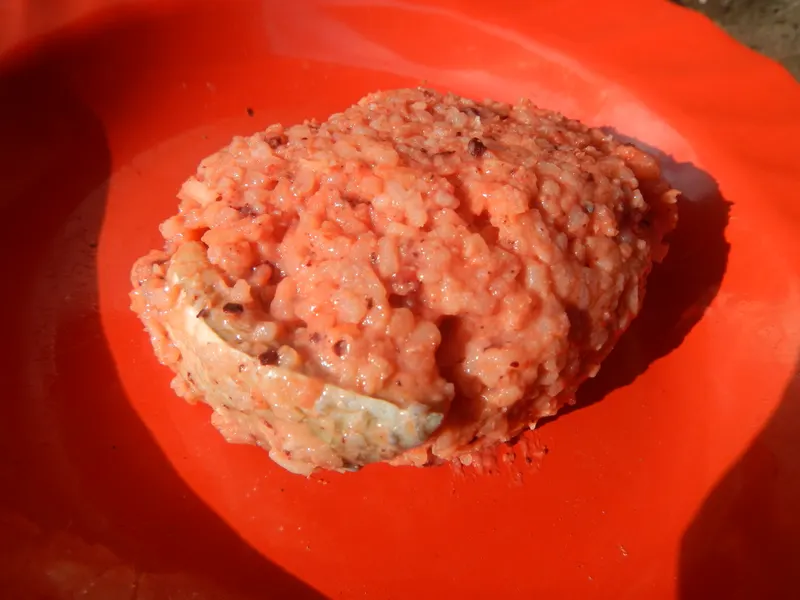
Salted pieces of freshwater fish are mixed with plenty of cooled cooked rice, packed into a sealed jar and left for about a week. Lactic bacteria ferment the rice, and the mix turns sour, falling below pH 4.0.
Amounts from a sourceA 750 g case-study batch from Bicol (Cabal et al. 2024), with rice and fish at 65 to 35. A lab burong bangus used 29 % milkfish, 69 % rice and 2 % rock salt; household recipes vary.
Fish, cleaned and sliced (tilapia in this recipe)35 parts by weight
75 g in a 750 g batch, split between the fish (50 g) and the rice (25 g)[cabal2024]
Total time across the recorded steps: 7 days
Start
Drag the bar or press Play
What changes:The fish is washed, cleaned and cut into slices
Step 1 of 4
Clean and slice the fish
Time
Not documented
Temperature
Not documented
Salt
None given
Acidity
Not documented
Which microbes the steps name, step by step
Lactic acid bacteria
Output: fish slices or fillets.
Flavour
Not documented
Texture
Not documented
Colour
Not documented
Microbes at work in this step
Not documented for this step.
Method
Measured measured in a studySet fixed by a specification or tested recipeReported one source reports itTypical a general value, not sourced for this fermentUnconfirmed not yet checked against a source
At a glance
Salted pieces of freshwater fish are mixed with plenty of cooled cooked rice, packed into a sealed jar and left for about a week. Lactic bacteria ferment the rice, and the mix turns sour, falling below pH 4.0. Made in 4 steps over 7 days. The longest step, pack into a sealed jar and ferment, takes 7 days (Orillo C.A. and Pederson C.S. 1968) and runs at 26–29 °C (Cabal M.S 2024). Salt is 2–10 % (Cabal M.S 2024). Leuconostoc mesenteroides, Pediococcus cerevisiae and Lactobacillus plantarum and Streptococcus first, then Leuconostoc and Lactobacillus from day 3, with Lactobacillus dominant at the end do most of the fermenting.
Burong isda uses much more rice than fish and less salt, so it is a quick lactic ferment that turns sour in a week. Bagoong and patis are salted at about 15–20 % and are not soured by rice.
Red burong isdaAngkak (red yeast rice) is added, which makes the dish red (Wikipedia).
White burong isda (western Central Luzon)Made without angkak, so it is white (Wikipedia).
Burong bangusMade with milkfish.
Hingmay and kuyog (Bicol)Similar fish ferments of Bicol; kuyog uses small rabbitfish and ginger.
Safety
Burong dalag fell below pH 4.0 within a week in a 1968 study, under the pH 4.6 limit the FDA gives for growth of Clostridium botulinum, but it must be kept covered or yeasts and moulds grow. Until the mix has soured, the fish has no acid barrier. A lab recipe uses 2 % salt, well under the FDA's 10 % water-phase salt limit for growth of Clostridium botulinum type A (5 % for type E, which FDA calls the most common form in fresh and sea water), and the covered jar keeps out air at room temperature. We found no study that tested burong isda for the toxin, which you cannot see, smell or taste. Throw out any batch that a pH meter does not show below pH 4.6. No source we read says a low final pH rules out toxin formed before the mix soured, and CDC says not to eat food if you do not know whether it was safely fermented. A Bicol case-study batch at 10 % salt had an aerobic plate count of 2.1 × 10^7 CFU/g, above the 5 × 10^5 CFU/g guideline of the Philippine FDA, with E. coli under 25 CFU/g. Clean fish, clean jars and enough salt matter. The fish is not cooked in this process. FDA says brining and pickling do not eliminate parasites in fish, and that fish raised in fresh water may carry flukes, so cook burong isda through before eating it. That advice is for the parasites, not the toxin.