Side-by-side or overlay PDF diff driven by one engine that reads each file into a structured model — text, vector geometry, images, form fields, annotations — and compares the models. Moves show as moves, edits show only where they happened, and any PDF type works without picking a mode.
Open a STEP / STP part and it measures itself — volume, thinnest wall, draft and undercut checks on load, plus hole detection with a BOM. Measure, section, export STL. Rust + WASM B-rep kernel, runs in your browser.
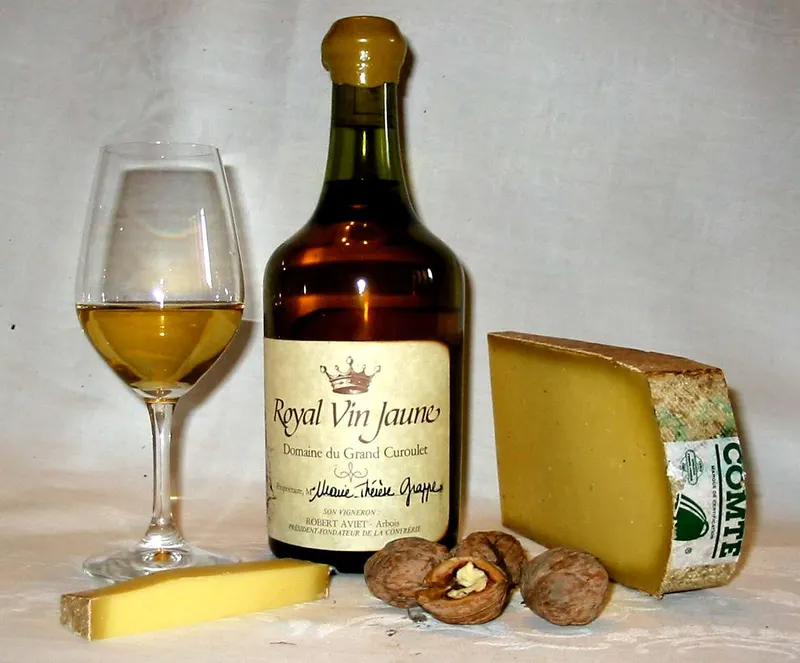
Savagnin grapes are made into a dry white wine, which is then left in oak barrels that are never topped up. A film of flor yeast (the voile) grows on the wine and ages it slowly for more than six years before it is bottled in the 62 cl clavelin.
No fixed amounts recordedSet by the appellation rules (cahier des charges); there is no recipe beyond the grape, the barrel and the time.
Savagnin grapes
The grape of the vin jaune mention; since 2022 the Côtes du Jura rules also allow enfariné N and gringet B under an agreement signed with INAO and the producers' body[cdc-cotes-du-jura]
Voile yeasts
The voile of yeasts develops naturally on the wine during ageing[cdc-cotes-du-jura]
Starter
spontaneous (indigenous flor yeasts)
Total time across the recorded steps: 5 years
Start
Drag the bar or press Play
What changes:Starting material: ripe Savagnin grapes
Step 1 of 5
Harvest ripe Savagnin
Time
Not documented
Temperature
Not documented
Salt
None given
Acidity
Not documented
Which microbes the steps name, step by step
Saccharomyces cerevisiae
Yeasts
Output: ripe Savagnin grapes.
Flavour
Not documented
Texture
Not documented
Colour
Not documented
Microbes at work in this step
Not documented for this step.
Method
Measured measured in a studySet fixed by a specification or tested recipeReported one source reports itTypical a general value, not sourced for this fermentUnconfirmed not yet checked against a source
At a glance
Savagnin grapes are made into a dry white wine, which is then left in oak barrels that are never topped up. A film of flor yeast (the voile) grows on the wine and ages it slowly for more than six years before it is bottled in the 62 cl clavelin. Made in 5 steps over 5 years. The longest step, age in oak under the voile, never topped up, takes at least 5 years (Ministère de l'agriculture 2022). Saccharomyces cerevisiae and Flor strains of Saccharomyces cerevisiae, which make up most of the voile do most of the fermenting.
Unlike sherry fino, vin jaune is not fortified, and it is not blended through a solera. It stays in one barrel, never topped up, for more than six years under its voile, at least 60 months of that under the film.
Château-Chalon AOCA separate appellation from four communes, whose protected wine is the vin jaune itself, a dry still white of Savagnin with at least 12 % natural alcohol.
Sampled Savagnin wines held 12.5–13.5 % alcohol, pH 3.1 to 3.4 and 200–500 mg/L acetic acid, and the rules cap fermentable sugar at 3 g/L at bottling. The barrels are never topped up, so the wine ages under an air space and the voile.
The appellation rules call the method of making vin jaune obscure in origin, improved over time by Jura makers and then bound by strict rules on grape, voile and ageing. The Château-Chalon file says the wine's history is tied to the abbey of the abbesses of Château-Chalon, founded before the 10th century, and that the wine was once called "vin de gelée" or "vin de garde". The Vieille Loye glassworks held the privilege of making the clavelin bottle by a concession of Margaret of Burgundy in 1506. Louis Pasteur, from nearby Arbois, wrote at length on how the wine is made. The Château-Chalon growers' union was formed on 14 May 1933 and the appellation was recognised by decree on 31 May 1936.
[pham1995] Pham T.T., Guichard E., Schlich P., Charpentier C. 1995, Optimal conditions for the formation of sotolon from alpha-ketobutyric acid in the French Vin Jaune, J Agric Food Chem 43:2616–2619, doi:10.1021/jf00058a012paper