Side-by-side or overlay PDF diff driven by one engine that reads each file into a structured model — text, vector geometry, images, form fields, annotations — and compares the models. Moves show as moves, edits show only where they happened, and any PDF type works without picking a mode.
Open a STEP / STP part and it measures itself — volume, thinnest wall, draft and undercut checks on load, plus hole detection with a BOM. Measure, section, export STL. Rust + WASM B-rep kernel, runs in your browser.
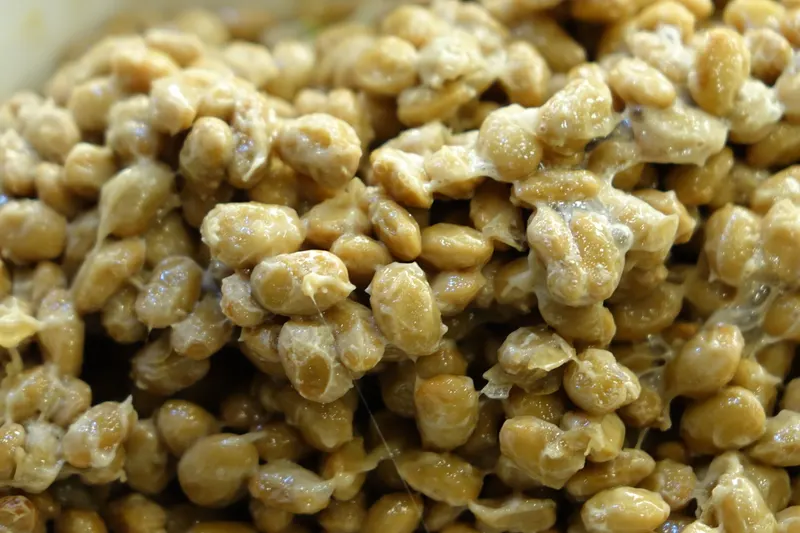
Boiled soybeans are kept warm under a blanket with rice straw for two or three days, while Bacillus from the straw coats them in sticky threads and a strong, savoury smell. Unlike the other Korean jang it is ready in days, not months, and it is mostly cooked into a stew.
No fixed amounts recordedHousehold process with no fixed batch size. The beans and the straw are the whole ferment.
Soybeans
Washed, soaked and boiled until tender[sic-natto3]
Rice straw
The source of the Bacillus; its middle part carries the most bacilli[heu1999][park2020]
Salt, garlic and red chillito taste, optional
Mixed in when the paste is mashed to keep until winter[sic-natto3]
Starter
rice straw added to the beans supplies the Bacillus; modern methods use starter cultures instead
Total time across the recorded steps: 36 h – 3.7 days
Start
Drag the bar or press Play
What changes:Starting material: soybeans, washed and soaked
Step 1 of 5
Wash and soak the soybeans
Time
12–16 h
Reported
Temperature
Not documented
Salt
None given
Acidity
Not documented
Which microbes the steps name, step by step
Bacillus
Output: soaked beans.
Flavour
Not documented
Texture
Not documented
Colour
Not documented
Microbes at work in this step
Not documented for this step.
Method
Measured measured in a studySet fixed by a specification or tested recipeReported one source reports itTypical a general value, not sourced for this fermentUnconfirmed not yet checked against a source
At a glance
Boiled soybeans are kept warm under a blanket with rice straw for two or three days, while Bacillus from the straw coats them in sticky threads and a strong, savoury smell. Unlike the other Korean jang it is ready in days, not months, and it is mostly cooked into a stew. Made in 5 steps over 36 h – 3.7 days. The longest step, keep warm under straw and a blanket, takes 24 h – 3 days (Park Y.K 2020) and runs at 25–45 °C (Shi B 2024). Salt is 2–9.4 % (Park Y.K 2020). Bacillus from rice straw, mainly B. subtilis and Bacillus velezensis, B. subtilis, B. amyloliquefaciens and B. licheniformis isolated from commercial products do most of the fermenting.
Cheonggukjang is ready in two to three days, while doenjang, gochujang and ganjang are salted and aged for months. It is close to Japanese natto but is usually mashed and cooked, not eaten whole and raw.
Damsujang / dambukjangMade the same way but with no spices.
Starter-made cheonggukjangStarter cultures instead of rice straw.
Safety
In a study of six retail products, tyramine passed the 100 mg/kg limit used by the authors in three of them, by up to 14 times, with Enterococcus faecium a major source. In a lab study that added E. faecium to the beans, tyramine stayed under 10 mg/kg at 25 °C over 3 days but kept rising at 37 °C and 45 °C. The authors suggest that fermenting cooler and for less time may reduce it. Use clean straw from fields free of sewage and livestock waste.
Hazards the sources name: Coliform bacteria on some rice straw from areas polluted by sewage or livestock waste.
No firm origin record exists. Kwon, Chung and Jang (2019) argue that similar fermented beans appear in Chinese texts from before 40 BC and that the Korean food has a long continuous history; treat this as one school's view.