Side-by-side or overlay PDF diff driven by one engine that reads each file into a structured model — text, vector geometry, images, form fields, annotations — and compares the models. Moves show as moves, edits show only where they happened, and any PDF type works without picking a mode.
Open a STEP / STP part and it measures itself — volume, thinnest wall, draft and undercut checks on load, plus hole detection with a BOM. Measure, section, export STL. Rust + WASM B-rep kernel, runs in your browser.
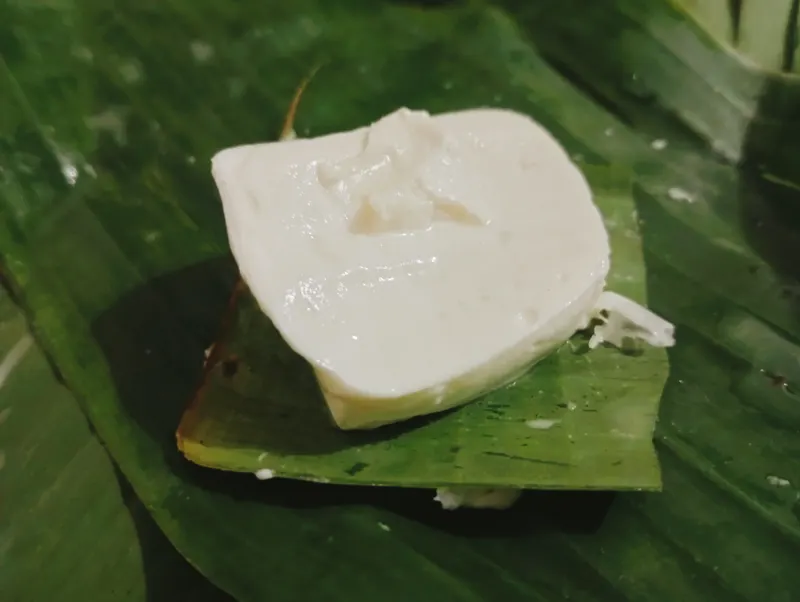
Carabao milk is set with rennet extract from abomasum, which gives a firmer curd, or in some places with vinegar, which gives a slightly sour one. In the Philippine Carabao Center method the milk sets in 30 minutes to one hour, and the curd is cut, drained, salted and wrapped in banana leaves or packed in plastic. It is eaten fresh within days. Little acid forms, so kesong puti is a boundary case, closer to a fresh rennet or acid-set cheese than to a fermented one.
Amounts from a sourceThe traditional technology has no measured quantities; Barraquio 2006 reports that steps and amounts were set by experience and passed down in families. The Philippine Carabao Center sheet gives the brine amount used here but no milk volume, so no batch size is stated.
Carabao (water buffalo) milk
The Philippine Carabao Center sheet uses buffalo milk; cow milk or a mix is also used[pcc2017][moreno2021]
Rennet from abomasum (bahay asim), dissolved in a little water
Both Lumban makers studied used bahay asim. In a lab trial with cow milk, 5 g of diluted rennet went into 100 L of milk.[aquino2011][pcc2017][moreno2021]
Dilute vinegar
Used instead of rennet in some places; it gives a slightly sour, softer cheese[pcc2017][barraquio2006]
Salt brine400 g of salt in 5 L of water
Boiled and cooled to 35–40 °C, then mixed into the cut curd (Philippine Carabao Center method)[pcc2017]
Total time across the recorded steps: 2.1 h – 3.3 h
Start
Drag the bar or press Play
What changes:Rennet from abomasum, or vinegar in some places, is made ready
Step 1 of 8
Get the coagulant
Time
Not documented
Temperature
Not documented
Salt
None given
Acidity
Not documented
Which microbes the steps name, step by step
Lactic acid bacteria
Lactobacillus helveticus
Lactococcus lactis
L. mesenteroides
Both Lumban makers studied coagulate the milk with bahay asim, the abomasum. The coagulant decides the texture, rennet or dilute vinegar. For the Philippine Carabao Center method the rennet is dissolved in a small amount of water before use. Output: rennet from abomasum (bahay asim), or dilute vinegar.
Flavour
Not documented
Texture
Not documented
Colour
Not documented
Microbes at work in this step
Not documented for this step.
Method
Measured measured in a studySet fixed by a specification or tested recipeReported one source reports itTypical a general value, not sourced for this fermentUnconfirmed not yet checked against a source
At a glance
Carabao milk is set with rennet extract from abomasum, which gives a firmer curd, or in some places with vinegar, which gives a slightly sour one. In the Philippine Carabao Center method the milk sets in 30 minutes to one hour, and the curd is cut, drained, salted and wrapped in banana leaves or packed in plastic. It is eaten fresh within days. Little acid forms, so kesong puti is a boundary case, closer to a fresh rennet or acid-set cheese than to a fermented one. Made in 8 steps over 2.1 h – 3.3 h. The longest step, drain the whey and pack, takes 1–1.5 h (Abella M.P. 2017). Salt is 2–2.2 % (Aquino E.M 2011). Lactic bacteria from the raw milk, highest in raw carabao-milk cheese - Lactobacillus helveticus, Lactococcus lactis subsp. lactis, L. rhamnosus, Leuconostoc mesenteroides, L. plantarum and others; their counts rise as the pH falls does most of the fermenting.
Kesong puti is set with rennet, or vinegar in some places, and eaten within days, so its pH stays near that of milk (6.18–6.34 in Lumban cheese). It is often wrapped in banana leaves. With vinegar it is an acid-set cheese rather than a fermented one.
Milk
Carabao milk, or cow milk or a mix
Coagulant
Rennet from abomasum (bahay asim); dilute vinegar in some places
Vinegar-set kesong putiSet with vinegar; slightly sour and softer; an acid-set product
Rennet-set kesong putiFirmer and not sour
Kasilyo (Cavite)Cavite's name for the cheese (also kesilyo or quesillo); Wikipedia says it is vinegar-set and softer than the Laguna and Cebu versions
Safety
Most traditional makers do not pasteurise the milk, and a 2006 report says no disease outbreak from the cheese has been documented. Cavite samples carried E. coli and S. aureus, though no Salmonella, Shigella or Yersinia were detected, and the authors blamed unhygienic handling and the cheese's high moisture. A Laguna study isolated Listeria sp. and E. coli type 1. Lumban cheese had coliforms too numerous to count, beyond the 10 cfu/g coliform limit of the Philippine Bureau of Food and Drugs. The cheese is moist, eaten fresh and stays near pH 6.2–6.3, so neither ripening nor acid holds these bacteria back. Use pasteurised milk. The Philippine Carabao Center method pasteurises it at 72–75 °C for 15 seconds and keeps the cheese at 0–4 °C.
Hazards the sources name: Escherichia coli and Staphylococcus aureus, found in Cavite kesong puti; Coliforms, too numerous to count in Lumban cheese; Listeria sp. and Escherichia coli type 1, isolated from kesong puti sampled in Los Baños and Bay, Laguna (2001 study).
Kesong puti making is described as one of the oldest cottage industries in the Philippines. In Lumban, Laguna, the businesses of two cheese makers' families date back to 1900 and 1928. The technology has stayed artisanal and is passed on through generations within the family.
Starter
The sources we found do not say how its fermentation begins.