Side-by-side or overlay PDF diff driven by one engine that reads each file into a structured model — text, vector geometry, images, form fields, annotations — and compares the models. Moves show as moves, edits show only where they happened, and any PDF type works without picking a mode.
Open a STEP / STP part and it measures itself — volume, thinnest wall, draft and undercut checks on load, plus hole detection with a BOM. Measure, section, export STL. Rust + WASM B-rep kernel, runs in your browser.
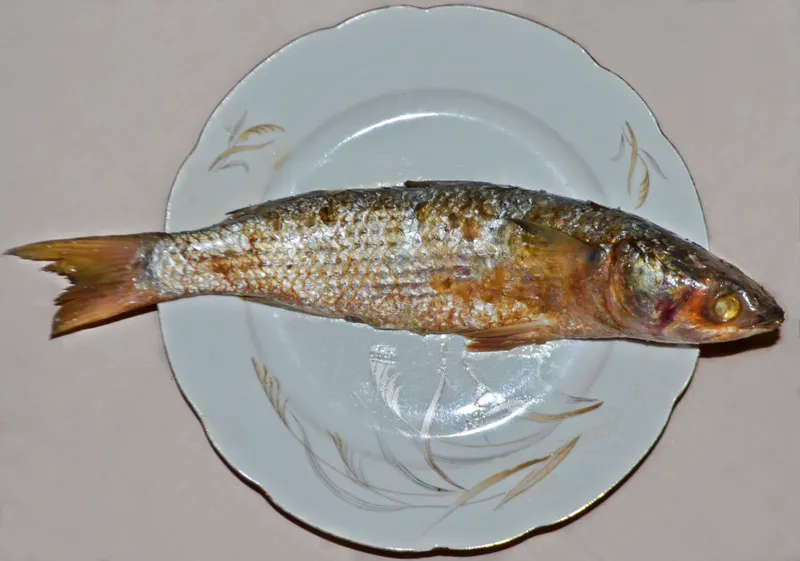
Whole, ungutted grey mullet (in Sudan, Alestes and Hydrocynus) are left to soften, then packed in layers of dry salt and pressed under weights for weeks while the flesh ripens. The soft, pungent fish is eaten without cooking. Because the guts stay in and salt reaches the inside slowly, fessikh carries a real risk of type E botulism.
Fully documentedFish and seafood10 days – 12 months
Amounts from a sourceThe amount is from a study of the traditional Egyptian method; households and shops vary. The FAO survey layers whole fish with salt in Sudan without a ratio.
Total time across the recorded steps: 10 days – 12 months
Start
Drag the bar or press Play
What changes:Starting material: whole grey mullet, washed but not gutted
Step 1 of 5
Wash the whole, ungutted fish
Time
Not documented
Temperature
Not documented
Salt
None given
Acidity
Not documented
Which microbes the steps name, step by step
Staphylococcus equorum
T. halophilus
Output: whole mullet with the guts left in.
Flavour
Not documented
Texture
Not documented
Colour
Not documented
Microbes at work in this step
Not documented for this step.
Method
Measured measured in a studySet fixed by a specification or tested recipeReported one source reports itTypical a general value, not sourced for this fermentUnconfirmed not yet checked against a source
At a glance
Whole, ungutted grey mullet (in Sudan, Alestes and Hydrocynus) are left to soften, then packed in layers of dry salt and pressed under weights for weeks while the flesh ripens. The soft, pungent fish is eaten without cooking. Because the guts stay in and salt reaches the inside slowly, fessikh carries a real risk of type E botulism. Made in 5 steps over 10 days – 12 months. The longest step, repack with more salt, cover and weigh down, takes 7 days – 12 months (Essuman K.M. 1992) and runs at 18–20 °C (Essuman K.M. 1992). Salt is 25 % (Kassem A.E.M 2002). Staphylococcus equorum and Tetragenococcus halophilus do most of the fermenting.
Fessikh is made from whole fish with the guts left in and is ripened wet under salt, not dried. That keeps it soft but lets salt reach the inside of the fish slowly, which is why it can carry botulism.
Gaza fesikhStuffed with onion and fried, or cooked in a stew.
Safety
Salt is hard to bring to every part of a whole fish with the guts in, and the FDA notes that toxin may be present with no outward sign of spoilage. The US FDA will consider seizure or detention of uneviscerated salt-cured, dried or smoked fish longer than five inches, because such products, faseikh among them, have caused botulism outbreaks and deaths. It calls them a potentially life-threatening hazard whether kept at room temperature, chilled or frozen. Do not make fessikh at home. The steps here record a traditional trade, and none of them makes it safe. C. botulinum, mostly type E, was found in 10–15 % of Egyptian fesikh samples (Hamad 2023), and market samples ranged from 3.2 % to 14.1 % water-phase salt. The FDA puts the growth limit at 5 % for type E and 10 % for type A and the proteolytic types B and F, so the low end of that range gives no protection. FAO notes that a processing temperature above 25 °C gives a poor product in Sudan. That is a quality note, not a safety limit, since the FDA has type E growing from 3.3 °C.
Hazards the sources name: Clostridium botulinum, mostly type E (in 10–15 % of fesikh samples in one survey); Staphylococcus aureus (in 80 % of 20 market samples); Escherichia coli (in 10 % of samples).