Side-by-side or overlay PDF diff driven by one engine that reads each file into a structured model — text, vector geometry, images, form fields, annotations — and compares the models. Moves show as moves, edits show only where they happened, and any PDF type works without picking a mode.
Open a STEP / STP part and it measures itself — volume, thinnest wall, draft and undercut checks on load, plus hole detection with a BOM. Measure, section, export STL. Rust + WASM B-rep kernel, runs in your browser.
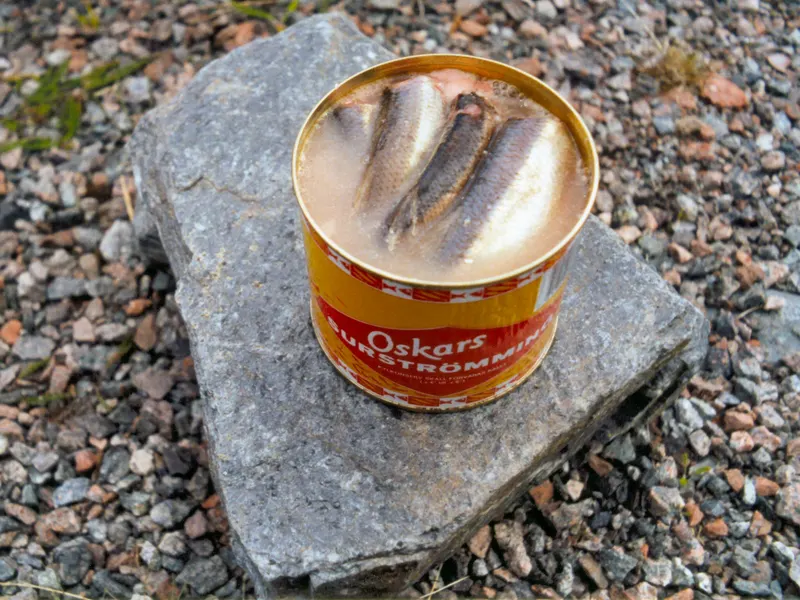
Baltic herring caught before spawning are bled in strong brine, gilled and partly gutted, then fermented in lidded barrels of weaker brine for six to eight weeks. The fish are canned with their brine and keep fermenting in the can, which swells with gas.
Amounts from a sourceAmounts are from the Swedish Food Agency's example process and HACCP plan for a surströmming plant. Fish, water and salt are the only ingredients.
Fresh Baltic herring, iced and sorted by size2 parts
Total time across the recorded steps: 43 days – 58 days
Start
Drag the bar or press Play
What changes:Starting material: Baltic herring caught in spring before they spawn
Step 1 of 7
Catch the herring before spawning
Time
Spring until midsummer; a royal ordinance names herring caught in April and May
Reported
Temperature
Not documented
Salt
None given
Acidity
Not documented
Which microbes the steps name, step by step
T. halophilus
Lactobacilli
Output: fresh herring, sorted by size and iced.
Flavour
Not documented
Texture
Not documented
Colour
Not documented
Microbes at work in this step
Not documented for this step.
Method
Measured measured in a studySet fixed by a specification or tested recipeReported one source reports itTypical a general value, not sourced for this fermentUnconfirmed not yet checked against a source
At a glance
Baltic herring caught before spawning are bled in strong brine, gilled and partly gutted, then fermented in lidded barrels of weaker brine for six to eight weeks. The fish are canned with their brine and keep fermenting in the can, which swells with gas. Made in 7 steps over 43 days – 58 days. The longest step, ferment in the barrel, takes 42–56 days (Livsmedelsverket 2025) and runs at 16–18 °C (Livsmedelsverket 2025). Salt is 26 % (Livsmedelsverket 2025). Haloanaerobium praevalens and H. alcaliphilum and Tetragenococcus halophilus do most of the fermenting.
Surströmming is canned while still active, so gas keeps forming in the can. It stays close to neutral, pH 6.5–7.0, and relies on salt above 8–10 % plus chilling; rakfisk uses far less salt and depends on the cold.
The Swedish Food Agency considers surströmming safe against botulism mainly because its salt stays above 8–10 % w/w and it is kept chilled; brine below 8 °Baumé during storage is a critical failure. Its example plan has each barrel ferment at least 6 weeks so parasites do not survive. These limits come from a plant's control plan, with salt measured in every barrel. The fish stays near neutral pH, so salt and cold are the only barriers, and a home barrel or home-sealed can without those checks is not covered. Gas makes the cans dome, which is normal for this product; Japan's agriculture ministry says not to eat other swollen vacuum packs or cans. Keep cans at +8 °C or colder. Baltic herring can carry dioxins and PCBs, so the agency advises risk groups to limit fatty Baltic fish.
Hazards the sources name: Clostridium botulinum spores, expected in small numbers and held back by brine of at least 8 °Baumé; no toxin genes found in 15 cans; Listeria monocytogenes (pH and water activity allow growth in theory; absent in 15 cans); Salt-tolerant Staphylococcus aureus (not known to have caused outbreaks).
Belleggia and colleagues, citing Kurlansky, say surströmming arose in the 16th century on the Swedish coast of the Gulf of Bothnia, and they say it is assumed to have been invented to make up for a lack of salt. At Norje-Sunnansund near Sölvesborg in Blekinge, southern Sweden, a pit on a settlement site 9,200 years old held large amounts of fish bone and bark. Adam Boethius of Lund University reported in 2016 that it was the world's oldest find of fish fermented in bulk, an early forerunner of surströmming.