Side-by-side or overlay PDF diff driven by one engine that reads each file into a structured model — text, vector geometry, images, form fields, annotations — and compares the models. Moves show as moves, edits show only where they happened, and any PDF type works without picking a mode.
Open a STEP / STP part and it measures itself — volume, thinnest wall, draft and undercut checks on load, plus hole detection with a BOM. Measure, section, export STL. Rust + WASM B-rep kernel, runs in your browser.
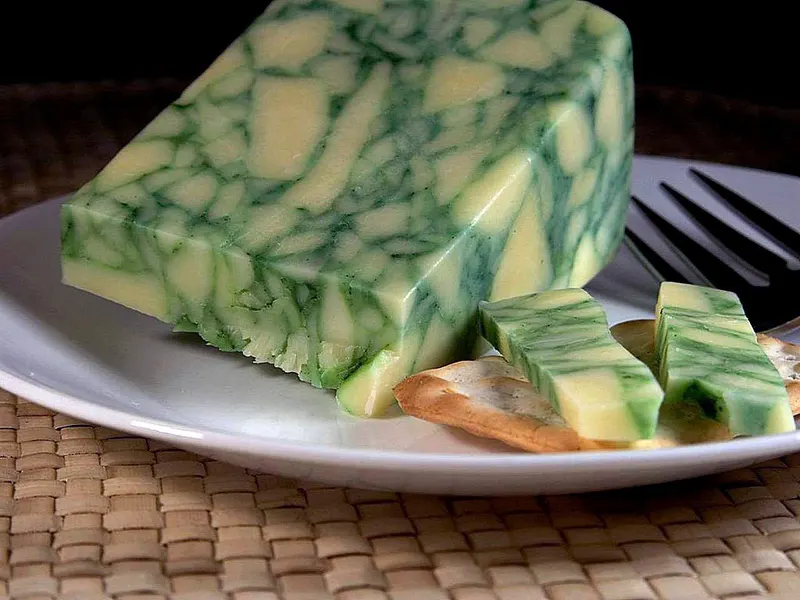
Derby is a hard English cow-milk cheese made like Cheddar but moister and quicker to ripen. In the 1953 USDA account, milk is set at 80–85 °F, the curd is cooked to 96 °F, matted, milled, pressed, dipped in hot water and cured 3–4 months; Sage Derby is the same cheese marbled green with sage.
Photo: Jon Sullivan, Public domain, via Wikimedia Commons
Amounts from a sourceHistorical accounts with no fixed batch. A 1953 Derby was a cylinder about 15 inches across, 5 inches thick and about 30 pounds. No current specification, standard or study was found, so the steps follow the 1928 and 1953 USDA accounts; today's creamery method may differ.
Total time across the recorded steps: 31 days – 4 months
Start
Drag the bar or press Play
What changes:Starter and rennet go into warm milk and it sets firm in about an hour
Step 1 of 6
Set the milk
Time
1 h
Reported
Temperature
27–29 °C
Reported
Salt
None given
Acidity
Not documented
Output: firm curd.
Flavour
Not documented
Texture
Not documented
Colour
Not documented
Microbes at work in this step
Not documented for this step.
Method
Measured measured in a studySet fixed by a specification or tested recipeReported one source reports itTypical a general value, not sourced for this fermentUnconfirmed not yet checked against a source
At a glance
Derby is a hard English cow-milk cheese made like Cheddar but moister and quicker to ripen. In the 1953 USDA account, milk is set at 80–85 °F, the curd is cooked to 96 °F, matted, milled, pressed, dipped in hot water and cured 3–4 months; Sage Derby is the same cheese marbled green with sage. Made in 6 steps over 31 days – 4 months. The longest step, cure, takes 30 days – 4 months (Sanders G.P. 1953) and runs at 16 °C (Sanders G.P. 1953).
Derby is close to Cheddar but holds more moisture, is less firm, breaks into flakes and ripens faster. The pressed cheese is dipped in hot water for about a minute before it is dressed in cloth and pressed again.
Sage DerbyA Derby variety that is mild, mottled green and tastes of sage (Wikipedia, citing Harbutt 1999). No sourced recipe for it was found; a 1953 USDA account of American sage cheese says green sage leaves were once mixed into the curd and later sage extract plus green-coloured curd.
Safety
The 1953 USDA account gives moisture 35–39 % and salt 2 %, and says the cheese cures at about 60 °F for at least a month, more often 3 or 4 months. It does not say whether the milk is pasteurised, and the curd is cooked only to 96 °F (about 36 °C). ANSES, the French food safety agency, names uncooked pressed cheeses with a short ripening, such as Morbier and Reblochon, among the main sources of Salmonella, Listeria and E. coli outbreaks from raw-milk cheese in France. It advises pregnant women, people with weak immunity, people over 65 and young children not to eat raw-milk cheeses other than hard cooked ones.
Factory cheesemaking in England began in 1870 with two factories built to make Derby cheese, so it could be made more evenly than on farms. Gloucester, Leicester, Warwickshire and Wiltshire cheeses were counted as the same type.