Side-by-side or overlay PDF diff driven by one engine that reads each file into a structured model — text, vector geometry, images, form fields, annotations — and compares the models. Moves show as moves, edits show only where they happened, and any PDF type works without picking a mode.
Open a STEP / STP part and it measures itself — volume, thinnest wall, draft and undercut checks on load, plus hole detection with a BOM. Measure, section, export STL. Rust + WASM B-rep kernel, runs in your browser.
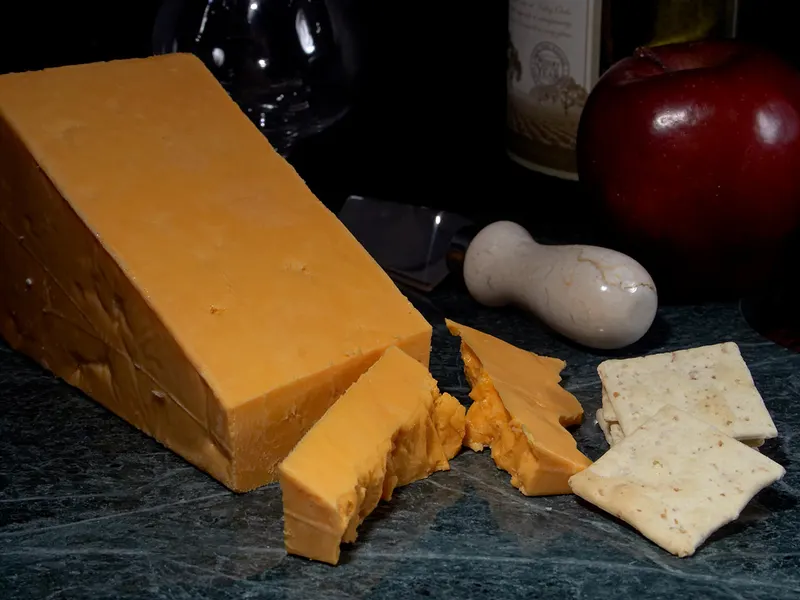
Evening and morning cow milk is coloured with annatto, given lactic starter and rennet at 80–84 °F in winter or 76–78 °F in summer, and the firm curd is cut, scalded to 92 °F and drained. The matted curd is cut into blocks, turned until it has the right acidity, milled, salted at about 2 lb per 100 lb of curd and pressed hard. It cures on shelves at about 60 °F for 2 months to a year, most often 6 to 8 months.
Total time across the recorded steps: 2 months – 12 months
Start
Drag the bar or press Play
What changes:Annatto, starter and rennet go into the mixed milk
Step 1 of 6
Colour, seed and set the milk
Time
1.3–1.5 h
Reported
Temperature
24.4–28.9 °C
Reported
Salt
None given
Acidity
Not documented
Flavour
Not documented
Texture
Not documented
Colour
milk coloured with annatto
Microbes at work in this step
Not documented for this step.
Method
Measured measured in a studySet fixed by a specification or tested recipeReported one source reports itTypical a general value, not sourced for this fermentUnconfirmed not yet checked against a source
At a glance
Evening and morning cow milk is coloured with annatto, given lactic starter and rennet at 80–84 °F in winter or 76–78 °F in summer, and the firm curd is cut, scalded to 92 °F and drained. The matted curd is cut into blocks, turned until it has the right acidity, milled, salted at about 2 lb per 100 lb of curd and pressed hard. It cures on shelves at about 60 °F for 2 months to a year, most often 6 to 8 months. Made in 6 steps over 2 months – 12 months. The longest step, cure on shelves, takes 2–12 months (Sanders G.P. 1953) and runs at 16 °C (Sanders G.P. 1953). Salt is 2 % (Sanders G.P. 1953).
The 1953 USDA account says it may be sold after about 2 months of curing at about 60 °F. Slow Food UK says the traditional cheese is made from unpasteurised milk and sold at 3 to 12 months. The US FDA says ageing raw-milk cheese for 60 days may not eliminate or adequately reduce E. coli O157:H7 and Salmonella, and Listeria may grow in some cheeses while they age.
Leicester cheese was first made in Leicestershire in the English Midlands and was once said to rank among the finest English cheeses, second only perhaps to Stilton (USDA, 1953). Slow Food UK traces it back to the 17th century and says most of it was traded at Leicester, which gave it its name although little was made inside the city. The dyed colour set it apart from other county cheeses. As farm cheesemaking disappeared, production moved to other parts of the UK and some was made in block form by larger creameries.