Side-by-side or overlay PDF diff driven by one engine that reads each file into a structured model — text, vector geometry, images, form fields, annotations — and compares the models. Moves show as moves, edits show only where they happened, and any PDF type works without picking a mode.
Open a STEP / STP part and it measures itself — volume, thinnest wall, draft and undercut checks on load, plus hole detection with a BOM. Measure, section, export STL. Rust + WASM B-rep kernel, runs in your browser.
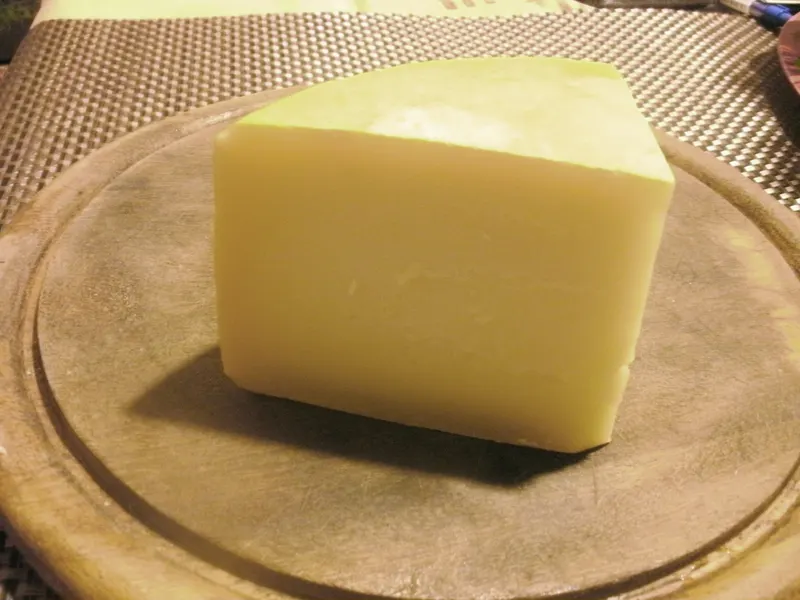
Trappista is a salted, ripened, semi-hard cow cheese set with rennet, with small round fermentation eyes. The Hungarian Food Codex defines it as made from cow milk with a lactic acid bacteria culture and a coagulating enzyme, and fixes its shape, size and composition. A 2025 amending decree calls it the most popular kind of cheese.
No fixed amounts recordedThe Codex lists the allowed ingredients and the limits for the finished cheese, not a recipe or amounts. No readable source gives a dairy's make sheet.
Cow milk
The Codex also allows skim or part-skim milk, milk adjusted in fat or protein by membrane separation, or mixtures of these[fvm152]
The finished cheese holds 1.5 ± 0.5 % salt[fvm152]
Starter
lactic acid bacteria culture and a coagulating enzyme, as the Hungarian Food Codex lists
Total time across the recorded steps: 28 days
Start
Drag the bar or press Play
What changes:Starting material: cow milk, whole or adjusted in fat
Step 1 of 4
Take the cheese milk
Time
Not documented
Temperature
Not documented
Salt
None given
Acidity
Not documented
Which microbes the steps name, step by step
Lactic acid bacteria
The Codex allows cow milk, skim or part-skim milk, membrane-adjusted milk and cream. The 1991 Listeria trials used pasteurised milk. Output: cheese milk.
Flavour
Not documented
Texture
Not documented
Colour
Not documented
Microbes at work in this step
Not documented for this step.
Method
Measured measured in a studySet fixed by a specification or tested recipeReported one source reports itTypical a general value, not sourced for this fermentUnconfirmed not yet checked against a source
At a glance
Trappista is a salted, ripened, semi-hard cow cheese set with rennet, with small round fermentation eyes. The Hungarian Food Codex defines it as made from cow milk with a lactic acid bacteria culture and a coagulating enzyme, and fixes its shape, size and composition. A 2025 amending decree calls it the most popular kind of cheese. Made in 4 steps over 28 days. The longest step, ripen, takes 28 days (Darnay L 2022) and runs at 11–13 °C (Darnay L 2022). Salt is 1–2 % (Földművelésügyi és Vidékfejlesztési Miniszter…). Lactic acid bacteria culture does most of the fermenting.
The Hungarian Codex fixes its shape as a disc of 14–18 cm or a mini disc, and allows a block only if it is sold sliced or grated. A 2003 paper compares the Trappist cheese with Saint-Paulin, a descendant of Port-Salut, in taste, technology and composition.
Milk
Cow milk, which may be skimmed, part-skimmed or membrane-adjusted, with cream allowed
Shape (Hungarian Codex)
Disc 14–18 cm across and 6–9 cm high, 1.0–2.2 kg; mini disc 9–12 cm, 0.15–0.6 kg; blocks of any size, sold only sliced or grated
Composition (Hungarian Codex)
Full-fat type 58 ± 2.5 % dry matter and 47 ± 2.5 % fat in dry matter; half-fat 53 and 32 %; low-fat 47.5 and 22.5 %; salt 1.5 ± 0.5 %
Ripening
4 weeks at 12 ± 1 °C and 85 % relative humidity in one lab make
Smoked trappistaThe Hungarian Codex allows a smoked or smoke-flavoured version.
Mini trappistaSmall discs of 9–12 cm and 0.15–0.6 kg.
Safety
In a 1991 Yugoslav study, Trappist cheese was made from pasteurised milk in three trials and from whey in two, inoculated with Listeria monocytogenes. Counts rose after 30 days of ripening, and after 90 days of ripening and storage they were 2.72–5.64 log₁₀ CFU/g. Where counts declined, the decline was correlated with a fall in moisture and pH and a rise in NaCl and titratable acidity.
Hazards the sources name: Listeria monocytogenes, which survived making and 90 days of ripening and storage in inoculated trials (2.72–5.64 log₁₀ CFU/g at the end).
A 2003 paper on the 120th anniversary of the cheese of the monastery Marija Zvijezda in Banja Luka traces it from France to Banja Luka, then through many countries, especially the former Austro-Hungarian empire, and into Croatia during the 20th century. By 1991 Trappist cheese made up more than a third of Yugoslavia's semi-soft cheese. The 2025 decree 43/2025 (X. 2.) AM amended the Codex decree to set quality requirements for trappista, which it calls the most popular kind of cheese.