Side-by-side or overlay PDF diff driven by one engine that reads each file into a structured model — text, vector geometry, images, form fields, annotations — and compares the models. Moves show as moves, edits show only where they happened, and any PDF type works without picking a mode.
Open a STEP / STP part and it measures itself — volume, thinnest wall, draft and undercut checks on load, plus hole detection with a BOM. Measure, section, export STL. Rust + WASM B-rep kernel, runs in your browser.
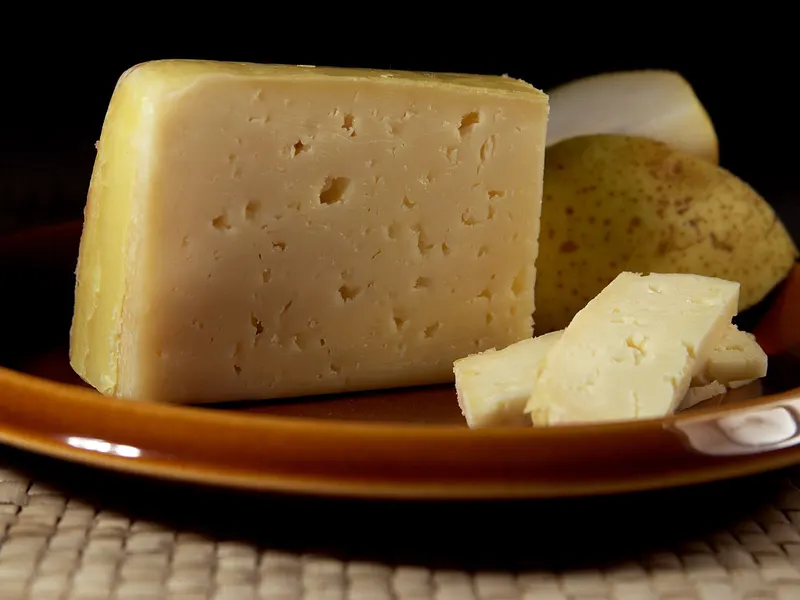
Cow milk, raw or pasteurised, is soured with a mesophilic starter and set with rennet. In the method of one European patent for Tilsiter the milk is set at about 30–32 °C, the curd is cut to pea size, washed with hot water and warmed to 36–37 °C, filled loosely into moulds so the typical slits form, and brined for about a day. In the traditional process the rind is smeared every 2–3 days with Brevibacterium linens, and the cheese ripens at least five weeks.
Photo: Jon Sullivan, Public domain, via Wikimedia Commons
No fixed amounts recordedThe sources give no batch recipe for traditional Tilsiter. The patent's own foil-ripened method adds a mesophilic starter at about 10^5 to 10^7 cells per ml of cheese milk, optionally calcium chloride and nitrate, and rennet of strength 1:15 000; those figures belong to that method. Standard Tilsiter weighs 1.5–20 kg; Holsteiner Tilsiter loaves weigh 3.5–5.0 kg.
Mesophilic starter (in the patent's example Streptococcus lactis, S. cremoris, S. lactis subsp. diacetylactis and Leuconostoc mesenteroides subsp. cremoris)
mesophilic lactic starter; red smear culture on the rind
Total time across the recorded steps: 36 days
Start
Drag the bar or press Play
What changes:Starter and rennet go into the cheese milk and it sets
Step 1 of 6
Add starter and rennet
Time
35–40 min
Reported
Temperature
30–32 °C
Reported
Salt
None given
Acidity
Not documented
Which microbes the steps name, step by step
Streptococcus lactis
L. mesenteroides
Brevibacterium linens
Flavour
Not documented
Texture
Not documented
Colour
Not documented
Microbes at work in this step
Not documented for this step.
Method
Measured measured in a studySet fixed by a specification or tested recipeReported one source reports itTypical a general value, not sourced for this fermentUnconfirmed not yet checked against a source
At a glance
Cow milk, raw or pasteurised, is soured with a mesophilic starter and set with rennet. In the method of one European patent for Tilsiter the milk is set at about 30–32 °C, the curd is cut to pea size, washed with hot water and warmed to 36–37 °C, filled loosely into moulds so the typical slits form, and brined for about a day. In the traditional process the rind is smeared every 2–3 days with Brevibacterium linens, and the cheese ripens at least five weeks. Made in 6 steps over 36 days. The longest step, smear and ripen, takes at least 35 days (European Commission 2012). Mesophilic lactic starter and Brevibacterium linens smear on the rind during ripening do most of the fermenting.
Its slit openings come from filling the washed curd loosely into moulds, and its aroma from a red smear of Brevibacterium linens applied every few days; Holsteiner Tilsiter may only be spiced with caraway.
Fat levels
Holsteiner Tilsiter has 30 % to 60 % fat in dry matter
Standard variety
German standard Tilsiter weighs 1.5–20 kg, is at least 5 weeks old and may contain pepper or caraway; minimum dry matter 49–61 % by fat level
Holsteiner Tilsiter PGIMade and ripened at least five weeks in Schleswig-Holstein, wheel or loaf shaped, 3.5–5.0 kg, with 30 to 60 % fat in dry matter.
Rindless foil-ripened TilsiterRipened in film without smearing, using special cultures; described in patent EP 0 384 553.
Safety
May be made from raw milk; standard Tilsiter must be at least 5 weeks old when sold.
The Holsteiner Tilsiter application says the recipe was first described in 1840 by Mrs Westpfahl of Tilsit in East Prussia and reached Schleswig-Holstein around 1900, where it became the most popular cheese.