Side-by-side or overlay PDF diff driven by one engine that reads each file into a structured model — text, vector geometry, images, form fields, annotations — and compares the models. Moves show as moves, edits show only where they happened, and any PDF type works without picking a mode.
Open a STEP / STP part and it measures itself — volume, thinnest wall, draft and undercut checks on load, plus hole detection with a BOM. Measure, section, export STL. Rust + WASM B-rep kernel, runs in your browser.
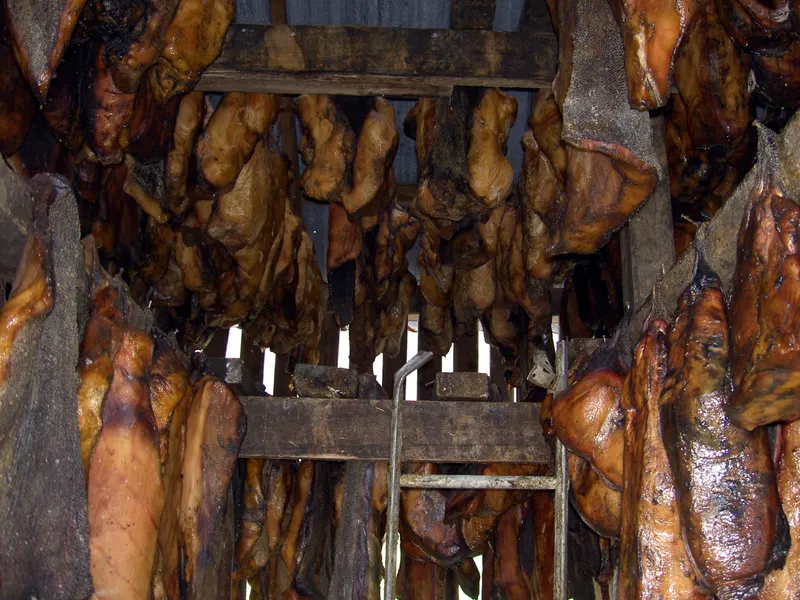
Greenland shark meat, which is considered toxic if eaten fresh in quantity, is cut up, stacked in a draining box or a gravel pit and left for six to twelve weeks while bacteria break down its urea and TMAO into ammonia and trimethylamine. The pieces are then hung for weeks to months in an open drying shed and served in small pieces (Wikipedia describes tiny cubes on toothpicks).
Fully documentedFish and seafood2.5 months – 3.9 months
No fixed amounts recordedThe sources give no batch size for traditional hákarl. The Matís trial used the meat of one 4–4.5 m female shark split into two equal halves, each cut into 4–5 kg pieces.
Greenland shark meat, gutted and beheaded, cut into pieces
Back cuts and flap cuts; the trial used 4–5 kg pieces[matis2023]
Gravel pit near the sea, covered with stones, seaweed or turf (traditional pit method)
The old way, where seawater washed over the cut-up shark at high tide; today the pieces are mostly fermented indoors in perforated containers that let the liquid drain off[matis2023]
Total time across the recorded steps: 2.5 months – 3.9 months
Start
Drag the bar or press Play
What changes:The gutted shark is cut into large pieces of meat
Step 1 of 4
Gut, behead and cut the shark
Time
Not documented
Temperature
Not documented
Salt
None given
Acidity
Not documented
Which microbes the steps name, step by step
Lactococcus
In the Matís trial the shark was gutted and beheaded on board and kept on deck for two days before landing. Output: 4–5 kg back and flap cuts.
Flavour
Not documented
Texture
Not documented
Colour
Not documented
Microbes at work in this step
Not documented for this step.
Method
Measured measured in a studySet fixed by a specification or tested recipeReported one source reports itTypical a general value, not sourced for this fermentUnconfirmed not yet checked against a source
At a glance
Greenland shark meat, which is considered toxic if eaten fresh in quantity, is cut up, stacked in a draining box or a gravel pit and left for six to twelve weeks while bacteria break down its urea and TMAO into ammonia and trimethylamine. The pieces are then hung for weeks to months in an open drying shed and served in small pieces (Wikipedia describes tiny cubes on toothpicks). Made in 4 steps over 2.5 months – 3.9 months. The longest step, stack and press to ferment, takes 42 days – 2.8 months (Jensen S 2023) and runs at -3–20 °C (Jensen S 2023). Photobacterium (fresh meat) or Pseudoalteromonas (frozen meat), dominant in weeks 1–3, when TMAO was still high and Atopostipes, Pseudomonas and Tissierella do most of the fermenting.
Hákarl turns alkaline rather than sour, because the pH rises from about 6 to 9 as bacteria turn the shark's urea and TMAO into ammonia, trimethylamine and dimethylamine. After fermenting, the meat is air-dried in open sheds.
Skyrhákarl"Skyr shark": soft, white body meat (Wikipedia).
Safety
Fresh Greenland shark meat is considered toxic if eaten in quantity because it holds a lot of urea and TMAO. Fermentation turns these into ammonia, trimethylamine and dimethylamine, and it has been considered a detoxification as well as a preservation, but the finished food still carries those amines and no source here sets a safe level. The alkaline pH of 8–9 holds back spoilage microbes, but finished hákarl has water activity near 0.96, enough for an active microbial community. Shark frozen before fermenting started with more TMAO but ended with less TMA and DMA. These studies followed commercial or small-scale industrial hákarl and none tests a home method, so the steps here are a record, not instructions. The FDA lists shark among the highest-mercury fish and advises people who are or may become pregnant, are breastfeeding, or are feeding children to avoid it.
Hazards the sources name: Listeria (minor DNA sequences, under 1 %, in ready-to-eat samples); Shiga toxin-producing Escherichia coli (tested for; not found); Sulphite-reducing Clostridium (low counts in one sample of the 2021 trial; species not named).
The oldest record of processed shark in Iceland dates from 1374. Hákarl was long a valued source of protein and energy, and today it is eaten mainly at the midwinter Þorri feasts.
Starter
The sources we found do not say how its fermentation begins.