Side-by-side or overlay PDF diff driven by one engine that reads each file into a structured model — text, vector geometry, images, form fields, annotations — and compares the models. Moves show as moves, edits show only where they happened, and any PDF type works without picking a mode.
Open a STEP / STP part and it measures itself — volume, thinnest wall, draft and undercut checks on load, plus hole detection with a BOM. Measure, section, export STL. Rust + WASM B-rep kernel, runs in your browser.
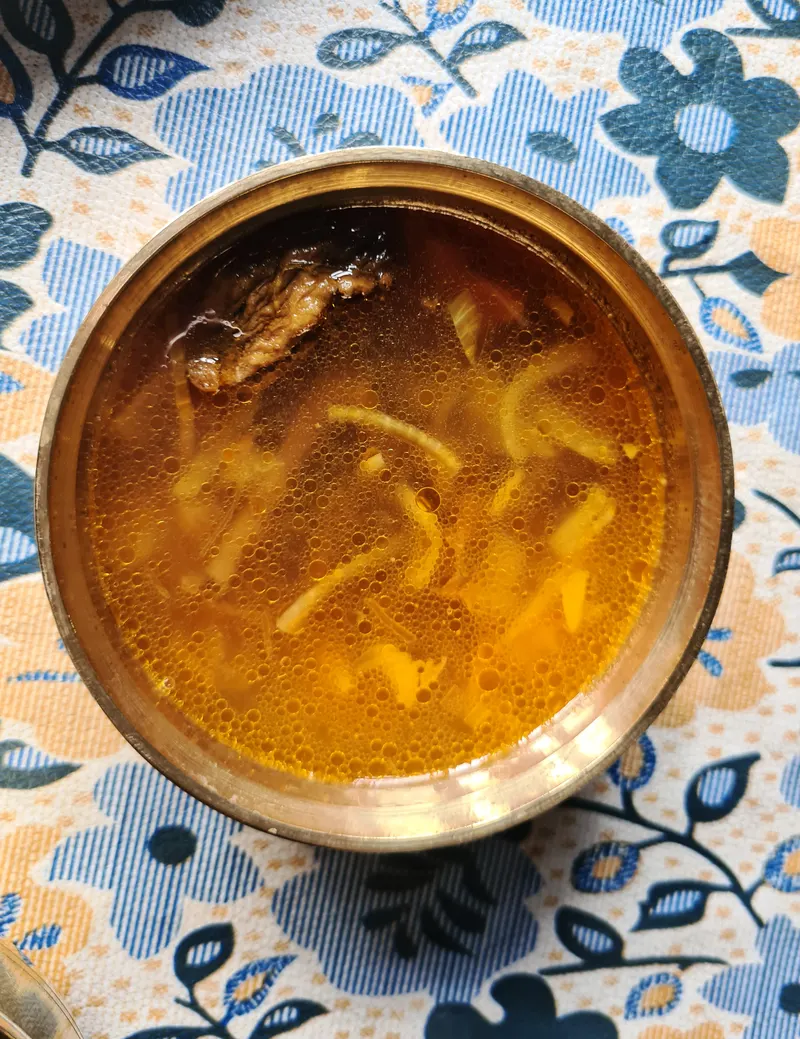
Sinki is radish root that is wilted, shredded and fermented with no salt, in a sealed jar or a clay-lined pit, until lactic bacteria make it sour. The sour shreds are then sun-dried, and the dry sinki keeps for a long time as a base for soup and pickle.
Total time across the recorded steps: 13 days – 3.1 months
Start
Drag the bar or press Play
What changes:Fresh radish roots wilt in the sun
Step 1 of 6
Wilt the radishes in the sun
Time
24 h – 2 days
Reported
Temperature
Not documented
Salt
None given
Acidity
Not documented
Which microbes the steps name, step by step
L. fermentum
L. brevis
L. plantarum
Output: wilted roots.
Flavour
Not documented
Texture
Not documented
Colour
Not documented
Microbes at work in this step
Not documented for this step.
Method
Measured measured in a studySet fixed by a specification or tested recipeReported one source reports itTypical a general value, not sourced for this fermentUnconfirmed not yet checked against a source
At a glance
Sinki is radish root that is wilted, shredded and fermented with no salt, in a sealed jar or a clay-lined pit, until lactic bacteria make it sour. The sour shreds are then sun-dried, and the dry sinki keeps for a long time as a base for soup and pickle. Made in 6 steps over 13 days – 3.1 months. The longest step, ferment, takes 12 days – 3 months (Tamang J.P. and Sarkar P.K. 1993) and runs at 30 °C (Tamang J.P. and Sarkar P.K. 1993). Lactobacillus plantarum, the dominant species, found in every one of 40 samples and Lactobacillus brevis, also found in every sample do most of the fermenting.
Pit sinkiFermented in a clay-lined pit for 2–3 months instead of a jar.
Sinki pickleThe fermented radish is eaten as a pickle instead of being dried for soup.
Safety
With no salt, safety depends on souring fast; the pH fell from 6.7 to 3.3 under the optimized conditions. Drying the sour shreds then keeps them stable. Souring below pH 4.6 is what holds back Clostridium botulinum in a sealed jar or pit. The 3.3 figure comes from the jar method, and the sources we read give no pH for the pit. Snyder et al. say a vegetable ferment that fails to reach below pH 4.6 should be discarded, and that in some low-salt ferments the pH can rise back above 4.6. CDC says the toxin cannot be seen, smelled or tasted, so taste is no test of safety.
FAO's 1998 bulletin calls sinki one of the most popular pickles in Nepal and says it is eaten in India, Nepal and parts of Bhutan. It records two ways of making it, a jar method and a clay-lined pit method (citing Karki 1986) (Battcock and Azam-Ali 1998).
Starter
The sources we found do not say how its fermentation begins.