Side-by-side or overlay PDF diff driven by one engine that reads each file into a structured model — text, vector geometry, images, form fields, annotations — and compares the models. Moves show as moves, edits show only where they happened, and any PDF type works without picking a mode.
Open a STEP / STP part and it measures itself — volume, thinnest wall, draft and undercut checks on load, plus hole detection with a BOM. Measure, section, export STL. Rust + WASM B-rep kernel, runs in your browser.
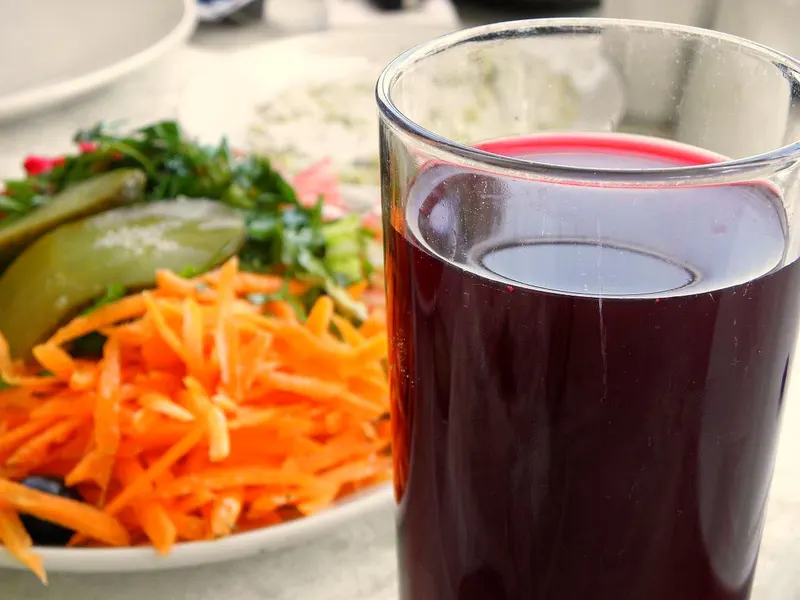
Şalgam is a sour, purple-red Turkish drink. Bulgur flour, sourdough and salt are first fermented as a dough and washed out with water, then the extract ferments for about a week with chopped black carrot, a little turnip and rock salt until it reaches at least 6 g of lactic acid per litre.
Fully documentedSoft drinks11 days
Recipe
Photo: Anatolianpride, Public domain, via Wikimedia Commons
Amounts from a sourceAmounts per litre from a 2024 laboratory run of the traditional two-stage method (Tanguler et al.). There is no standard amount of purple carrot.
To dough consistency, then to dilute the extract[tanguler2024]
Starter
other: sourdough or baker's yeast in a bulgur dough; the carrot stage is spontaneous
Total time across the recorded steps: 11 days
Start
Drag the bar or press Play
What changes:Bulgur flour, salt and sourdough are kneaded with water and ferment as a dough
Step 1 of 5
Knead and ferment the bulgur dough
Time
3 days
Reported
Temperature
25 °C
Reported
Salt
None given
Acidity
Not documented
Which microbes the steps name, step by step
Yeasts
Lactic acid bacteria
L. plantarum
Output: fermented bulgur dough.
Flavour
Not documented
Texture
Not documented
Colour
Not documented
Microbes at work in this step
yeasts and lactic acid bacteria multiply in the dough
Method
Measured measured in a studySet fixed by a specification or tested recipeReported one source reports itTypical a general value, not sourced for this fermentUnconfirmed not yet checked against a source
At a glance
Şalgam is a sour, purple-red Turkish drink. Bulgur flour, sourdough and salt are first fermented as a dough and washed out with water, then the extract ferments for about a week with chopped black carrot, a little turnip and rock salt until it reaches at least 6 g of lactic acid per litre. Made in 5 steps over 11 days. The longest step, carrot (second) fermentation in a closed tank, takes 8 days (Sengun I 2025) and runs at 15–35 °C (Sengun I 2025). Lactiplantibacillus plantarum, the dominant lactic acid bacterium in both fermentations and Lacticaseibacillus paracasei subsp. paracasei, the next most important do most of the fermenting.
Şalgam is a two-stage ferment. Unlike Indian kanji, which ferments black carrot in salted water with mustard seed, şalgam first ferments a bulgur and sourdough dough and uses its extract to start the carrot fermentation.
Direct methodCarrot, turnip, bulgur flour, sourdough and salt go into the drum together with no dough stage; 12 days at 25 °C in one study.
Acılı (hot) şalgamHot chilli is added; TS 11149 lists powdered hot pepper as an ingredient.
Starter-culture şalgamAdded lactic cultures reach 6 g/L lactic acid in about 6 days instead of 8.
Safety
Turkish standard TS 11149 sets the finished drink at pH 3.3–3.8 with at least 6 g lactic acid per litre. Mujdeci 2023 calls şalgam highly perishable, with a short shelf life when made industrially; heat treatment would extend it but harms taste, aroma and colour. The same study says yeasts can grow in the acid drink and cause film formation, colour change and off-taste.
Hazards the sources name: Film-forming spoilage yeasts that cause colour change and off-taste in stored şalgam.
Erol et al. (2024) say şalgam is widely consumed in Turkish regions such as Hatay, Mersin, Osmaniye, Adana and Kahramanmaraş, where it is made at home and commercially. Exports to European countries have grown recently, and larger production facilities are replacing smaller ones. Sengun et al. (2025) note that there is no standardized production method.
[tanguler2012] Tanguler H., Erten H. 2012, Occurrence and growth of lactic acid bacteria species during the fermentation of shalgam (salgam), a traditional Turkish fermented beverage, LWT 46(1):36–41, doi:10.1016/j.lwt.2011.10.026 (abstract)paper
[cirak2022] Cirak M.A., Agirman B., Erten H. 2022, The chemical, microbiological and sensory characteristics of şalgam during fermentation process, Journal of Food Processing and Preservation 46(6), doi:10.1111/jfpp.15440 (abstract)paper