Side-by-side or overlay PDF diff driven by one engine that reads each file into a structured model — text, vector geometry, images, form fields, annotations — and compares the models. Moves show as moves, edits show only where they happened, and any PDF type works without picking a mode.
Open a STEP / STP part and it measures itself — volume, thinnest wall, draft and undercut checks on load, plus hole detection with a BOM. Measure, section, export STL. Rust + WASM B-rep kernel, runs in your browser.
Soft drinks from Russia, Ukraine, Belarus, the Baltic states, Poland, Moldova, Armenia and Georgia
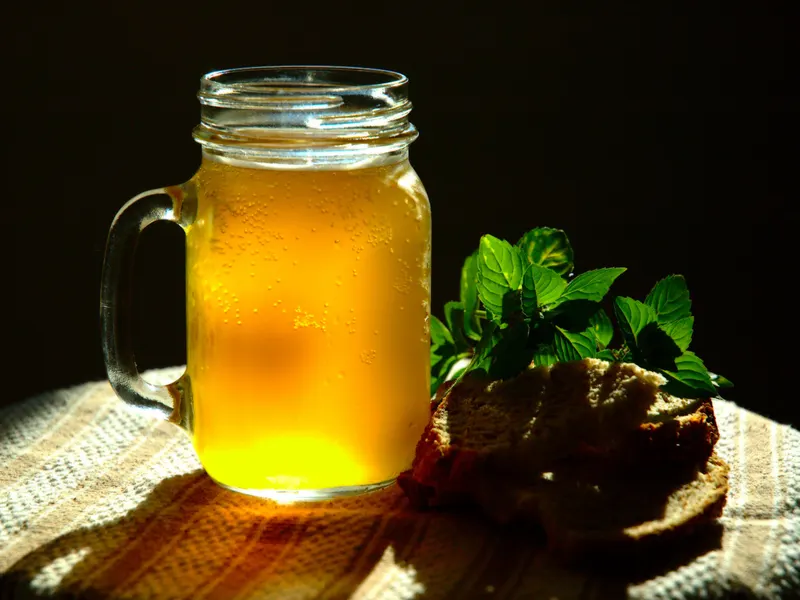
Kvass (bread kvass)квас
Rye bread (or rye malt and flour) is extracted in hot water to make a wort, then sugar and baker's yeast, sometimes with lactic bacteria, are added. The wort ferments for about a day and is then filtered and kept cold, so kvass stays fizzy, sweet-sour and at most 1.2 % alcohol under the Russian standard.
Amounts from a sourceThe laboratory recipe of Kaszuba et al. 2024 (a study of kvass from mountain-rye bread, following a method of Gambuś et al.), which uses 500 g of bread and 4.5 L of water. Other methods use rye flour boiled and mixed with rye malt, and factories can start from a wort concentrate (Wikipedia).
Rye bread, chopped into small cubes and air-dried500 g
Mountain-rye bread in the study; the bread is steeped in hot water[kaszuba2024]
Water1500 mL at 80 °C, then 1500 mL at 70 °C, then 1500 mL more at 70 °C
The first two portions extract the bread; the third is added to the filtrate[kaszuba2024]
Sugar100 g
Added to the filtrate with the yeast; a further 10 g per litre is added after fermentation[kaszuba2024]
other: baker's yeast, with lactic acid bacteria in some kvass
Total time across the recorded steps: 15 days
Start
Drag the bar or press Play
What changes:Hot water extracts the rye bread into a wort
Step 1 of 5
Steep rye bread in hot water
Time
2 h
Reported
Temperature
70–80 °C
Reported
Salt
None given
Acidity
Not documented
Which microbes the steps name, step by step
Saccharomyces cerevisiae
Lactobacillus casei
L. mesenteroides
Yeasts
Lactic acid bacteria
Stirred every 5 min in the first portion and every 10 min in the second. With rye flour and rye malt instead of bread, Wikipedia says the flour is boiled and mixed with the malt. Output: bread extract (wort).
Flavour
Not documented
Texture
Not documented
Colour
Not documented
Microbes at work in this step
Not documented for this step.
Method
Measured measured in a studySet fixed by a specification or tested recipeReported one source reports itTypical a general value, not sourced for this fermentUnconfirmed not yet checked against a source
At a glance
Rye bread (or rye malt and flour) is extracted in hot water to make a wort, then sugar and baker's yeast, sometimes with lactic bacteria, are added. The wort ferments for about a day and is then filtered and kept cold, so kvass stays fizzy, sweet-sour and at most 1.2 % alcohol under the Russian standard. Made in 5 steps over 15 days. The longest step, filter, sweeten and keep cold, takes 14 days (Kaszuba J 2024) and runs at 10 °C (Kaszuba J 2024). Saccharomyces cerevisiae and Lactic acid bacteria do most of the fermenting.
Kvass is made from rye bread, or from rye flour and malt, extracted in hot water. Sugar and baker's yeast are added and the ferment runs about a day, so the drink stays at 1.2 % alcohol or less under the Russian standard, and it is then kept cold.
Factory kvass from concentrateWort concentrate is warmed and mixed with a water and sugar solution, pasteurised, fermented with baker's yeast and a lactic acid bacteria culture, then cooled and clarified by filtration or centrifugation (Wikipedia).
Fruit and beet kvassIn Ukraine, pear and apple kvas was made from dried fruit kept in water, and beet kvas is drunk or used in borshch (Wikipedia); a 2025 review also lists beet kvass.
Finnish kalja / kotikaljaA similar drink of rye flour and rye malt; traditionally fermented in a cask with a previous batch, a sourdough starter, spontaneously or with baker's yeast, and now made from dark rye malt, sugar and baker's yeast (Wikipedia).
The Russian kvass standard caps alcohol at 1.2 % by volume, but lets unfiltered kvass rise by up to 0.2 percentage points during storage (0.1 if clarified), so the yeast keeps working. Wikipedia says kvass can reach 2.0 % in some cases and that children of all ages drink it. The laboratory recipe kept the finished kvass at 10 °C.
The first written mention of kvass is in the Primary Chronicle, in the account of Prince Vladimir's baptism, when kvass was handed out to the citizens of Kyiv; Wikipedia dates this to 988 and a 2025 review to 989. English 'quass' is recorded around 1553. The first scientific studies of kvass were done in Kyiv in the 1890s, and commercial mass-production technology was developed by chemists in Moscow in the 1960s (Wikipedia).