Side-by-side or overlay PDF diff driven by one engine that reads each file into a structured model — text, vector geometry, images, form fields, annotations — and compares the models. Moves show as moves, edits show only where they happened, and any PDF type works without picking a mode.
Open a STEP / STP part and it measures itself — volume, thinnest wall, draft and undercut checks on load, plus hole detection with a BOM. Measure, section, export STL. Rust + WASM B-rep kernel, runs in your browser.
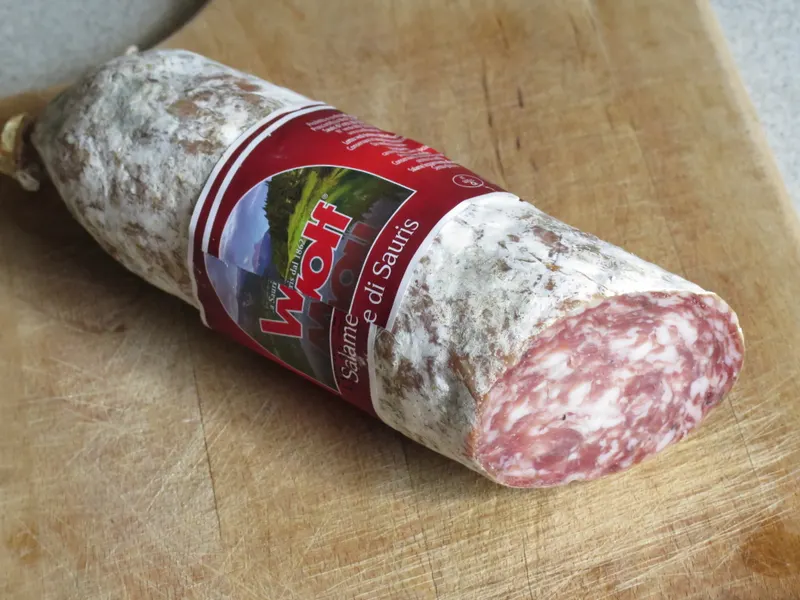
Minced pork and fat are seasoned with salt, pepper, garlic and often wine, stuffed into natural pork casings, and dried warm for a few days. The salami then matures for weeks in cool, humid, ventilated rooms until it is firm and mild. The Felino and Piacentino specifications keep the finished pH at 5.2 or above.
Amounts from a sourceAmounts are per 100 kg of fresh meat in the Salame Piacentino DOP specification (2012 amendment). Other salami set their own rules; Salame Felino IGP, for example, uses 2–2.8 % salt and 0.03–0.06 % pepper.
Fresh pork lean and fat, minced through a plate with holes over 10 mm100 kg
some salami ferment spontaneously without a starter; some specifications allow starter cultures
Total time across the recorded steps: 29 days – 31 days
Start
Drag the bar or press Play
What changes:Starting material: chilled pork lean and firm fat, trimmed clean
Step 1 of 6
Trim and chill the pork
Time
Not documented
Temperature
at least -1 °C
Set
Salt
None given
Acidity
Not documented
Which microbes the steps name, step by step
Latilactobacillus sakei
L. curvatus
Pediococcus pentosaceus
Staphylococcus xylosus
Lactic acid bacteria
Large pieces of connective tissue and soft fat are removed. Output: trimmed lean and fat, never frozen.
Flavour
Not documented
Texture
Not documented
Colour
Not documented
Microbes at work in this step
Not documented for this step.
Method
Measured measured in a studySet fixed by a specification or tested recipeReported one source reports itTypical a general value, not sourced for this fermentUnconfirmed not yet checked against a source
At a glance
Minced pork and fat are seasoned with salt, pepper, garlic and often wine, stuffed into natural pork casings, and dried warm for a few days. The salami then matures for weeks in cool, humid, ventilated rooms until it is firm and mild. The Felino and Piacentino specifications keep the finished pH at 5.2 or above. Made in 6 steps over 29 days – 31 days. The longest step, mature in cool, ventilated rooms, takes at least 25 days (Salame Felino IGP 2013) and runs at 12–19 °C (Salame Felino IGP 2013). Salt is 1.5–3.5 % (Salame Felino IGP 2013). Latilactobacillus sakei and Latilactobacillus curvatus do most of the fermenting.
The Felino and Piacentino specifications keep the final pH at 5.2–5.3 or higher, a mild acidification. They rely on salt, nitrate or nitrite and slow drying in cool, humid rooms rather than a strong lactic sour.
Salame Felino IGPParma province; 6–8 mm mince, natural casing, at least 25 days maturing; see its entry.
Salame Piacentino DOPPiacenza province below 900 m; coarse mince over 10 mm, at least 45 days; see its entry.
Safety
Salami is eaten raw, so its safety rests on salt, nitrite or nitrate, competition from lactic bacteria and drying. Since 9 October 2025 EU law caps added nitrite in non-heat-treated meat products at 80 mg/kg (residual at most 45 mg/kg) and added nitrate at 90 mg/kg, or 110 mg/kg in dry sausages made without nitrite. EU rules treat a ready-to-eat food as unable to support Listeria when its pH is 4.4 or less, its water activity 0.92 or less, or both pH 5.0 or less and water activity 0.94 or less. Protected salami such as Felino and Piacentino keep pH at 5.2 or above, so of those tests only a water activity of 0.92 or less fits them; the rules let other products qualify on scientific justification. A 2023 review names L. monocytogenes and Salmonella as the main microbial hazards in dry fermented meats. It cites an EU report in which fermented sausages had one of the highest L. monocytogenes rates at distribution (3.1 %), and it says nitrite inhibits Clostridium botulinum. These are figures for controlled production, not a home method. Washington State University Extension does not recommend making dry sausage at home, because S. aureus toxin can form if fermentation is not rigidly controlled. It also warns that nitrite overdoses can be harmful and that the small amounts are hard to weigh accurately, so it says to use a pre-blended cure. The US CDC says curing, drying or smoking alone does not reliably kill Trichinella worms.
The Salame Piacentino specification says the curing of Piacenza pork goes back to Roman times. The Salame Felino specification names Latin authors of the 1st century AD as its first references and gives what appears to be the oldest depiction of the product, in the Baptistery of Parma (1196–1307). It adds that Salame Felino entered the Italian dictionary in 1905.