Side-by-side or overlay PDF diff driven by one engine that reads each file into a structured model — text, vector geometry, images, form fields, annotations — and compares the models. Moves show as moves, edits show only where they happened, and any PDF type works without picking a mode.
Open a STEP / STP part and it measures itself — volume, thinnest wall, draft and undercut checks on load, plus hole detection with a BOM. Measure, section, export STL. Rust + WASM B-rep kernel, runs in your browser.
Pork lean and hard fat are minced, salted and stuffed into natural casing, rested cold, then warmed in a first drying (étuvage) of 3–8 days that starts the lactic fermentation and the surface bloom. A cooler second drying follows. In the Label Rouge specification the whole drying, from stuffing to the dryer exit, lasts at least 18 to 42 days by size.
Amounts from a sourceMaximum doses in the Label Rouge specification LA 02/08 for dry saucisson and saucisse; ordinary saucisson follows the French charcuterie code of practice.
Pork lean and hard fat
Label Rouge requires mainly label rouge porc charcutier, with at most 30 % sow meat[lr0208]
a selected surface bloom may be applied (Label Rouge specification)
Total time across the recorded steps: 3.5 days – 13 days
Start
Drag the bar or press Play
What changes:Pork lean and hard fat are minced
Step 1 of 5
Mince lean and fat
Time
Not documented
Temperature
Not documented
Salt
None given
Acidity
Not documented
Which microbes the steps name, step by step
Lactic acid bacteria
Kocuria
Output: minced pork.
Flavour
Not documented
Texture
Not documented
Colour
Not documented
Microbes at work in this step
Not documented for this step.
Method
Measured measured in a studySet fixed by a specification or tested recipeReported one source reports itTypical a general value, not sourced for this fermentUnconfirmed not yet checked against a source
At a glance
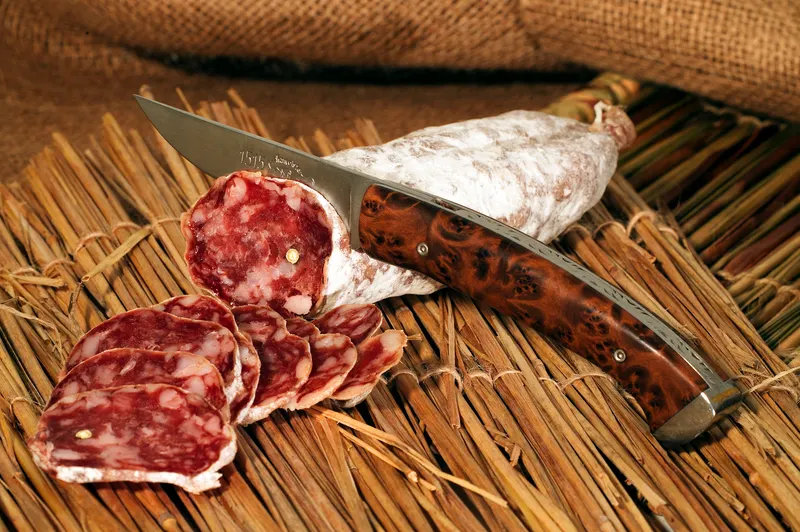
Pork lean and hard fat are minced, salted and stuffed into natural casing, rested cold, then warmed in a first drying (étuvage) of 3–8 days that starts the lactic fermentation and the surface bloom. A cooler second drying follows. In the Label Rouge specification the whole drying, from stuffing to the dryer exit, lasts at least 18 to 42 days by size. Made in 5 steps over 3.5 days – 13 days. The longest step, first drying (étuvage), takes 3–8 days (Cahier des charges du label rouge n° LA 02/08…). Salt is up to 3 % (Cahier des charges du label rouge n° LA 02/08…). Lactic acid bacteria and Staphylococcus/Kocuria does most of the fermenting.
Saucisson sec is the general French dry sausage; protected versions (Ardèche, Lacaune, Auvergne) add origin and size rules. Its two-stage drying, a warm étuvage then a cooler maturation, is set out in the Label Rouge specification.
RosetteSpindle-shaped casing (fuseau), at least 60 mm across; at least 28 or 42 days by weight.
JésusBag-shaped casing or caecum; at least 28 or 42 days by weight.
Saucisse sècheThin casing (menu), horseshoe, pole or straight; at least 18 days.
Safety
The Label Rouge specification checks dryness as moisture of the fat-free product (HPD), at most 52 % for pieces up to 70 mm across. In a study of nine small traditional French units, sausages from seven presented no health risk; sausages from two exceeded the maximum tolerable limit, one for S. aureus and one for L. monocytogenes. Surfaces in two units showed insufficient cleaning and disinfection. The figures here describe controlled production, not a home method. Washington State University Extension does not recommend making dry sausage at home, because S. aureus toxin can form if fermentation is not rigidly controlled.
Hazards the sources name: Staphylococcus aureus and Listeria monocytogenes (each above the maximum tolerable limit in sausages from one of nine units; sausages from the other seven presented no health risk).