Side-by-side or overlay PDF diff driven by one engine that reads each file into a structured model — text, vector geometry, images, form fields, annotations — and compares the models. Moves show as moves, edits show only where they happened, and any PDF type works without picking a mode.
Open a STEP / STP part and it measures itself — volume, thinnest wall, draft and undercut checks on load, plus hole detection with a BOM. Measure, section, export STL. Rust + WASM B-rep kernel, runs in your browser.
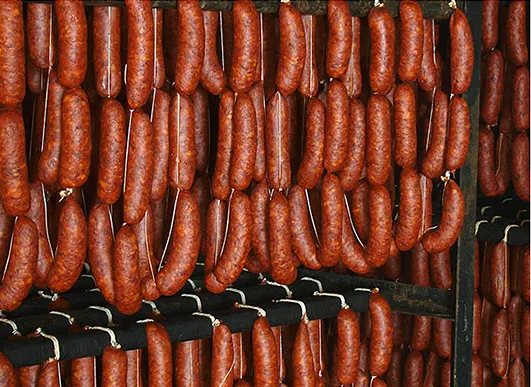
Chilled pork and fat are minced, seasoned with salt, pimentón (paprika) and garlic, and rested cold before they are stuffed into natural pork casing. The sausages then cure for three to six weeks or more in cool, ventilated rooms, where lactic bacteria and cocci grow, the pH barely drops and the chorizo loses a quarter or more of its weight.
Amounts from a sourceThe amounts are the Chorizo Riojano recipe used in a 2021 University of La Rioja study, based on a survey of 10 traditional PGI makers. Chorizo Riojano allows no additives and no sugar; Chorizo de Cantimpalos allows oregano and permitted additives.
No starter culture is added to Chorizo Riojano (González-Fandos et al. 2021).
Total time across the recorded steps: 35 days – 36 days
Start
Drag the bar or press Play
What changes:Cold pork and fat are cut through the mincer plate
Step 1 of 6
Mince the chilled pork and fat
Time
Not documented
Temperature
0–2 °C
Set
Salt
None given
Acidity
Not documented
Which microbes the steps name, step by step
Lactic acid bacteria
Chorizo Riojano requires meat with a pH below 6.3, not frozen, and a handling area no warmer than 12 °C. Output: minced lean and fat.
Flavour
Not documented
Texture
Not documented
Colour
Not documented
Microbes at work in this step
Not documented for this step.
Method
Measured measured in a studySet fixed by a specification or tested recipeReported one source reports itTypical a general value, not sourced for this fermentUnconfirmed not yet checked against a source
At a glance
Chilled pork and fat are minced, seasoned with salt, pimentón (paprika) and garlic, and rested cold before they are stuffed into natural pork casing. The sausages then cure for three to six weeks or more in cool, ventilated rooms, where lactic bacteria and cocci grow, the pH barely drops and the chorizo loses a quarter or more of its weight. Made in 6 steps over 35 days – 36 days. The longest step, dry in curing rooms, takes at least 21 days (Single document 'Chorizo de Cantimpalos' 2007) and runs at 6–16 °C (Single document 'Chorizo de Cantimpalos' 2007). Salt is 2 % (Gonzalez-Fandos E 2021). Lactic acid bacteria and Micrococcaceae do most of the fermenting.
Chorizo gets its colour and flavour from pimentón, and the protected styles cure cold, at 6–16 °C (Cantimpalos) or 16 °C or less (Riojano), and Chorizo Riojano adds no starter, sugar or nitrite. The pH stays near 5–6, so little acid forms.
Chorizo Riojano IGPLa Rioja; sarta form, no additives, made cold; see its entry.
Chorizo de Cantimpalos IGPSegovia highlands above 900 m; sarta, achorizado and cular formats with a white mould on the larger ones; see its entry.
Chorizo de PamplonaThick and finely minced.
Portuguese chouriçoUsually smoked slowly as it dries.
Mexican chorizo (boundary)Fresh, with chilli and vinegar, not fermented; must be cooked.
Goan chouriçoPork in vinegar, chilli and spices; raw, smoked or salt-cured and air-dried.
Safety
Chorizo is eaten raw. EU rules treat a ready-to-eat food as unable to support Listeria when its water activity is 0.92 or less, or its pH is 5.0 or less with water activity 0.94 or less; in the Riojano study water activity fell below 0.92 by day 13 and to 0.86 by day 21, and inoculated Listeria fell by 1.24 log by day 21 but survived into the finished sausage. The authors say the process cannot fully remove it at the 4 log CFU/g they added, which is above the under 2 log CFU/g they give as normal for raw meat, and that Salmonella and Clostridium botulinum have also been found in dry-cured sausages, though sulfite-reducing clostridia were not detected in their own samples. The amounts here record that pilot-plant trial, with 2 % salt, no nitrite, chilled rooms and measured water activity, and no study we found covers a home batch. Curing, drying and smoking alone do not consistently kill Trichinella worms in pork (CDC). CDC tells people who are pregnant, 65 or older or have a weakened immune system to avoid unheated fermented or dry sausages, or to heat them until steaming hot. Chorizo Riojano caps nitrate at 100 ppm and nitrite at 20 ppm; EU law caps added nitrite in other cured sausages at 80 mg/kg since October 2025.
Hazards the sources name: Listeria monocytogenes (no growth at 4 °C in the first 6 days, then a 1.24 log fall by day 21; it survived into the finished sausage).