Side-by-side or overlay PDF diff driven by one engine that reads each file into a structured model — text, vector geometry, images, form fields, annotations — and compares the models. Moves show as moves, edits show only where they happened, and any PDF type works without picking a mode.
Open a STEP / STP part and it measures itself — volume, thinnest wall, draft and undercut checks on load, plus hole detection with a BOM. Measure, section, export STL. Rust + WASM B-rep kernel, runs in your browser.
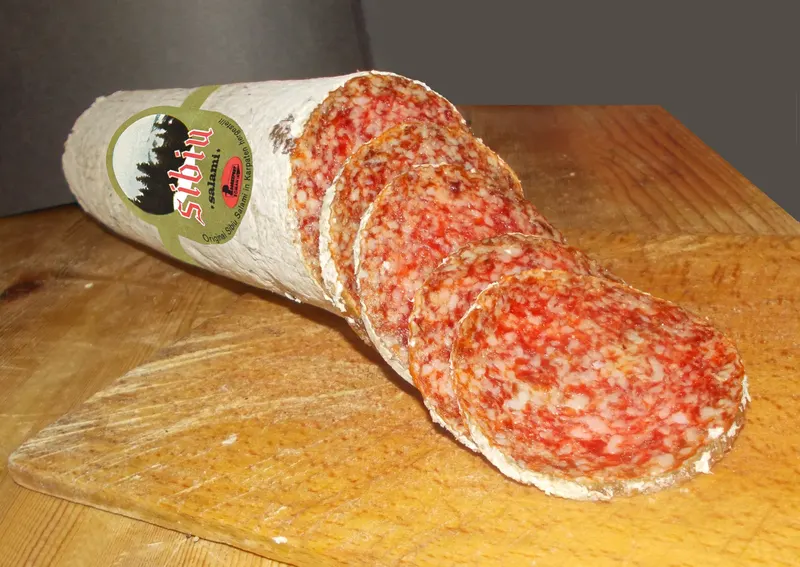
Salam de Sibiu is a Romanian dried raw salami with a white noble mould. Pork and hard fat are chopped to the size of a grain of rice, seasoned and filled into wide casings, cold-smoked over Romanian beech or oak for 3 to 10 days, sprayed with Penicillium nalgiovense spores and matured and dried for at least 60 days to 30 % moisture or less.
starter and/or bioprotective cultures in the mix; surface sprayed with Penicillium nalgiovense spores
Total time across the recorded steps: 2.4 months – 2.7 months
Start
Drag the bar or press Play
What changes:Pork and hard fat are chopped to the size of rice grains
Step 1 of 7
Chop meat and fat in a bowl cutter
Time
Not documented
Temperature
Not documented
Salt
None given
Acidity
Not documented
Which microbes the steps name, step by step
Penicillium nalgiovense
Penicillium
Flavour
Not documented
Texture
Not documented
Colour
Not documented
Microbes at work in this step
Not documented for this step.
Method
Measured measured in a studySet fixed by a specification or tested recipeReported one source reports itTypical a general value, not sourced for this fermentUnconfirmed not yet checked against a source
At a glance
Salam de Sibiu is a Romanian dried raw salami with a white noble mould. Pork and hard fat are chopped to the size of a grain of rice, seasoned and filled into wide casings, cold-smoked over Romanian beech or oak for 3 to 10 days, sprayed with Penicillium nalgiovense spores and matured and dried for at least 60 days to 30 % moisture or less. Made in 7 steps over 2.4 months – 2.7 months. The longest step, mature, brush and dry in climate-controlled stores, takes at least 2 months (Single document 2014) and runs at 10–15 °C (Single document 2014). Salt is up to 5 % (Single document 2014). Penicillium nalgiovense, sprayed on the surface alone or in a Penicillium mixture that must include it does most of the fermenting.
Salam de Sibiu is cold-smoked and then deliberately sprayed with Penicillium nalgiovense, and acid makers such as glucono delta-lactone are banned. The protected Szeged téliszalámi relies on the house mould flora of its ripening rooms; its specification allows no mould starter.
Limited editions with wine, brandy or stoutUp to 3 % of an alcoholic maturation agent, named in the product name.
Safety
The specification sets at most 30 % moisture and under 50 mg/kg nitrite in the finished salami, and requires Listeria monocytogenes and Salmonella to be absent in 25 g. These are figures for controlled production, not a home method. Washington State University Extension does not recommend making dry sausage at home, because S. aureus toxin can form if fermentation is not rigidly controlled.
Hazards the sources name: Listeria monocytogenes and Salmonella must be absent in 25 g of the finished salami; E. coli 500–5 000 CFU/g.
The specification says it was first known as salam de iarnă (winter salami) and took its present name from exports through the Sibiu customs post; it appears on menus and in advertisements from 1890. Romanian Wikipedia says some sources credit its start to the Italian Filippo Dozzi in Sinaia in 1910. PGI since Reg. (EU) 2016/234 of 9 February 2016.