Side-by-side or overlay PDF diff driven by one engine that reads each file into a structured model — text, vector geometry, images, form fields, annotations — and compares the models. Moves show as moves, edits show only where they happened, and any PDF type works without picking a mode.
Open a STEP / STP part and it measures itself — volume, thinnest wall, draft and undercut checks on load, plus hole detection with a BOM. Measure, section, export STL. Rust + WASM B-rep kernel, runs in your browser.
Cheese from Germany, southern Germany and especially Bavaria
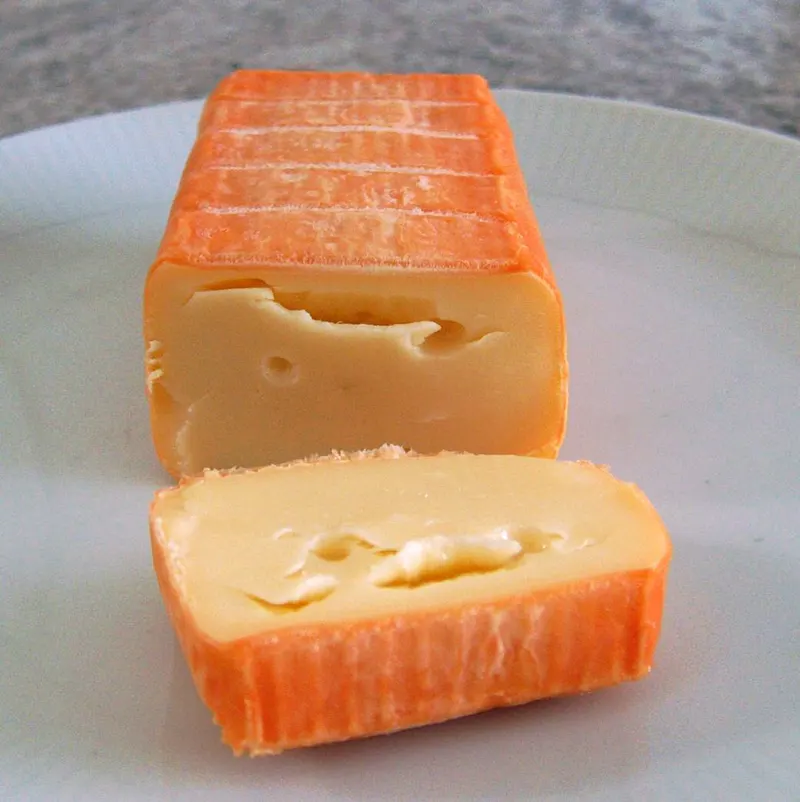
Romadur
Whole or partly skimmed cow milk is set with lactic starter and rennet as for Limburger, cut, and drained in sectioned forms into small loaves. The cheeses are rubbed with dry salt several times over 12 hours, then ripen with a light yellow-brown to reddish smear at a lower temperature and for less time than Limburger, giving a smaller, milder cheese of 80–180 g.
Total time across the recorded steps: 8.5 days – 15 days
Start
Drag the bar or press Play
What changes:Lactic starter and rennet go into the warm cow milk
Step 1 of 5
Set the milk
Time
Not documented
Temperature
30–33 °C
Reported
Salt
None given
Acidity
Not documented
Which microbes the steps name, step by step
Yeasts
Brevibacterium linens
Flavour
Not documented
Texture
Not documented
Colour
Not documented
Microbes at work in this step
Not documented for this step.
Method
Measured measured in a studySet fixed by a specification or tested recipeReported one source reports itTypical a general value, not sourced for this fermentUnconfirmed not yet checked against a source
At a glance
Whole or partly skimmed cow milk is set with lactic starter and rennet as for Limburger, cut, and drained in sectioned forms into small loaves. The cheeses are rubbed with dry salt several times over 12 hours, then ripen with a light yellow-brown to reddish smear at a lower temperature and for less time than Limburger, giving a smaller, milder cheese of 80–180 g. Made in 5 steps over 8.5 days – 15 days. The longest step, ripen with a smear, takes 8–14 days (Wikipedia (German)) and runs at 6–7 °C (Sanders G.P. 1953). Lactic starter bacteria (Säurewecker) in the milk; no species named and Surface yeasts, which lower the acidity first, followed by Bacterium linens (now Brevibacterium linens), described for the Limburger smear do most of the fermenting.
A 1953 USDA handbook says raw-milk Limburger is cured at least 60 days. It gives no such figure for Romadur and says only that it is cured for a shorter time. If Romadur is made from raw milk, note that ANSES ranks soft washed-rind cheeses just after the main raw-milk cheese sources of Listeria, Salmonella and enterohaemorrhagic E. coli, and advises pregnant women, young children, people over 65 and people with weak immunity not to eat raw-milk cheeses other than pressed cooked ones such as Gruyère or Comté.
Romadur shares its origin with Limburger, which was first made in the Liège area of Belgium and named after the market town of Limburg [usda-hb54]. German Wikipedia says Carl Hirnbein introduced Romadur to the Allgäu in the 1830s, as he did Limburger [wiki-de]. In Germany it is a standard variety of the Cheese Ordinance [kasev].