Side-by-side or overlay PDF diff driven by one engine that reads each file into a structured model — text, vector geometry, images, form fields, annotations — and compares the models. Moves show as moves, edits show only where they happened, and any PDF type works without picking a mode.
Open a STEP / STP part and it measures itself — volume, thinnest wall, draft and undercut checks on load, plus hole detection with a BOM. Measure, section, export STL. Rust + WASM B-rep kernel, runs in your browser.
Cow milk is soured with a lactic culture and set with rennet, then cut into small cubes and heated gently. The curd is ladled into moulds, turned while it drains and dry-salted over one to two days. The surface is washed often with weak brine until the surface-curing organisms (yeasts and bacteria) have grown, then the cheese is wrapped and ripened further.
No fixed amounts recordedThe US standard fixes the steps and the composition, not the amounts.
Cow milk
Milk, nonfat milk or cream, alone or combined; raw or pasteurised. The 1928 USDA bulletin calls it a cheese made from cows' milk[cfr-limburger][usda-608]
Or other clotting enzymes; calcium chloride up to 0.02 % of the milk weight[cfr-limburger]
Salt
Dry salt on the curd, then weak brine on the surface[cfr-limburger]
Starter
lactic acid-producing bacterial culture; the smear flora is largely the dairy's own house flora
Total time across the recorded steps: 2 months
Start
Drag the bar or press Play
What changes:A lactic culture and rennet go into warm milk and it sets
Step 1 of 6
Warm the milk and add culture and rennet
Time
Not documented
Temperature
32–33 °C
Set
Salt
None given
Acidity
Not documented
Which microbes the steps name, step by step
Lactic acid bacteria
Yeasts
Geotrichum candidum
B. aurantiacum
Debaryomyces hansenii
Output: coagulum.
Flavour
Not documented
Texture
soft gel
Colour
white
Microbes at work in this step
lactic bacteria sour the milk; rennet sets it
Method
Measured measured in a studySet fixed by a specification or tested recipeReported one source reports itTypical a general value, not sourced for this fermentUnconfirmed not yet checked against a source
At a glance
Cow milk is soured with a lactic culture and set with rennet, then cut into small cubes and heated gently. The curd is ladled into moulds, turned while it drains and dry-salted over one to two days. The surface is washed often with weak brine until the surface-curing organisms (yeasts and bacteria) have grown, then the cheese is wrapped and ripened further. Made in 6 steps over 2 months. The longest step, wrap and ripen, takes at least 2 months (US Code of Federal Regulations) and runs at at least 2 °C (US Code of Federal Regulations). Lactic acid bacteria and Debaryomyces hansenii and Geotrichum candidum do most of the fermenting.
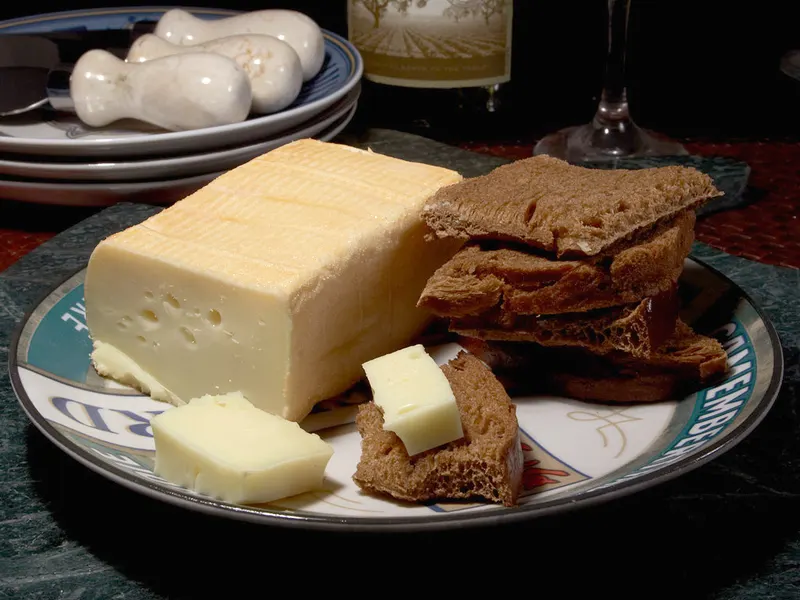
Limburger is a soft rennet cheese whose surface is washed with weak brine until a smear grows. A study of five smear cheeses found Limburger had the simplest smear, two yeasts and two bacteria, while Livarot had ten yeasts and 38 bacteria.
Milk
Cow milk, cream or nonfat milk; raw-milk cheese is cured at least 60 days
Composition
US standard: no more than 50 % moisture; at least 50 % milkfat in the solids
Smear flora
Two yeasts and two bacteria, the simplest flora of five smear cheeses studied
The US standard requires a cheese from unpasteurised dairy ingredients to be cured at not less than 35 °F (about 2 °C) for at least 60 days. A cheese from pasteurised ingredients must have a phenol equivalent value of no more than 4 micrograms per 0.25 g of cheese. Maximum moisture is 50 %. In the pasteurised method, salt brine at 66–70 °F is added to the curd so that its pH is about 4.8. The 60-day minimum is an American rule and does not guarantee safety. In tests that added the bacteria on purpose, E. coli O157:H7 and Listeria survived well beyond 60 days in Cheddar, and Listeria put on the surface of soft mould-ripened cheese grew over 60 days at 4 °C. Those tests did not use Limburger.
Limburger was first made in the Province of Liège, Belgium, and is named for the town of Limburg, where much of it was first sold (USDA, 1953). By 1928 it was also made in Germany and Austria, and in large quantities in the United States, mostly in New York and Wisconsin (USDA Bulletin 608). The 1953 handbook lists Allgäuer Limburger and Stangen from Bavaria, Romadur and Herve from Belgium and Backsteiner from Germany as similar cheeses. The US standard of identity was published on 21 January 1983 (48 FR 2744).