Side-by-side or overlay PDF diff driven by one engine that reads each file into a structured model — text, vector geometry, images, form fields, annotations — and compares the models. Moves show as moves, edits show only where they happened, and any PDF type works without picking a mode.
Open a STEP / STP part and it measures itself — volume, thinnest wall, draft and undercut checks on load, plus hole detection with a BOM. Measure, section, export STL. Rust + WASM B-rep kernel, runs in your browser.
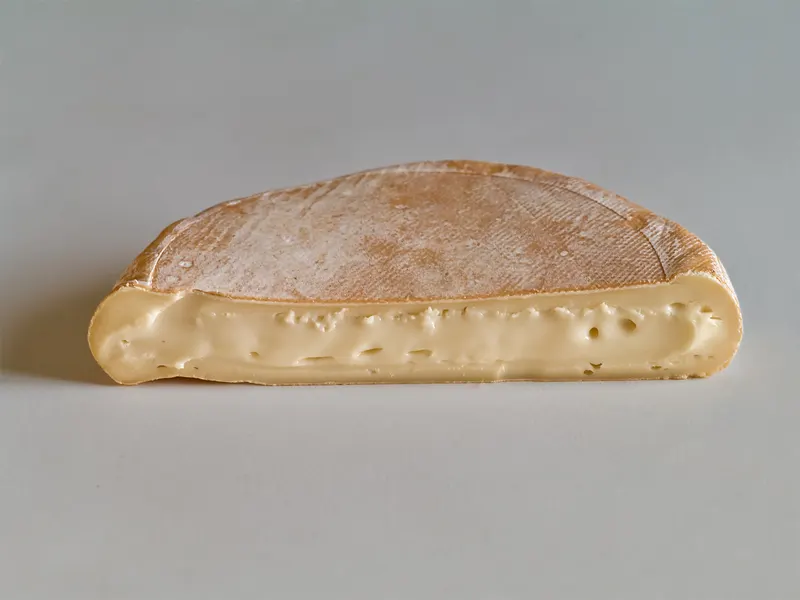
Whole raw cow milk is set with calf rennet at 30–35 °C within a day of milking, cut to grains the size of wheat or maize, and pressed under a weight in small moulds. After salting, the cheese dries in a warm room where it is washed, then ripens in a cool cave until its thin yellow rind is covered with a short white bloom of Geotrichum.
Rind colour only; colouring the paste is banned[cdc-reb2020]
Starter
lactic starter (grand levain) plus selected fungal cultures
Total time across the recorded steps: 1.7 h – 1.8 h
Start
Drag the bar or press Play
What changes:Starting material: whole raw cow milk, used within a day of milking
Step 1 of 7
Use the milk raw within a day
Time
Not documented
Temperature
up to 10 °C
Set
Salt
None given
Acidity
Not documented
Which microbes the steps name, step by step
S. thermophilus
L. delbrueckii
Geotrichum candidum
Yeasts
Geotrichum
Output: whole raw milk.
Flavour
Not documented
Texture
Not documented
Colour
white
Microbes at work in this step
raw-milk flora
Method
Measured measured in a studySet fixed by a specification or tested recipeReported one source reports itTypical a general value, not sourced for this fermentUnconfirmed not yet checked against a source
At a glance
Whole raw cow milk is set with calf rennet at 30–35 °C within a day of milking, cut to grains the size of wheat or maize, and pressed under a weight in small moulds. After salting, the cheese dries in a warm room where it is washed, then ripens in a cool cave until its thin yellow rind is covered with a short white bloom of Geotrichum. Made in 7 steps over 1.7 h – 1.8 h. The longest step, mould and press, takes at least 1.5 h (Ministère de l'agriculture 2020). Lactic starter bacteria; Streptococcus thermophilus and Lactobacillus delbrueckii subsp. bulgaricus in a Reblochon-style study and Geotrichum candidum, which the specification credits with the white bloom on the rind; in a pasteurised-milk Reblochon-style cheese it was the most active microbe on the rind do most of the fermenting.
Reblochon is made from whole raw milk within 24 hours of milking, and farm cheese is made twice a day straight after milking with no chilling. It is pressed under 1.5–2 kg per cheese, washed while drying, and ripened under a white Geotrichum bloom rather than a sticky red smear.
Milk
Whole raw milk from two milkings, stored at 10 °C or less and renneted within 24 h of the oldest milking
Setting
Rennet at 30–35 °C, set in 10–20 min; curd the size of a wheat to maize grain
Pressing
Pressed at 1.5–2 kg per cheese, for at least 1 h 30 min in dairies or 6 h on farms
Washing
Drying room at 14–21 °C, RH above 90%, until day 4 or more, with a compulsory washing
Ripening
In the cave at 10–15 °C, RH above 90%, until day 12 or more; then packed and ripened to at least day 18
Size
About 14 cm across and 3.5 cm high, 450–550 g; fat in dry matter at least 45%
Petit ReblochonAbout 9 cm across, in 9 cm moulds; press weight over 500 g.
Reblochon fermierMade on the farm twice a day with unchilled milk, pressed at least 6 h, at most 0.5 % starter.
Safety
The milk is raw by rule; the specification bans any pasteuriser, thermiser or microfilter in the workshop. The cheese is ripened to at least day 16, or day 18 if packed, well under 60 days. Jones and colleagues (2019) report that two outbreaks of haemolytic uraemic syndrome in France in 2018 were linked to eating Reblochon. The US FDA says ageing raw-milk cheese for 60 days may not eliminate or adequately reduce E. coli O157:H7 and Salmonella, and Listeria may grow in some cheeses while they age. The US CDC says people at higher risk of Listeria infection, including pregnant women, people 65 or older and people with weak immunity, should avoid cheese made from raw milk unless it is heated to 165 °F (74 °C) or until steaming hot.
The specification says the name comes from the word Reblâche, "to milk a second time". The specification says the practice was common from the 13th century. A farmer who rented an alp paid the owner a fee, the cows were not milked out when the owner measured the milk, and the second milking gave a little rich, creamy milk that went into small cheeses. Ripening began on the alp farm and later moved to affineurs in the valleys, and trade in Reblochon grew in the 19th century. It was registered as a PDO on 21 June 1996 (Regulation (EC) No 1107/96).