Side-by-side or overlay PDF diff driven by one engine that reads each file into a structured model — text, vector geometry, images, form fields, annotations — and compares the models. Moves show as moves, edits show only where they happened, and any PDF type works without picking a mode.
Open a STEP / STP part and it measures itself — volume, thinnest wall, draft and undercut checks on load, plus hole detection with a BOM. Measure, section, export STL. Rust + WASM B-rep kernel, runs in your browser.
Cheese from Colombia, Boyacá, the municipalities of Paipa and Sotaquirá
Queso Paipa
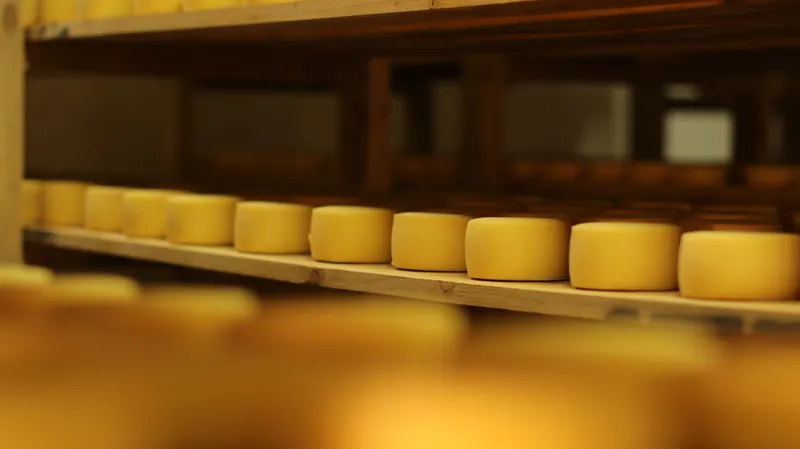
Raw cow milk, mostly hand-milked, has its floating cream skimmed off by hand and is set with rennet with no added starter. The curd is kneaded, pressed and moulded by hand, then ripened on wooden shelves at ambient temperature (12–20 °C) for a standard 21 days, up to 28. It has held a Colombian designation of origin since 2011.
Total time across the recorded steps: 21 days – 28 days
Start
Drag the bar or press Play
What changes:Starting material: raw cow milk with the cream skimmed off by hand
Step 1 of 4
Collect and skim the raw milk
Time
Not documented
Temperature
Not documented
Salt
None given
Acidity
pH 6.5
Set
Which microbes the steps name, step by step
Lactococcus
Enterococcus
Leuconostoc
Streptococcus
The floating cream is removed by hand.
Flavour
Not documented
Texture
Not documented
Colour
Not documented
Microbes at work in this step
Not documented for this step.
Method
Measured measured in a studySet fixed by a specification or tested recipeReported one source reports itTypical a general value, not sourced for this fermentUnconfirmed not yet checked against a source
At a glance
Raw cow milk, mostly hand-milked, has its floating cream skimmed off by hand and is set with rennet with no added starter. The curd is kneaded, pressed and moulded by hand, then ripened on wooden shelves at ambient temperature (12–20 °C) for a standard 21 days, up to 28. It has held a Colombian designation of origin since 2011. Made in 4 steps over 21 days – 28 days. The longest step, ripen on wooden shelves, takes 21–28 days (Castellanos-Rozo J 2020) and runs at 12–20 °C (Castellanos-Rozo J 2020). Lactococcus, the main genus, with Enterococcus, Leuconostoc and Streptococcus does most of the fermenting.
Described in a 2022 study as the one Colombian ripened cheese with a designation of origin; it is made from raw milk without starter and kneaded and pressed entirely by hand.
Composition
About 47.4 % moisture, 21.8 % fat, 24.3 % protein, 2.1 % salt and pH 5.21 under the designation
Area
Paipa and Sotaquirá, Boyacá, about 2581 m above sea level
Made from raw milk with hand handling. A sensory study found Listeria monocytogenes in 3 of its 17 samples. A three-year survey of 16 of the roughly 70 Paipa dairies found Staphylococcus above the Colombian limits in 98 to 100 % of 48 samples, Listeria monocytogenes in 38 % and no Salmonella.
Hazards the sources name: Staphylococcus, relevant in some samples; Listeria monocytogenes, found in 3 samples in a sensory study; Listeria monocytogenes in 38 % of 48 cheese samples from formal and informal Paipa dairies; Staphylococcus above the Colombian limits in 98 to 100 % of samples, with 56 % of the isolates S. aureus; Salmonella was not detected.
The Superintendencia de Industria y Comercio granted the designation in Resolution 70802 of 8 December 2011. About 15 of some 70 producers are formally registered and use the seal.