Side-by-side or overlay PDF diff driven by one engine that reads each file into a structured model — text, vector geometry, images, form fields, annotations — and compares the models. Moves show as moves, edits show only where they happened, and any PDF type works without picking a mode.
Open a STEP / STP part and it measures itself — volume, thinnest wall, draft and undercut checks on load, plus hole detection with a BOM. Measure, section, export STL. Rust + WASM B-rep kernel, runs in your browser.
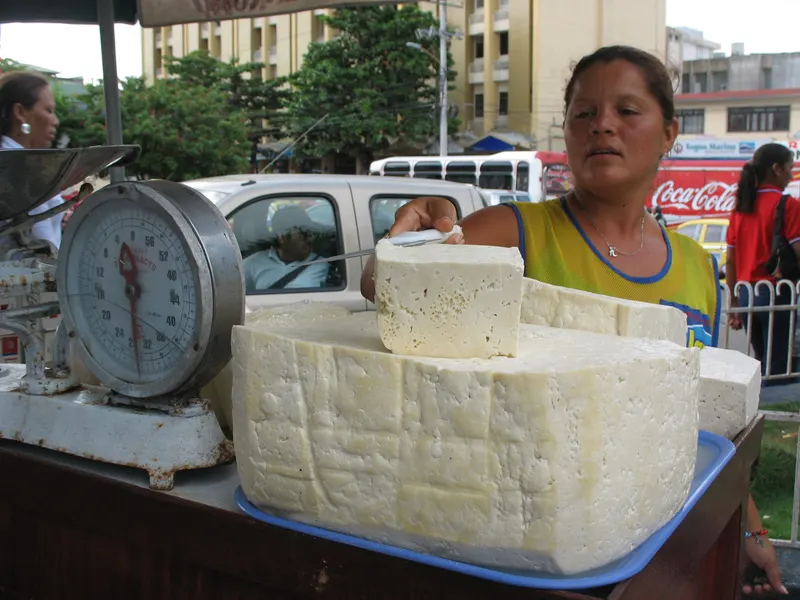
Queso costeño is a firm, salty, white cheese of Colombia's Caribbean region, made by hand from whole fresh cow milk, rennet and salt. The milk is heated, set with rennet, the curd cut into small cubes, salted and pressed in moulds. It is a pressed, unripened cheese, and one Colombian trade article says its high salt content lengthens its shelf life in hot places.
Added with the rennet in a buffalo-milk costeño study; no amount is given[claro2024]
Total time across the recorded steps: 16 h
Start
Drag the bar or press Play
What changes:Starting material: whole fresh cow milk
Step 1 of 7
Take whole fresh cow milk
Time
Not documented
Temperature
Not documented
Salt
None given
Acidity
Not documented
Artisanal costeño is made by hand from raw milk. Raw milk is also the main input in the Valledupar samples.
Flavour
Not documented
Texture
Not documented
Colour
Not documented
Microbes at work in this step
Not documented for this step.
Method
Measured measured in a studySet fixed by a specification or tested recipeReported one source reports itTypical a general value, not sourced for this fermentUnconfirmed not yet checked against a source
At a glance
Queso costeño is a firm, salty, white cheese of Colombia's Caribbean region, made by hand from whole fresh cow milk, rennet and salt. The milk is heated, set with rennet, the curd cut into small cubes, salted and pressed in moulds. It is a pressed, unripened cheese, and one Colombian trade article says its high salt content lengthens its shelf life in hot places. Made in 7 steps over 16 h. The longest step, unmould, rest cold and keep, takes 14 h (Claro Vásquez M.J 2024) and runs at 6–8 °C (Claro Vásquez M.J 2024). Salt is 1–2 % (Claro Vásquez M.J 2024).
Costeño is a pressed, unripened rennet cheese salted heavily, and Contexto Ganadero says the salt lengthens its life where there is no refrigeration. The Andean picado salado is made in a similar way but pressed for less time and with less weight, so it is softer and more moist.
Milk
Whole fresh cow milk, raw in artisanal making
Ripening
None; the cheese is pressed and not ripened, with high salt and low moisture
Buffalo-milk version
pH 5.63, fat 24.91 %, protein 22.99 % and total solids 51.42 % in the cheese judged best by 23 tasters
Queso costeño from buffalo milkMade from buffalo milk in a 2024 study. The milk is pasteurised, cooled to 34–36 °C, set with calcium chloride and rennet, brined and pressed.
Safety
In 360 artisanal samples from 120 shops in Córdoba (2012–2013), total coliforms (97.5 %), faecal coliforms (88.9 %), coagulase-positive staphylococci (41.4 %), moulds (40.4 %) and yeasts (96.1 %) were at values not suitable for consumption. The authors link this to poor handling and to shop conditions, such as inadequate cleaning of floors, walls and ceilings, exposure conditions, ventilation, lighting and improper handling of the product. In 60 samples from Valledupar in 2019, total coliforms were present in every sample and 67 % exceeded the Colombian standard NTC 750. Contexto Ganadero's claim that the salt lengthens shelf life comes with no safety test, and these counts are from cheese on sale.
Hazards the sources name: Total coliforms (97.5 %), faecal coliforms (88.9 %) and coagulase-positive staphylococci (41.4 %) at values not suitable for consumption in 360 artisanal samples from Córdoba.
Contexto Ganadero (4 April 2025) says the knowledge of making costeño is handed between generations and arose from a need to turn milk into something that keeps on farms far from roads and cold chains. A student poster from Caucasia (posted December 2020) says the cheese is at risk of disappearing because it is replaced by an industrial costeño unlike the artisanal one. No source used here gives a dated origin for the cheese.
Starter
The sources we found do not say how its fermentation begins.