Side-by-side or overlay PDF diff driven by one engine that reads each file into a structured model — text, vector geometry, images, form fields, annotations — and compares the models. Moves show as moves, edits show only where they happened, and any PDF type works without picking a mode.
Open a STEP / STP part and it measures itself — volume, thinnest wall, draft and undercut checks on load, plus hole detection with a BOM. Measure, section, export STL. Rust + WASM B-rep kernel, runs in your browser.
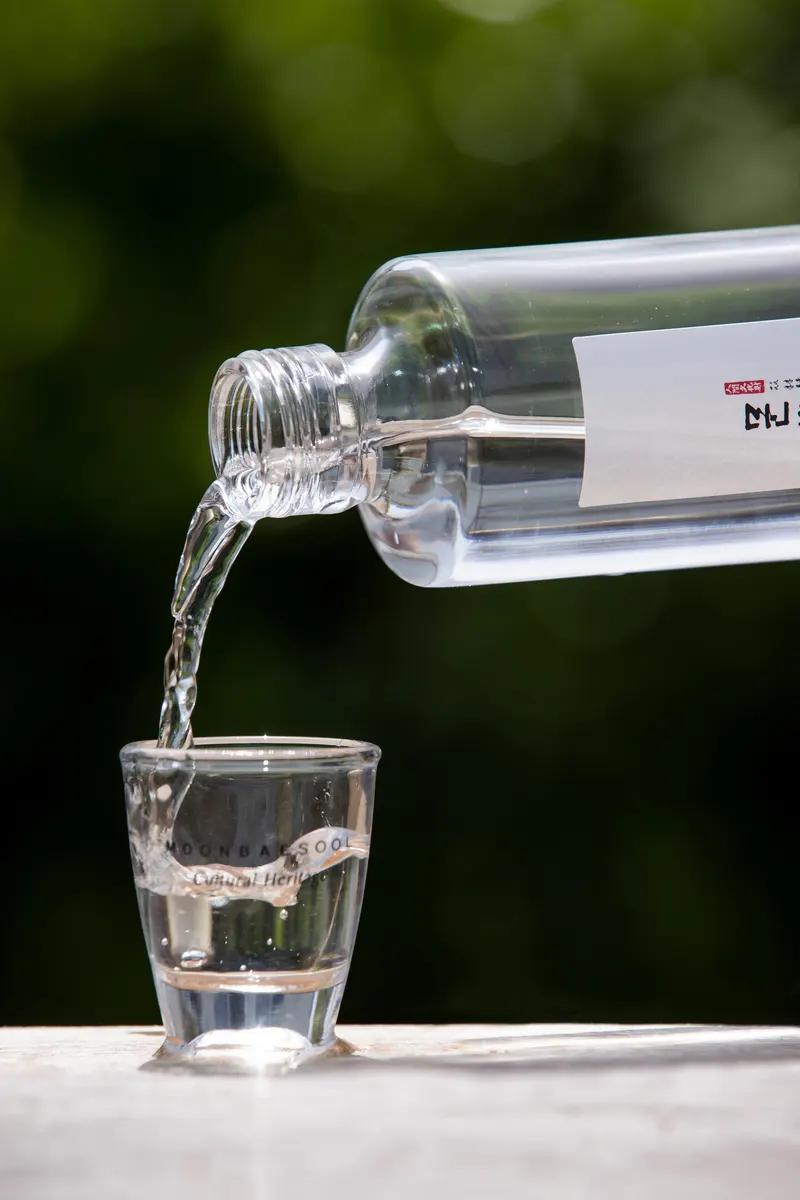
Munbaeju is a clear Korean spirit with a wild-pear (munbae) scent, though no pear goes into it. Korea.net describes a three-stage mash of millet and sorghum started with a watery nuruk, which is then distilled to about 40 % alcohol and aged six to 12 months. The mashing is the atlas part, and the distilling is a boundary step.
Amounts from a sourceThe primary-mash amounts Korea.net gives for one jar (27 L millet, 3.6 L nuruk, 16.6 L water). It gives no amounts for the sorghum mashes, and commercial munbaeju recipes are not published.
Hulled millet, steeped a day and steamed, for the primary mash27 L (1 mal and 5 doe)
Korea.net gives this amount for the primary mash; the sorghum for the later mashes has no amount there[koreanet2014]
Nuruk (the starter; wheat is the usual grain), as a watery nuruk made with 16.6 L of water3.6 L (2 doe)
The primary mash ratio on Korea.net is 27 L millet to 3.6 L nuruk to 16.6 L water[koreanet2014]
Indian millet (sorghum), washed, soaked a day and boiled hard, for the secondary and tertiary mashes
What changes:Pressed wheat dough sits cool for two weeks while fungi grow, then dries in the sun
Step 1 of 6
Make the wheat nuruk
Time
14 days
Reported
Temperature
Not documented
Salt
None given
Acidity
Not documented
Which microbes the steps name, step by step
Aspergillus oryzae
Rhizopus oryzae
Wheat is roughly ground in a millstone, mixed with water into a dough and pressed in a frame. The cakes sit in a cool place so that fungi grow, then dry in the sun. Output: dry nuruk cakes.
Flavour
Not documented
Texture
Not documented
Colour
Not documented
Microbes at work in this step
Not documented for this step.
Method
Measured measured in a studySet fixed by a specification or tested recipeReported one source reports itTypical a general value, not sourced for this fermentUnconfirmed not yet checked against a source
At a glance
Munbaeju is a clear Korean spirit with a wild-pear (munbae) scent, though no pear goes into it. Korea.net describes a three-stage mash of millet and sorghum started with a watery nuruk, which is then distilled to about 40 % alcohol and aged six to 12 months. The mashing is the atlas part, and the distilling is a boundary step. Made in 6 steps over 31 days. The longest step, make the wheat nuruk, takes 14 days (Korea.net (Ministry of Culture 2014). In a survey of Korean nuruk that does not name munbaeju (165 samples, 384 fungal strains), the ten strains picked for amylase activity were Aspergillus oryzae (three), A. flavus (two), Lichtheimia (two), Rhizopus oryzae, Talaromyces spectabilis and Paecilomyces variotii does most of the fermenting.
Its pear scent comes without any pear. In the 1995 study of four traditional sojus, munbaeju soju had the most volatile aroma components, and its fusel oil, with Andong soju's, was lower than that of the other two types.
Mashes of the 1995 study (four traditional types, munbaeju type among them)
Ethanol in the four mashes reached 8.8-11.2 % after 16 days, and the soju distilled from them had 35-40 % ethanol.
Distilling raised fusel oils from 0.09-0.32 mg/ml in the four mashes to 0.35-0.87 mg/ml in the sojus, and furfural, absent from the mashes, appeared in all four sojus. A survey of 165 Korean nuruk samples found two Aspergillus flavus among ten amylase-rich isolates, and under 1.11 ppb total aflatoxins in those ten nuruks. Those ten were picked for their enzymes, not at random. Another survey found 14 of 61 nuruk samples above Korea's 15 ppb limit for cereal products. In drinks made from those high nuruks, only aflatoxin G1 was detected, at 0.3 ppb, a transfer of about 1.2–1.3 % [yun2020]. Neither survey reports a test of munbaeju.
Hazards the sources name: Aflatoxins; in a study of Korean nuruk that does not name munbaeju, two of ten amylase-rich isolates were Aspergillus flavus, and the ten nuruks held less than 1.11 ppb in total; Fusel oils, which rose in the distillate (0.35-0.87 mg/ml in the four sojus of the 1995 study, munbaeju type among them, against 0.09-0.32 mg/ml in the four mashes).
Munbaeju is named for the munbae wild pear, whose scent the spirit carries. Korea.net (2014) says it originated in Pyongyang in the Goryeo Dynasty (918-1392), that it was designated an Important Intangible Cultural Heritage in 1986, and that it was served at the South Korea-Soviet Union summit in 1991. Wikipedia lists it as Important Intangible Cultural Property No. 86-1 in South Korea.