Side-by-side or overlay PDF diff driven by one engine that reads each file into a structured model — text, vector geometry, images, form fields, annotations — and compares the models. Moves show as moves, edits show only where they happened, and any PDF type works without picking a mode.
Open a STEP / STP part and it measures itself — volume, thinnest wall, draft and undercut checks on load, plus hole detection with a BOM. Measure, section, export STL. Rust + WASM B-rep kernel, runs in your browser.
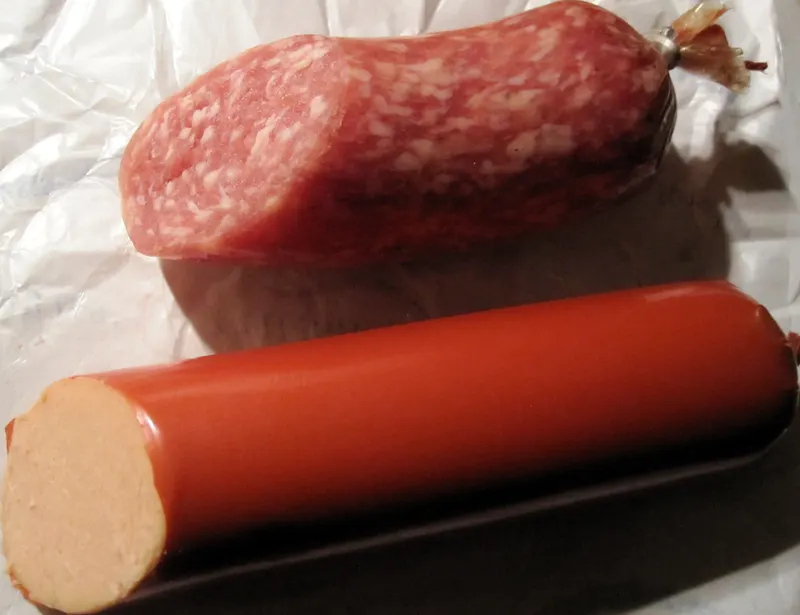
Pork, often with some beef and fat, is minced, mixed with nitrite curing salt and a little sugar, stuffed into casings and ripened for a few days while lactic bacteria sour it. The spreadable kind is usually smoked, dried only a little and kept chilled; firm kinds are dried longer until they slice.
Amounts from a sourceAmounts are percent of the batter for the Mettwurst made in a Swiss challenge study. German guidelines set the meat cuts and minimum meat protein, not a recipe.
The Swiss guidelines say some raw sausages are made with starter cultures[toenz2024][sff2022]
Pepper and other spices
Spreadable types are often seasoned with paprika; coarse Braunschweiger is flavoured with rum[wp-de]
Starter
defined culture (most industrial) or spontaneous
Total time across the recorded steps: 28 h
Start
Drag the bar or press Play
What changes:Cold pork and fat are minced fine
Step 1 of 6
Chill and mince the meat
Time
Not documented
Temperature
Not documented
Salt
None given
Acidity
Not documented
Which microbes the steps name, step by step
Lactic acid bacteria
Latilactobacillus sakei
L. curvatus
L. plantarum
Pediococcus acidilactici
German guidelines call for fine mincing in spreadable Mettwurst. Output: finely minced meat and fat for spreadable types; medium to coarse for firm types.
Flavour
Not documented
Texture
Not documented
Colour
Not documented
Microbes at work in this step
Not documented for this step.
Method
Measured measured in a studySet fixed by a specification or tested recipeReported one source reports itTypical a general value, not sourced for this fermentUnconfirmed not yet checked against a source
At a glance
Pork, often with some beef and fat, is minced, mixed with nitrite curing salt and a little sugar, stuffed into casings and ripened for a few days while lactic bacteria sour it. The spreadable kind is usually smoked, dried only a little and kept chilled; firm kinds are dried longer until they slice. Made in 6 steps over 28 h. The longest step, ripen warm and humid, takes 28 h (Tönz A 2024) and runs at 24 °C (Tönz A 2024). Salt is 2.4 % (Tönz A 2024). Latilactobacillus sakei and Latilactobacillus curvatus, Lactiplantibacillus plantarum, Pediococcus acidilactici and P. pentosaceus do most of the fermenting.
Spreadable Mettwurst is ripened for only a few days and dried very little, so fat coats the meat and it spreads; it must be kept chilled. Firm Mettwurst is ripened and dried longer, like salami.
Braunschweiger MettwurstSpreadable Mettwurst; the coarse Braunschweiger type is flavoured with rum.
Westfälische grobe MettwurstCoarse-grained firm Mettwurst of pork, beef and bacon.
Luftgetrocknete MettwurstAir-dried, coarse to medium grain, usually in pork small intestine.
Zwiebelwurst and Frische MettwurstCoarse-grained; the German guidelines call them unsmoked and meant to be eaten soon after making (Zwiebelmettwurst is listed in the same coarse group but is not called unsmoked).
Safety
Mettwurst is eaten raw. Spreadable types are only lightly dried and must be kept chilled. In a study of a cold-smoking and ripening process for mettwurst, a norovirus model (murine norovirus) fell by only about 1.9 log in the sausage, so a substantial amount of virus would remain in the product. Hepatitis E virus was tested only in solution, where it was inactivated, so the study does not show how it behaves in the sausage. In 2016 Germany's Federal Institute for Risk Assessment (BfR) said it was not fully clarified whether raw sausage passes on the virus, but advised anyone wanting to minimise hepatitis E risk to avoid barely cured raw sausage such as fresh Mettwurst, above all people with weak immunity or liver damage and pregnant women. Never use a concentrated cure mix at the 2.4 % rate given here. A mix of 6.25 % sodium nitrite at that rate would put about 1,500 mg/kg of sodium nitrite in the batter, about 1,000 mg/kg as nitrite ion. That is over 12 times the 80 mg/kg, as nitrite ion, that EU law has allowed to be added to non-heat-treated meat products since 9 October 2025, and the US CDC warns that nitrite poisoning can be fatal.
Hazards the sources name: Listeria monocytogenes; Noroviruses and hepatitis E virus (in a cold-smoking study a norovirus model fell only about 1.9 log in the sausage; hepatitis E virus was tested only in solution, where it was inactivated).