Side-by-side or overlay PDF diff driven by one engine that reads each file into a structured model — text, vector geometry, images, form fields, annotations — and compares the models. Moves show as moves, edits show only where they happened, and any PDF type works without picking a mode.
Open a STEP / STP part and it measures itself — volume, thinnest wall, draft and undercut checks on load, plus hole detection with a BOM. Measure, section, export STL. Rust + WASM B-rep kernel, runs in your browser.
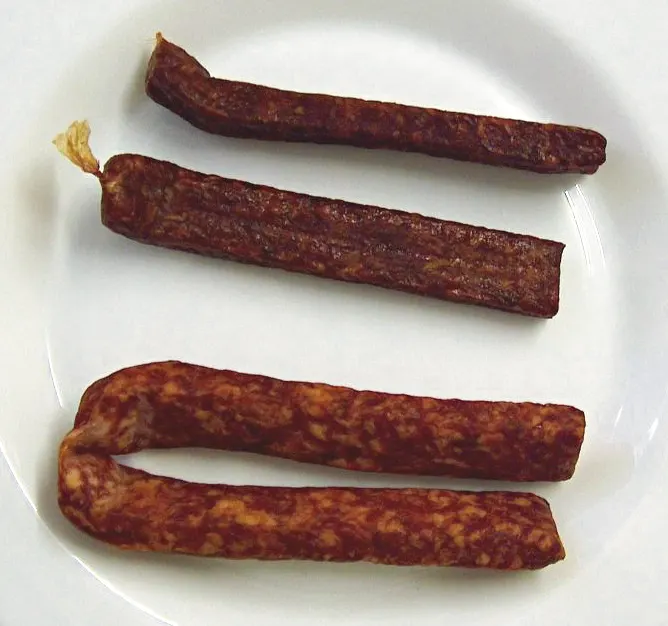
Beef or pork lean is minced with back fat, curing salt and spices such as caraway, pepper and coriander, stuffed in pairs into narrow pork casing and pressed flat. The links are fermented, cold-smoked or air-dried, and eaten raw as a hard, square-sided snack sausage.
Glucono-delta-lactone (E575) is allowed; a starter culture is not required[sff2022]
Starter
a starter culture is not required (Swiss guidelines)
Total time across the recorded steps: 2 days – 3 days
Start
Drag the bar or press Play
What changes:Lean meat is minced and the fat cut coarser so it shows in the slice
Step 1 of 6
Mince lean meat; cut the fat coarser
Time
Not documented
Temperature
Not documented
Salt
None given
Acidity
Not documented
The meat is chopped or bowl-cut; the back fat is cut less fine so it shows in the slice. Output: coarse sausage mix with visible fat.
Flavour
Not documented
Texture
Not documented
Colour
Not documented
Microbes at work in this step
Not documented for this step.
Method
Measured measured in a studySet fixed by a specification or tested recipeReported one source reports itTypical a general value, not sourced for this fermentUnconfirmed not yet checked against a source
At a glance
Beef or pork lean is minced with back fat, curing salt and spices such as caraway, pepper and coriander, stuffed in pairs into narrow pork casing and pressed flat. The links are fermented, cold-smoked or air-dried, and eaten raw as a hard, square-sided snack sausage. Made in 6 steps over 2 days – 3 days. The longest step, press flat, takes 24 h – 2 days (German Wikipedia). Salt is up to 2.5 % (Schweizer Fleisch-Fachverband (SFF) 2022).
Landjäger is stuffed in pairs into narrow pork casing and pressed flat, which gives it its square shape. The Swiss guidelines class it as a firm raw sausage storable unchilled, unlike spreadable Mettwurst.
Appenzeller PantliAn angular pressed raw sausage of beef, pork and bacon from Appenzell, protected as an IGP.
Tiroler LandjägerNot pressed.
Safety
In one challenge study, beef and pork trim was inoculated with E. coli O157:H7, Listeria monocytogenes and Salmonella and sprayed with 4.5 % lactic acid; the sausages were then fermented to pH 4.8, cold smoked and dried to water activity 0.88. Fermenting and drying cut the three pathogens by 3.94, 4.11 and 4.29 log, and by 7.83, 6.19 and 7.21 log over the whole study, which included 20 days of vacuum-packed storage at about 23 °C. The authors conclude that traditional processing may give about a 5 log reduction. That result belongs to that study's controlled process, with the acid spray and a starter culture, and it does not cover a home batch of the recipe here. The sausage is raw meat, and CDC says curing, drying or smoking alone does not consistently kill Trichinella worms. Oregon's rules for shops making dry sausage require certified trichina-free pork, a commercial starter, a pH test and a water-activity test on each batch, and a process shown to cut E. coli O157:H7 by 5 log. The curing salt in this recipe is the weak European kind. US pink curing salt is more than 6 times stronger in nitrite, and swallowing too much nitrite can cause methemoglobinemia, which starves the body of oxygen.
Hazards the sources name: Escherichia coli O157:H7 (inoculated at about 8 log CFU/g in one study; fermenting and drying cut it by 3.94 log); Listeria monocytogenes (same study; cut by 4.11 log); Salmonella (same study; cut by 4.29 log).