Side-by-side or overlay PDF diff driven by one engine that reads each file into a structured model — text, vector geometry, images, form fields, annotations — and compares the models. Moves show as moves, edits show only where they happened, and any PDF type works without picking a mode.
Open a STEP / STP part and it measures itself — volume, thinnest wall, draft and undercut checks on load, plus hole detection with a BOM. Measure, section, export STL. Rust + WASM B-rep kernel, runs in your browser.
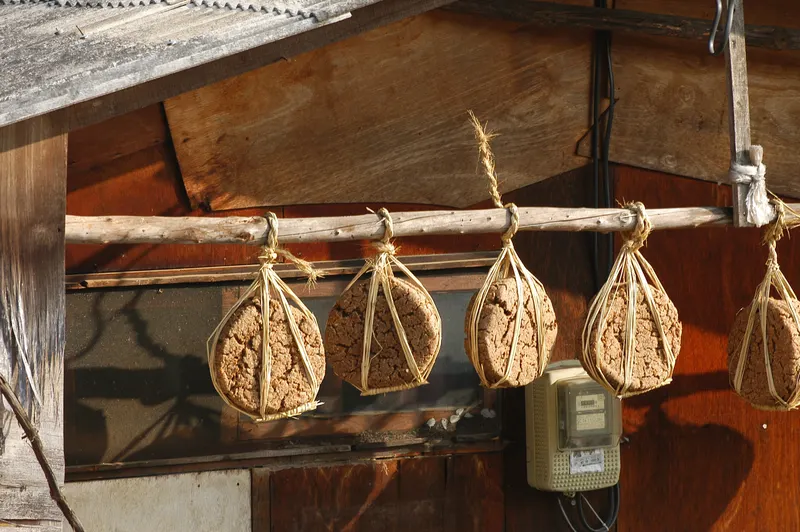
Meju is a brick of steamed, mashed soybeans that dries and ferments for one to two months, often tied with rice straw. Moulds such as Aspergillus and bacteria such as Bacillus do the fermenting. The finished bricks are soaked in salt brine to make ganjang (soy sauce) and doenjang (soybean paste), and ground meju goes into gochujang.
Amounts from a sourceAmounts are from one study that made traditional meju from 40 kg of soybeans. Households work by the brick, with no fixed batch size.
Moulds and bacteria come from the beans, the straw and the air[kim2015][jo2024]
Starter
spontaneous (rice straw and air); factory meju may be inoculated with Aspergillus oryzae
Total time across the recorded steps: 3.7 months
Start
Drag the bar or press Play
What changes:Water soaks into the dry soybeans overnight
Step 1 of 6
Soak the soybeans overnight
Time
Not documented
Temperature
Not documented
Salt
None given
Acidity
Not documented
Which microbes the steps name, step by step
Aspergillus
Moulds
Bacillus
Output: swollen beans.
Flavour
Not documented
Texture
Not documented
Colour
Not documented
Microbes at work in this step
Not documented for this step.
Method
Measured measured in a studySet fixed by a specification or tested recipeReported one source reports itTypical a general value, not sourced for this fermentUnconfirmed not yet checked against a source
At a glance
Meju is a brick of steamed, mashed soybeans that dries and ferments for one to two months, often tied with rice straw. Moulds such as Aspergillus and bacteria such as Bacillus do the fermenting. The finished bricks are soaked in salt brine to make ganjang (soy sauce) and doenjang (soybean paste), and ground meju goes into gochujang. Made in 6 steps over 3.7 months. The longest step, wash and put into brine for jang, takes 2 months (Jo E 2024). Salt is 27.5 % (Jo E 2024). Bacillus and Aspergillus oryzae do most of the fermenting.
Meju is made from soybeans alone, with no grain and no salt, and its moulds come from the straw and the air. Japanese miso koji is grown on rice or barley with a chosen Aspergillus oryzae culture instead.
Royal court mejuMade around the fourth month of the lunar calendar, while meju for home cooking was made around the tenth or twelfth month.
Sunchang gochujang mejuMeju for gochujang in Sunchang is made around August and September; for gochujang the soybeans may be mixed with rice, barley or wheat.
Factory mejuInoculated with an Aspergillus oryzae starter in some factories.
High-temperature meju (study)After the open-air stage, half the bricks were held at 37 °C and 40 % humidity instead of about 10 °C.
Safety
Naturally fermented meju can carry Bacillus cereus. One study found 1.7 × 10³ to 1.8 × 10⁴ CFU/g in meju after 60 days, and says the South Korean food authority reports that more than 10⁴ CFU/g in fermented soybean products may cause food poisoning. A few meju moulds can form aflatoxin. One survey of 533 Aspergillus strains found 14 A. flavus and 2 A. parasiticus. Most other strains in their group (section Flavi) were non-aflatoxin-forming A. oryzae and A. tamari, though that survey told A. oryzae from A. flavus by whether the strain made aflatoxin.
Hazards the sources name: Bacillus cereus (1.7 × 10³ to 1.8 × 10⁴ CFU/g in naturally fermented meju after 60 days); Aspergillus flavus (aflatoxin-forming; 14 of the 533 meju strains in one survey).
Korean records from AD 680 show that jang (soybean jiang) and kan jang (soy sauce) had come into Korea in the customary exchange of gifts between ruling houses (Shurtleff and Aoyagi, citing Wang and Lee 1978). The Samguk sagi reports meju among the wedding presents King Sinmun offered in February 683 (Wikipedia).