Side-by-side or overlay PDF diff driven by one engine that reads each file into a structured model — text, vector geometry, images, form fields, annotations — and compares the models. Moves show as moves, edits show only where they happened, and any PDF type works without picking a mode.
Open a STEP / STP part and it measures itself — volume, thinnest wall, draft and undercut checks on load, plus hole detection with a BOM. Measure, section, export STL. Rust + WASM B-rep kernel, runs in your browser.
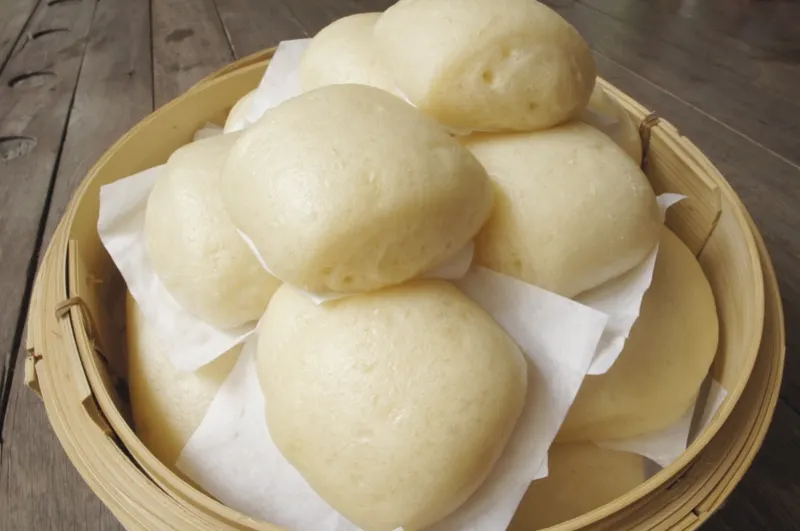
Mantou are plain wheat buns that are steamed, not baked. In the old-dough method a piece of sour dough from the last batch, laomian, leavens the new dough. The sourness is then cancelled by kneading in an alkali, now sodium carbonate, before the buns are shaped, proofed and steamed white and smooth.
Amounts from a sourceA laboratory recipe built on the starter makers' own instructions, from a study of starters from eight northern Chinese cities; it makes several 60 g buns.
One of eight Chinese traditional starters from northern cities in the study[tang2023]
Alkali (food-grade sodium carbonate)0.45 g
Dissolved with the starter in the water in this method[tang2023]
Starter
backslop (laomian, a piece of the last sour dough)
Total time across the recorded steps: 8.4 h
Start
Drag the bar or press Play
What changes:A piece of sour, well-risen dough is kept back from the last batch
Step 1 of 5
Keep a piece of old dough (laomian)
Time
Not documented
Temperature
Not documented
Salt
None given
Acidity
pH 4
Reported
Which microbes the steps name, step by step
Yeasts
Lactic acid bacteria
Laomian is the part of a well-soured, well-risen dough kept back for the next batch. In one study, laomian frozen at −20 °C for six months fermented less well than frozen jiaozi, and steamed bread made from it had the smallest specific volume of the four starters (1.66, against 2.38 for unfrozen jiaozi). Output: laomian, the starter for the next batch.
Flavour
sour
Texture
Not documented
Colour
Not documented
Microbes at work in this step
yeasts and lactic bacteria dominate the old dough
Method
Measured measured in a studySet fixed by a specification or tested recipeReported one source reports itTypical a general value, not sourced for this fermentUnconfirmed not yet checked against a source
At a glance
Mantou are plain wheat buns that are steamed, not baked. In the old-dough method a piece of sour dough from the last batch, laomian, leavens the new dough. The sourness is then cancelled by kneading in an alkali, now sodium carbonate, before the buns are shaped, proofed and steamed white and smooth. Made in 5 steps over 8.4 h. The longest step, mix new dough with laomian and let it rise, takes 8 h (Li H 2024) and runs at 30 °C (Li H 2024). Fructilactobacillus sanfranciscensis, dominant in type I steamed-bread sourdoughs and Saccharomyces cerevisiae and Candida humilis do most of the fermenting.
Sourdough bread is baked and stays sour. Mantou dough is soured by the same kind of starter but then neutralised with alkali, and the buns are steamed, so they stay white and mild.
Leavening
A piece of the last sour dough, not commercial yeast
Alkali
Sodium carbonate cancels the acid; doughs with alkali measured pH 4.47–6.22, against 4.16–5.44 without
Jiaozi-leavened mantouLeavened with jiaozi, a dried starter made from Chinese daqu, maize flour and melon or rice wine; its initial pH is usually above 5, against about 4 for laomian.
BaoziThe same kind of leavened dough, filled.
Safety
Use only food-grade sodium carbonate, in small amounts. The tested dose was 0.45 g per 185 g of flour.
Wikipedia says mantou may have originated in the Qin state under King Zhaoxiang (307–250 BCE), that steamed cakes were written about by Shu Xi around 300 CE, who first called them mantou, and that the word meant filled and unfilled buns until the Song dynasty (960–1279), when baozi came to mean the filled ones. Mantou are the staple of the wheat-growing north.
[yan2019] Yan B. et al. 2019, Microbial diversity in traditional type I sourdough and jiaozi and its influence on volatiles in Chinese steamed bread, LWT 101:764–773, doi:10.1016/j.lwt.2018.12.004 (abstract)paper