Side-by-side or overlay PDF diff driven by one engine that reads each file into a structured model — text, vector geometry, images, form fields, annotations — and compares the models. Moves show as moves, edits show only where they happened, and any PDF type works without picking a mode.
Open a STEP / STP part and it measures itself — volume, thinnest wall, draft and undercut checks on load, plus hole detection with a BOM. Measure, section, export STL. Rust + WASM B-rep kernel, runs in your browser.
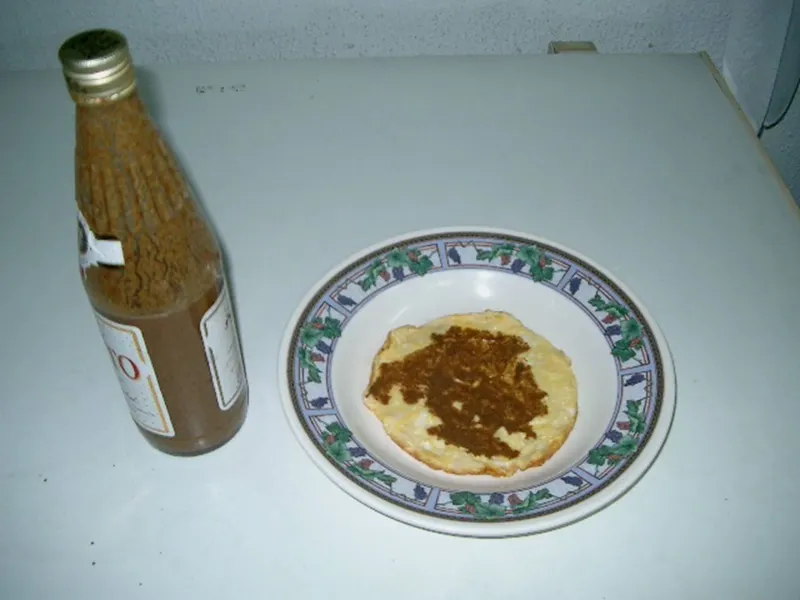
Small sardines or anchovies are mixed with salt and water and left to break down for about a month, stirred every day, until a brown liquid forms. The liquid is strained, mixed with roasted mustard and other spices and set in the sun for about two weeks.
Fully documentedSauces and condiments35 days – 55 days
Recipe
Photo: Unknown author, Public domain, via Wikimedia Commons
Amounts from a sourceThe amounts are from the Kavian and Nateghi laboratory recipe, which follows the traditional ingredients. No source gives a household recipe; traditional sauces measured 7.4–17.1 % salt.
Small sardines or anchovies1 part by weight
Whole, with the guts; Kavian and Nateghi also tested tuna[kavian2022]
spontaneous, according to Ghayoomi et al. 2024, who say fish fermentation in general depends on spontaneous fermentation
Total time across the recorded steps: 35 days – 55 days
Start
Drag the bar or press Play
What changes:Whole small fish go into salty water, which starts to draw water out of them
Step 1 of 4
Mix the fish with salt and water
Time
Not documented
Temperature
Not documented
Salt
15–35 %
Reported
Acidity
Not documented
Which microbes the steps name, step by step
Lactic acid bacteria
Output: fish in salty brine.
Flavour
Not documented
Texture
Not documented
Colour
Not documented
Microbes at work in this step
Not documented for this step.
Method
Measured measured in a studySet fixed by a specification or tested recipeReported one source reports itTypical a general value, not sourced for this fermentUnconfirmed not yet checked against a source
At a glance
Small sardines or anchovies are mixed with salt and water and left to break down for about a month, stirred every day, until a brown liquid forms. The liquid is strained, mixed with roasted mustard and other spices and set in the sun for about two weeks. Made in 4 steps over 35 days – 55 days. The longest step, ferment, stirring every day, takes 25–40 days (Ghayoomi H 2024) and runs at 37–39 °C (Ghayoomi H 2024). Salt is 15–35 % (Kavian F 2022). Lactic acid bacteria and Streptococcus, Micrococcus and Bacillus do most of the fermenting.
Mahyawa ferments for only about a month, far shorter than the 5 to 18 months given for Thai nam pla, and it is finished with roasted mustard and spices and set in the sun. Its salt is often lower, and very high histamine has been measured in it.
SuraghNamed by Kavian and Nateghi as another name for mahyaveh.
Low-salt mahyavehLab version with 12.65 % salt brine held at 39 °C for 40 days. Histamine rose from 6.25 mg/kg on day 5 to 43.49 mg/kg on day 40, fastest after day 20. That is under the Codex and EU limits, but one small batch from dried anchovies does not show that low salt is safe.
Safety
Histamine is the main hazard. Codex caps fish sauce at 40 mg histamine per 100 g, and the EU at 400 mg/kg. In 66 traditional mahyaveh samples, histamine ran from none detected to 7916 mg/kg. An untreated control batch in a lab test measured 16 339 mg/kg on day 30. Cooking or freezing cannot remove histamine once it has formed (FDA). Salt was 7.4–17.1 % in traditional sauces, while Codex expects at least 200 g/L (20 g per 100 ml). In one lab trial, more salt and longer fermentation lowered microbe counts, including Enterobacteriaceae, but in a 12.65 % lab batch histamine-forming bacteria and histamine still rose over 40 days. That batch stayed at pH 5.39–6.50, above the pH 4.6 minimum the FDA lists for Clostridium botulinum. The FDA also lists it as able to grow at up to 10 % salt in the food's water, so salt at the low end of the 7.4–17.1 % range is no barrier to it in a closed jar. No source tests a home method, so treat the steps here as a record, not instructions.
Hazards the sources name: Enterobacteriaceae (up to 4.4 log cfu/ml at 15 % salt and 30 days; fewer with more salt and time); Histamine-forming bacteria (3.00 → 4.58 log cfu/ml over 40 days).
Mahyawa is traditional in the southern provinces of Iran, including Fars and Hormozgan, and no quality control measures are applied in its traditional production. Zarei and colleagues studied the chemical and microbial properties of 66 local sauces in 2012. Laboratory studies since 2019 have tested spice oils on its histamine, and salt, fish type and fermentation time on its microbe counts.
[hajimohammadi2019] Hajimohammadi B., Raeisi M., Eftekhar E., Mohebat R., Saffari A. 2019, Studying the effect of Allium sativum and Bunium persicum essential oils on histamine production in Mahyaveh, Journal of Food Safety, doi:10.1111/jfs.12590 (abstract)paper