Side-by-side or overlay PDF diff driven by one engine that reads each file into a structured model — text, vector geometry, images, form fields, annotations — and compares the models. Moves show as moves, edits show only where they happened, and any PDF type works without picking a mode.
Open a STEP / STP part and it measures itself — volume, thinnest wall, draft and undercut checks on load, plus hole detection with a BOM. Measure, section, export STL. Rust + WASM B-rep kernel, runs in your browser.
Thick steaks of Atlantic bonito are cleaned, soaked in cold brine and packed in layers of dry salt under a weight, then ripened in the cold for weeks. This is a salt cure, not a microbial ferment. Salt draws water out while the fish's own enzymes change its texture, and bacterial numbers stay low.
Amounts from a sourcePer 1 kg of bonito slices, from a 2025 study that followed the traditional method. An earlier study used fish and salt at 5 to 1 by weight.
Atlantic bonito, gutted, head and tail off, cut into chunks about 4 cm thick1 kg
Ice-cold 5 % salt water, then plain ice waterAs needed
For soaking the chunks clean before salting[altan2025]
Total time across the recorded steps: 10 days – 20 days
Start
Drag the bar or press Play
What changes:The bonito is gutted and cut into thick chunks, and the backbone is cleaned out
Step 1 of 5
Gut and cut into thick chunks
Time
Not documented
Temperature
Not documented
Salt
None given
Acidity
Not documented
Head and tail are cut off, the guts removed, and a thin skewer is pushed along the backbone to clean out the spinal cord. Output: bonito chunks about 4 cm thick.
Flavour
Not documented
Texture
Not documented
Colour
Not documented
Microbes at work in this step
Not documented for this step.
Method
Measured measured in a studySet fixed by a specification or tested recipeReported one source reports itTypical a general value, not sourced for this fermentUnconfirmed not yet checked against a source
At a glance
Thick steaks of Atlantic bonito are cleaned, soaked in cold brine and packed in layers of dry salt under a weight, then ripened in the cold for weeks. This is a salt cure, not a microbial ferment. Salt draws water out while the fish's own enzymes change its texture, and bacterial numbers stay low. Made in 5 steps over 10 days – 20 days. The longest step, ripen in the cold in its own brine, takes 10–20 days (Altan C.O. 2025) and runs at 3–5 °C (Altan C.O. 2025). Salt is 5 % (Altan C.O. 2025).
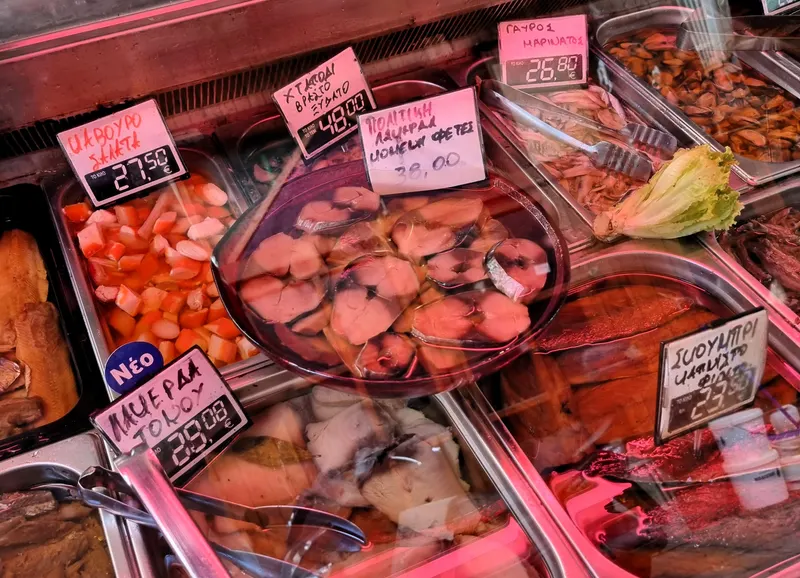
Lakerda is a dry salt cure of bonito steaks, ripened cold. Unlike pla ra or rakfisk there is no lactic stage and no rice or sugar; salt and the fish's own enzymes do the work.
Lakerda from young tunaMade the same way from young tuna instead of bonito.
Safety
At 4 °C, bacteria and yeasts did not multiply over 6 months in salted bonito. Biogenic amines fell during ripening in one study, to 63.93–68.79 mg/kg in total in the finished product; the FDA warns that histamine can form while fish is salted until the product is shelf-stable, that refrigeration holds it back, and that cooking or freezing cannot remove it once formed. So keep the fish cold from the start. Since 2024 the FDA treats 35 ppm histamine in one sample unit as decomposition and 200 ppm as the level where illness is possible. Lakerda is eaten without cooking, and salt does not reliably kill parasites in raw fish. The FDA says brining does not eliminate that hazard and that nematode larvae have survived 28 days in brine of 21 % salt. It gives −20 °C for 7 days as enough to kill parasites, so freeze the fish first.
Salted bonito and tuna have long been made on the Black Sea and Mediterranean coasts so that fish can be eaten out of season (Altan 2025). Wikipedia, citing Dalby (2003), says lakerda is very similar to an ancient Greek dish, tarikhos horaion, "ripe salted fish".
Starter
The sources we found do not say how its fermentation begins.