Side-by-side or overlay PDF diff driven by one engine that reads each file into a structured model — text, vector geometry, images, form fields, annotations — and compares the models. Moves show as moves, edits show only where they happened, and any PDF type works without picking a mode.
Open a STEP / STP part and it measures itself — volume, thinnest wall, draft and undercut checks on load, plus hole detection with a BOM. Measure, section, export STL. Rust + WASM B-rep kernel, runs in your browser.
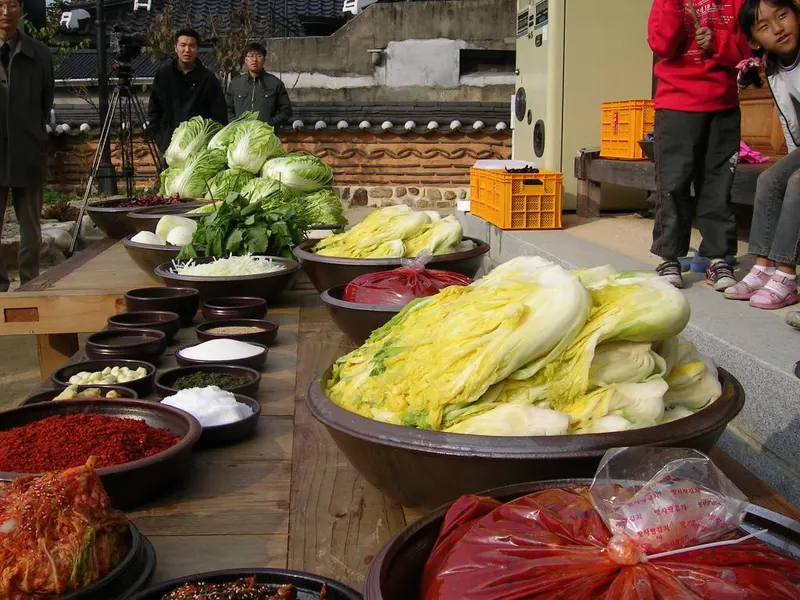
Kimjang is the late-autumn making of a winter's kimchi by families and neighbours together. The kimchi was packed into large earthenware jars (onggi) that were kept outside or buried in the ground under straw, so it stayed cold and ripened slowly for months; today kimchi refrigerators do the same job.
Amounts from a sourceA household tradition with no fixed recipe. The amounts describe one family's kimjang, as given in a 2022 review; each kimchi has its own recipe entry.
Napa cabbage, made into whole-cabbage kimchiAbout 50 heads
What a typical extended family prepares at kimjang[surya2022]
Shrimp, anchovy and other seafood, salted in spring
spontaneous, as described for kimchi in general, whose bacteria are present naturally on the cabbages and other raw materials (Surya 2022)
Total time across the recorded steps: 14 days – 2.8 months
Start
Drag the bar or press Play
What changes:Through the year the household salts seafood, buys salt and dries chilli for kimjang
Step 1 of 5
Gather the seasonings through the year
Time
Seafood is salted in spring, salt bought in summer and chilli dried and ground in late summer
Reported
Temperature
Not documented
Salt
None given
Acidity
Not documented
Which microbes the steps name, step by step
Leuconostoc spp.
Lactobacillus spp.
Leuconostoc
Flavour
Not documented
Texture
Not documented
Colour
Not documented
Microbes at work in this step
Not documented for this step.
Method
Measured measured in a studySet fixed by a specification or tested recipeReported one source reports itTypical a general value, not sourced for this fermentUnconfirmed not yet checked against a source
At a glance
Kimjang is the late-autumn making of a winter's kimchi by families and neighbours together. The kimchi was packed into large earthenware jars (onggi) that were kept outside or buried in the ground under straw, so it stayed cold and ripened slowly for months; today kimchi refrigerators do the same job. Made in 5 steps over 14 days – 2.8 months. The longest step, ripen slowly through the winter, takes 14 days – 2.8 months (Lee E.-H 2012) and runs at -2.5–-1 °C (Lee E.-H 2012). Leuconostoc spp., which grew fully even at −2.5 °C in stored winter kimchi and Lactobacillus spp., which grew more after a short warm start than in kimchi stored cold from the first day do most of the fermenting.
This entry is a way of keeping kimchi, not a kind of kimchi. Burying the jars held the kimchi cold and steady through winter. Kimchi refrigerators, invented in the 1980s, now do this in most Korean homes.
Kimchi refrigerator storageA home appliance invented in the 1980s, with a ripening mode and a storage mode near −1 to −2.5 °C; most Korean households now own one.
Jars kept outside the houseLarge jars stood outdoors instead of being buried.
Safety
No safety limits specific to buried storage were found. Cold storage slows souring; in the 2012 study, kimchi stored near freezing for 6 months stayed acceptable.
Kimjang is described as a family ritual of autumn that began thousands of years ago, to ensure kimchi through a winter of 3–4 months when vegetables were scarce, and it later took in neighbours and whole villages. It has been listed as UNESCO Intangible Cultural Heritage of Humanity since 2013 (Surya 2022; Wikipedia gives December 2013). Kimchi refrigerators, invented in the 1980s, now do the job of the buried jar.