Side-by-side or overlay PDF diff driven by one engine that reads each file into a structured model — text, vector geometry, images, form fields, annotations — and compares the models. Moves show as moves, edits show only where they happened, and any PDF type works without picking a mode.
Open a STEP / STP part and it measures itself — volume, thinnest wall, draft and undercut checks on load, plus hole detection with a BOM. Measure, section, export STL. Rust + WASM B-rep kernel, runs in your browser.
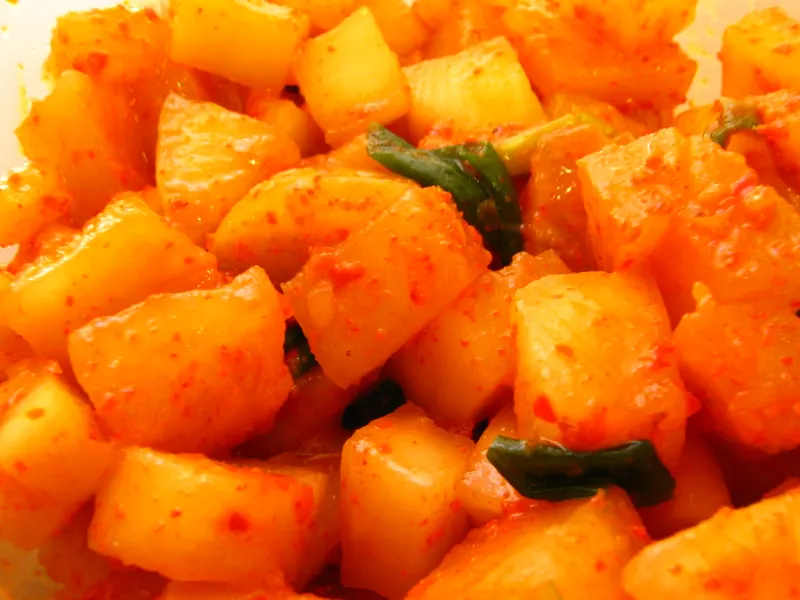
Korean radish is cut into cubes, salted briefly and coated in a paste of chilli powder, garlic, ginger and salted seafood. A few hours to a few days at room temperature start the lactic ferment, and it then ripens cold until sour and crunchy.
Amounts from a sourceThe amounts are per 100 g of salted radish, from the National Institute of Agricultural Sciences standard recipe as used in a 2019 study, with the salt of the finished mix set at 2.5 %.
Salted radish cubes (2 cm)100 g
Soaked 30 min in 10 % brine, rinsed three times, drained 3 h[jin2019kk]
spontaneous, as described for kimchi in general, which ferments through lactic acid bacteria naturally occurring in the raw materials (a review quoted by Maoloni 2020). The control groups of the 2019 study had no inoculum added.
Total time across the recorded steps: 50 days – 53 days
Start
Drag the bar or press Play
What changes:Korean radish is cut into cubes
Step 1 of 5
Cube the radish
Time
Not documented
Temperature
Not documented
Salt
None given
Acidity
Not documented
Which microbes the steps name, step by step
Leuconostoc
Weissella
Lactobacillus
Lactic acid bacteria
Smaller cubes soured faster in the first 5 days. Output: radish cubes.
Flavour
Not documented
Texture
Not documented
Colour
Not documented
Microbes at work in this step
Not documented for this step.
Method
Measured measured in a studySet fixed by a specification or tested recipeReported one source reports itTypical a general value, not sourced for this fermentUnconfirmed not yet checked against a source
At a glance
Korean radish is cut into cubes, salted briefly and coated in a paste of chilli powder, garlic, ginger and salted seafood. A few hours to a few days at room temperature start the lactic ferment, and it then ripens cold until sour and crunchy. Made in 5 steps over 50 days – 53 days. The longest step, ripen cold, takes 50 days (Choi H.W 2023) and runs at 4 °C (Choi H.W 2023). Salt is 10 % (Jin Y.H 2019). Leuconostoc, Weissella and Lactobacillus, the main lactic bacteria and Levilactobacillus brevis, the main tyramine maker among the isolates do most of the fermenting.
Kkakdugi is cut into cubes before salting. In a 2023 study, smaller cubes soured faster than larger ones in the first 5 days. Chonggak kimchi uses small ponytail radishes instead.
SeokbakjiRadish, cabbage and other vegetables cut and mixed together; early 20th-century cookbooks often mixed cabbage into kkakdugi too.
Seogeori-kkakdugiKkakdugi made with pollack gills, as it is called in Gangwon (Folk Encyclopedia).
Safety
Retail kkakdugi averaged pH 4.16. Some retail radish kimchi samples held histamine above the toxicity limit, much of it from anchovy sauce, and Levilactobacillus brevis was the main tyramine maker. Using less anchovy sauce, or a low-amine one, lowers biogenic amines.
The Folk Encyclopedia traces radish kimchi salted and mixed with jeotgal back to the 18th-century Somun sasol, whose kkakdugi was cut radish and chilli powder mixed in strained shrimp jeotgal. The late-1800s Siuijeonseo gives a jeotmu recipe with shrimp jeotgal, chilli powder, spring onion and garlic. The name kkakdugi first appears in an 18th-century pansori, Chunhyangga. Sugar came into use in the 20th century to keep the crunch and take away the radish's bitterness, and radish-only kkakdugi became the standard side dish of the seolleongtang restaurants of early 20th-century Seoul.