Side-by-side or overlay PDF diff driven by one engine that reads each file into a structured model — text, vector geometry, images, form fields, annotations — and compares the models. Moves show as moves, edits show only where they happened, and any PDF type works without picking a mode.
Open a STEP / STP part and it measures itself — volume, thinnest wall, draft and undercut checks on load, plus hole detection with a BOM. Measure, section, export STL. Rust + WASM B-rep kernel, runs in your browser.
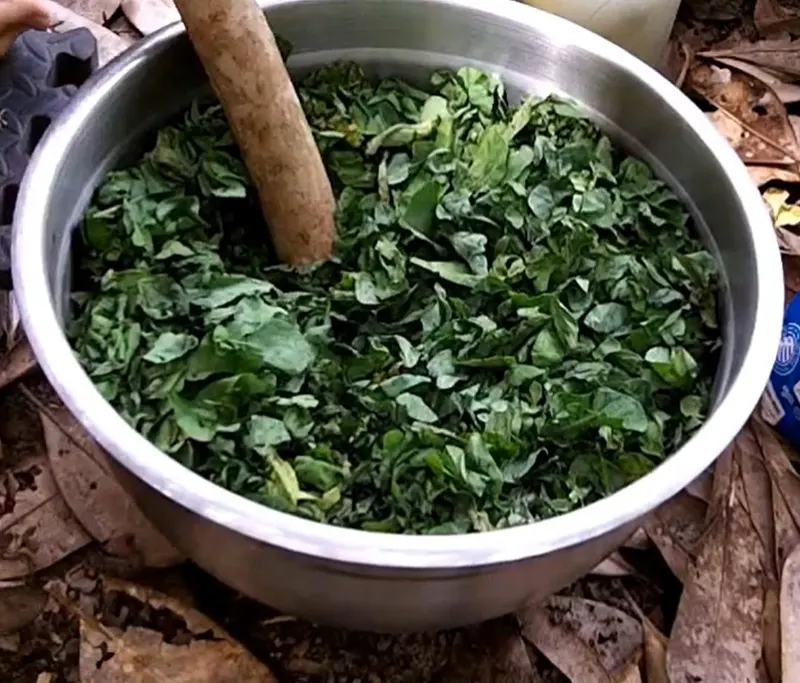
Kawal is the leaf of sicklepod (Senna obtusifolia), pounded to a green paste and fermented for 3 to 4 weeks in a jar or bag sunk in a shaded pit, then moulded into small balls and sun-dried. It is a boundary entry because it is a leaf ferment that works like a seed condiment. Bacillus bacteria break down the leaf protein to ammonia in an alkaline fermentation, as in dawadawa, not a lactic souring, and it is eaten as a meat substitute.
No fixed amounts recordedTraditional small-scale process with no fixed amounts; the leaf is the whole recipe.
Fresh green sicklepod leaves
Picked in the rainy season, sorted by hand and not washed[idriss2019]
Fresh sorghum leaves
In the Sudanese method described on Wikipedia the paste is covered with fresh sorghum leaves and weighed down with clean stones; the Chad survey does not mention them[wp-kawal]
Starter
spontaneous
Total time across the recorded steps: 17 days – 33 days
Start
Drag the bar or press Play
What changes:Starting material: fresh sicklepod leaves, sorted by hand
Step 1 of 4
Pick and sort the leaves
Time
Not documented
Temperature
Not documented
Salt
None given
Acidity
Not documented
Which microbes the steps name, step by step
Bacillus
The leaves are picked when the plant is fully grown in the rainy season, and petals, other leaves and insect-damaged leaves are picked out. The leaves are not washed.
Flavour
Not documented
Texture
Not documented
Colour
Not documented
Microbes at work in this step
Not documented for this step.
Method
Measured measured in a studySet fixed by a specification or tested recipeReported one source reports itTypical a general value, not sourced for this fermentUnconfirmed not yet checked against a source
At a glance
Kawal is the leaf of sicklepod (Senna obtusifolia), pounded to a green paste and fermented for 3 to 4 weeks in a jar or bag sunk in a shaded pit, then moulded into small balls and sun-dried. It is a boundary entry because it is a leaf ferment that works like a seed condiment. Bacillus bacteria break down the leaf protein to ammonia in an alkaline fermentation, as in dawadawa, not a lactic souring, and it is eaten as a meat substitute. Made in 4 steps over 17 days – 33 days. The longest step, ferment in a covered jar sunk in a shaded pit, takes 14–28 days (Abakar Idriss L 2019). Bacillus subtilis, B. licheniformis, B. pumilus and B. amyloliquefaciens does most of the fermenting.
Most leaf ferments are lactic and sour. Kawal is alkaline and Bacillus-driven, like dawadawa and other African seed condiments, and its pH stays near neutral. It is a vegetable by substrate but a protein condiment by chemistry.
A Chad survey describes household production with simple equipment, uncontrolled fermentation and poor hygiene. In 20 purchased samples, presumptive Staphylococcus reached up to 3.7 × 10^7 CFU/g and enterobacteria appeared in two; the authors rated the microbial quality good on a general scale, noting that the ICMSF recommends no criteria for fermented vegetables, and the dried balls held 7.5 to 10 % moisture. The Staphylococcus was not typed. If it was S. aureus, cooking can kill the cells but does not destroy a toxin already made in the food (CDC). The raw plant is described as toxic. In a 1987 feeding trial, broiler chicks given kawal at 25, 50 and 100 g/kg of feed grew more slowly and developed organ lesions, and the authors called even 25 g/kg unacceptable as a protein supplement. That is an animal study, not a human one.
Hazards the sources name: Staphylococcus sp. (presumptive, not typed to species; 1.5 × 10^3 to 3.7 × 10^7 CFU/g in market samples, possibly from handling); Enterobacteria, found in two of the samples (below 10 to 1.6 × 10^2 CFU/g).
Kawal is indigenous to western Sudan, mainly Kordofan and Darfur, and eastern Chad. In Chad the know-how passes from mother to daughter, and rural women do most of the processing. A survey of 186 people in eastern and central Chad found 62 active producers, 54 who had made it in the past and 70 producers and sellers. In Sudan its strong smell led the elite to count it a low-status food, yet it has spread across the country.