Side-by-side or overlay PDF diff driven by one engine that reads each file into a structured model — text, vector geometry, images, form fields, annotations — and compares the models. Moves show as moves, edits show only where they happened, and any PDF type works without picking a mode.
Open a STEP / STP part and it measures itself — volume, thinnest wall, draft and undercut checks on load, plus hole detection with a BOM. Measure, section, export STL. Rust + WASM B-rep kernel, runs in your browser.
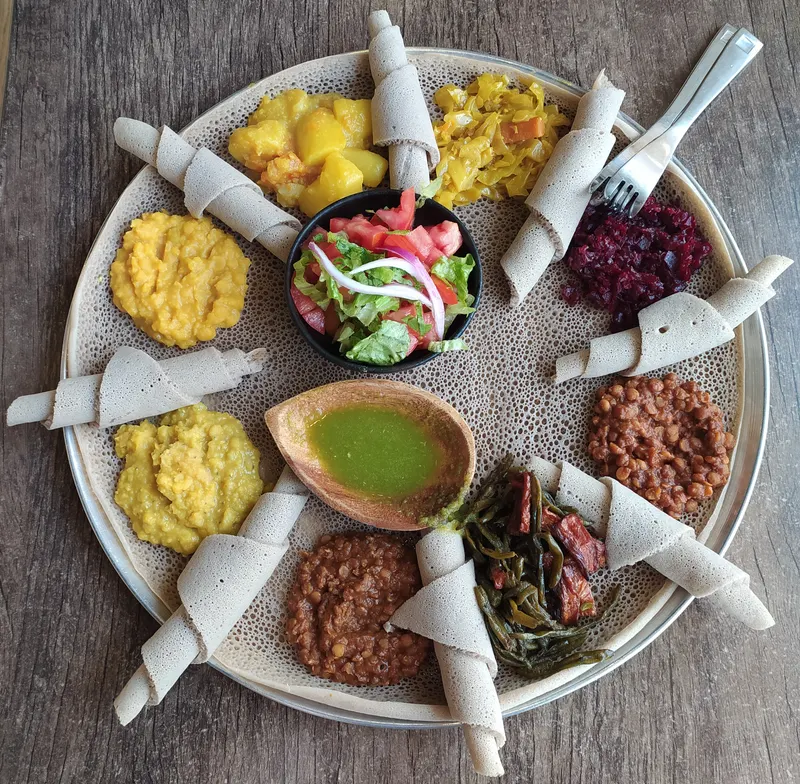
Teff flour, water and yellow starter liquid (ersho) saved from the last batch ferment for one to three days into a sour batter. A part is boiled into absit and stirred back for a second rise, then the batter is steam-baked on a hot griddle into a thin, spongy flatbread covered in small holes.
Amounts from a sourceThe sources read give no fixed amounts of flour or water. Keyeta 2021 says a starter culture is typically added at 1:1.6 w/v. For absit, about 10% of the fermented batter is boiled with three parts water.
Total time across the recorded steps: 25 h – 3.1 days
Start
Drag the bar or press Play
What changes:The saved yellow starter is stirred into teff flour and water
Step 1 of 7
Mix teff flour, water and ersho
Time
Not documented
Temperature
Not documented
Salt
None given
Acidity
Not documented
Which microbes the steps name, step by step
Lactic acid bacteria
Yeasts
Saccharomyces
Kazachstania humilis
Saccharomyces cerevisiae
Output: fresh batter.
Flavour
Not documented
Texture
thin, watery paste
Colour
Not documented
Microbes at work in this step
ersho brings in yeasts and lactic acid bacteria
Method
Measured measured in a studySet fixed by a specification or tested recipeReported one source reports itTypical a general value, not sourced for this fermentUnconfirmed not yet checked against a source
At a glance
Teff flour, water and yellow starter liquid (ersho) saved from the last batch ferment for one to three days into a sour batter. A part is boiled into absit and stirred back for a second rise, then the batter is steam-baked on a hot griddle into a thin, spongy flatbread covered in small holes. Made in 7 steps over 25 h – 3.1 days. The longest step, first fermentation, takes 24 h – 3 days (Mengesha Y 2022) and runs at 17–25 °C (Keyeta G.T. 2021). Kazachstania humilis (Candida milleri), in over 80% of household samples and dominant in ersho and Saccharomyces cerevisiae do most of the fermenting.
Injera is fermented twice in one container, with a boiled part of the batter (absit) added between the two rises. Teff has very little gluten, and the holes ("eyes") of the honeycomb-like top come from carbon dioxide bubbles that escape as the batter cooks on the mitad.
Aflegna (sweet, young injera)Fermented only 12–24 h; thick, sweet, with a reddish-brown underside.
KomtataMade from over-fermented, very sour batter.
White injeraWhere injera is a staple food, in Ethiopia and Eritrea, people prefer it white in colour.
Sorghum injeraSorghum flour kneaded with water, fermented 48 h with saved yellow liquid, thinned and baked.
Mixed-flour injeraTeff blended with sorghum, maize, barley or wheat flour; the rising price and falling output of teff led people to use other flours.
Safety
Souring holds pathogens back, but only once it has taken hold. In a challenge study, Salmonella, S. aureus and B. cereus grew in fermenting teff until about 30 h or pH 4.7, then declined [nigatu1994].
Hazards the sources name: Salmonella, Staphylococcus aureus and Bacillus cereus grew in fermenting teff until about 30 h or pH 4.7, then declined.
Studies of the kingdom of Aksum show teff was grown there, and a clay tray like the injera griddle appeared around the sixth century, but no scholar calls injera the kingdom's staple food. Eating teff spread over about 250 years from the 1520s, and round teff flatbreads were the staple of northern Ethiopia by the early 1750s; famines from wars and climate change helped (Ishikawa 2023). Other Ethiopian ethnic groups adopted injera in the 20th century. FAO calls it the undisputed national bread of Ethiopia, and it is also served in Eritrea.
[ashenafi1994] Ashenafi M. 1994, Microbial flora and some chemical properties of ersho, a starter for teff (Eragrostis tef) fermentation, World Journal of Microbiology and Biotechnology 10:69–73, doi:10.1007/BF00357567paper
[nigatu1994] Nigatu A., Gashe B.A. 1994, Inhibition of spoilage and food-borne pathogens by lactic acid bacteria isolated from fermenting tef (Eragrostis tef) dough, Ethiopian Medical Journal 32(4):223–229, PMID 7835350paper