Side-by-side or overlay PDF diff driven by one engine that reads each file into a structured model — text, vector geometry, images, form fields, annotations — and compares the models. Moves show as moves, edits show only where they happened, and any PDF type works without picking a mode.
Open a STEP / STP part and it measures itself — volume, thinnest wall, draft and undercut checks on load, plus hole detection with a BOM. Measure, section, export STL. Rust + WASM B-rep kernel, runs in your browser.
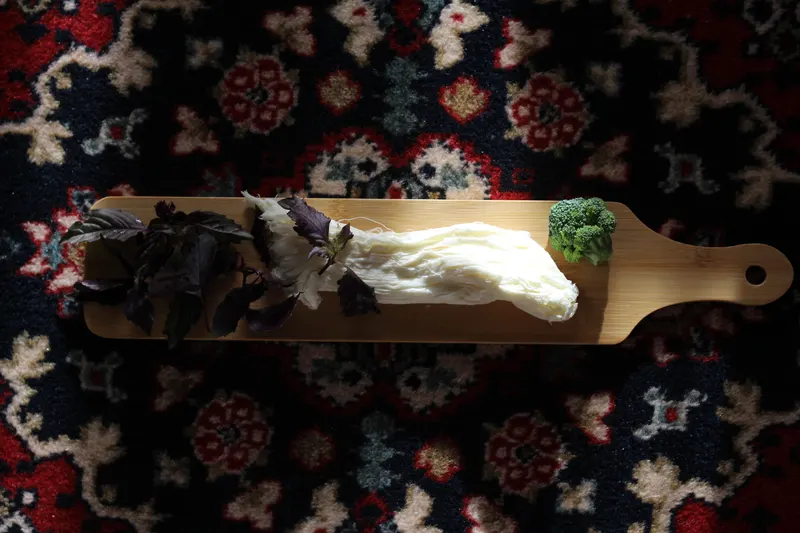
Skimmed cow milk is left to sour, then set and heated with stirring until the curd pieces stick together and can be pulled into threads by hand. The threads are coiled, cooled and tied into rope-like bundles of white, salty cheese that smells of cultured milk; a smoked form also exists.
No fixed amounts recordedThe Georgian specification gives no amounts; a finished bundle weighs 0.5–3 kg. Its salt figure (4–8 %) sits in a block headed for Megruli sulguni, so it is not used here.
Skimmed cow milk
Ripened to 45–50 °T acidity before setting, in the Georgian specification[meskh-spec]
Salt
The finished cheese tastes quite salty[meskh-spec]
Starter
In Armenia the milk is soured, with salt or vinegar added by some households to speed it, and sometimes it curdles on its own without a ferment (Harutyunyan 2025)
Total time across the recorded steps: 5 min – 10 min
Start
Drag the bar or press Play
What changes:Skimmed cow milk is left to sour before it is set
Step 1 of 5
Let the skimmed milk sour
Time
Not documented
Temperature
Not documented
Salt
None given
Acidity
Not documented
In Armenia the cheese is made from sour milk; some households add salt or vinegar to sour it faster, and sometimes the milk curdles on its own without a ferment (Harutyunyan 2025). Output: soured skimmed milk.
Flavour
Not documented
Texture
Not documented
Colour
Not documented
Microbes at work in this step
Not documented for this step.
Method
Measured measured in a studySet fixed by a specification or tested recipeReported one source reports itTypical a general value, not sourced for this fermentUnconfirmed not yet checked against a source
At a glance
Skimmed cow milk is left to sour, then set and heated with stirring until the curd pieces stick together and can be pulled into threads by hand. The threads are coiled, cooled and tied into rope-like bundles of white, salty cheese that smells of cultured milk; a smoked form also exists. Made in 5 steps over 5 min – 10 min. The longest step, set the curd, takes 5–10 min (Ministry of Agriculture of Georgia 2012) and runs at 38–40 °C (Ministry of Agriculture of Georgia 2012).
Chechil is made from skimmed milk that is soured before setting, so the curd stretches at a low 38–40 °C in the Georgian rules. It is pulled into threads and tied into ropes, not shaped into balls like most pasta filata cheeses.
Meskhuri chechili (Georgia)The Georgian GI form, from fat-free cow milk in Samtskhe-Javakheti.
Civil peyniri (Erzurum)Turkish registered relative from skimmed cow milk soured to 22 °SH, set with rennet, then heated to 60–65 °C while the curd is kneaded, stretched and hung on racks.
Safety
In 15 household Cecil cheeses from Erzurum, the Turkish form of this cheese, Staphylococcus aureus averaged 6.4 x 10^2 cfu/g and was not detected in 46.66 % of samples. Coliform bacteria were below 10 cfu/g in 86.66 % of samples (Dikbaş 2010).
Hazards the sources name: Staphylococcus aureus (mean 6.4 x 10^2 cfu/g, not detected in 46.66 % of samples) and coliform bacteria (mean 8.5 x 10^1 cfu/g in the positive samples), in the same Erzurum Cecil cheeses.
Harutyunyan (2025) records that in the past Armenian families plaited chechil into a white braid and sent it to the bride as a holiday gift. Georgia registered Meskhetian Chechili as a geographical indication on 24 January 2012. TÜRKPATENT received the application for Erzurum civil cheese on 17 December 2007 and announced it in the Official Gazette of 6 February 2009.