Side-by-side or overlay PDF diff driven by one engine that reads each file into a structured model — text, vector geometry, images, form fields, annotations — and compares the models. Moves show as moves, edits show only where they happened, and any PDF type works without picking a mode.
Open a STEP / STP part and it measures itself — volume, thinnest wall, draft and undercut checks on load, plus hole detection with a BOM. Measure, section, export STL. Rust + WASM B-rep kernel, runs in your browser.
Eggs from China, also eaten in Taiwan and Southeast Asia
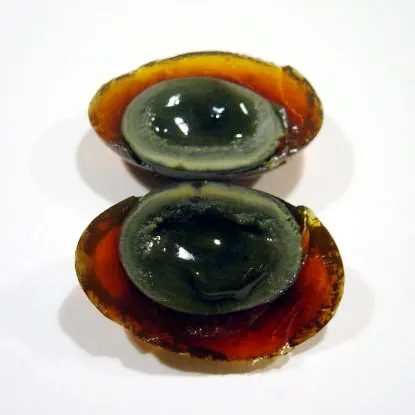
Century egg (boundary: alkaline, chemical)皮蛋 pídàn
Fresh duck eggs are soaked in, or coated with, a strong alkaline mix of sodium hydroxide (or lime and ash or soda ash), salt and tea, for several weeks to several months depending on the method. The alkali soaks through the shell and turns the white into a translucent jelly and the yolk dark green. This is a chemical cure, not a microbial fermentation.
Amounts from a sourceConcentrations of the soaking solution in a laboratory study of duck-egg pidan (Gao et al.: 4.5 % NaOH, 3.0 % NaCl and 0.4 % CuSO4, m/v, 35 days). Traditional coating pastes are given by weight in recipes: English Wikipedia lists tea, quicklime, sea salt and oak ash, and Chinese Wikipedia quotes the 1633 text, which gives salt, chestnut-charcoal ash and lime per 100 eggs. The amounts differ from place to place.
What changes:Starting material: fresh, uncracked duck eggs
Step 1 of 4
Select fresh duck eggs
Time
Not documented
Temperature
Not documented
Salt
None given
Acidity
Not documented
Output: fresh, uncracked eggs.
Flavour
Not documented
Texture
Not documented
Colour
Not documented
Microbes at work in this step
Not documented for this step.
Method
Measured measured in a studySet fixed by a specification or tested recipeReported one source reports itTypical a general value, not sourced for this fermentUnconfirmed not yet checked against a source
At a glance
Fresh duck eggs are soaked in, or coated with, a strong alkaline mix of sodium hydroxide (or lime and ash or soda ash), salt and tea, for several weeks to several months depending on the method. The alkali soaks through the shell and turns the white into a translucent jelly and the yolk dark green. This is a chemical cure, not a microbial fermentation. Made in 4 steps over 3.2 months. The longest step, roll in rice husk and seal in jars (coating method), takes at least 2 months (Chinese Wikipedia).
Century egg is cured by alkali, not microbes. The pH inside rises to about 10, the opposite of a lactic ferment. Salted eggs such as khai-khem use salt alone and keep a normal white.
Lead oxide was once used to speed the cure and is now strictly prohibited because of lead poisoning. Copper and copper-zinc salts are used instead, but residual heavy metals remain a concern, and heavy-metal-free methods are being developed. The soak listed here comes from a lab study and is not a tested home method. It is a lye solution, and sodium hydroxide burns skin and eyes. Swallowing large amounts of copper sulfate can cause vomiting and damage the liver and kidneys.
Hazards the sources name: Bacillus cereus (reported among the predominant bacteria); Heavy metals from the pickling liquid, which pass through the shell into the egg (not a microbe).
Chinese Wikipedia says the earliest written record is generally taken to be from 1504 (Song Xu, 竹嶼山房雜部), which calls it 混沌子. A 1633 text (Dai Xi, 養餘月令) gives a salt, chestnut-charcoal ash and lime method for 牛皮鴨子, an early form, turned three times and then sealed for a month.
Starter
The sources we found do not say how its fermentation begins.