Side-by-side or overlay PDF diff driven by one engine that reads each file into a structured model — text, vector geometry, images, form fields, annotations — and compares the models. Moves show as moves, edits show only where they happened, and any PDF type works without picking a mode.
Open a STEP / STP part and it measures itself — volume, thinnest wall, draft and undercut checks on load, plus hole detection with a BOM. Measure, section, export STL. Rust + WASM B-rep kernel, runs in your browser.
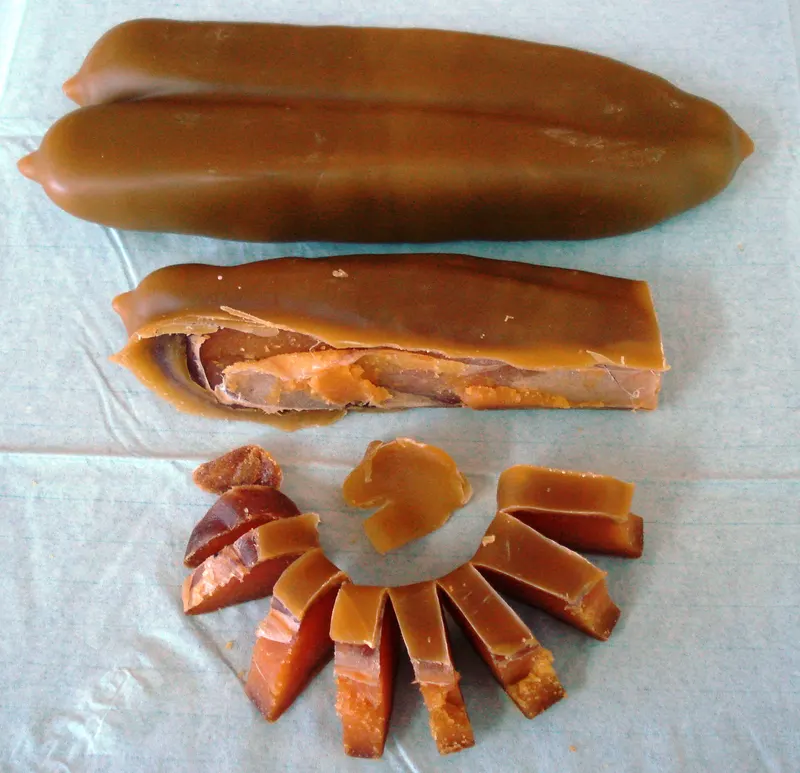
Bottarga is the whole roe sac of grey mullet (or tuna), salted, pressed and dried until it is firm. It is a salt-and-drying cure, not a microbial ferment, so it sits at the edge of the atlas. In Greece the dried roe is sealed in natural wax.
Amounts from a sourceThe times are from a 2020 study of Cabras lagoon mullet (Sardinia), in which the authors set and optimised the process, with 1 h of salting per 200 g of roe and drying until 30 % of the weight is lost. The authors say that small local producers use empirical, traditional methods, so their results differ between batches.
Whole ovaries of a ripe female mullet, kept intact in their membrane
Total time across the recorded steps: 6 days – 8 days
Start
Drag the bar or press Play
What changes:Starting material: whole mullet roe sacs, still in their membrane
Step 1 of 5
Take out the roe sacs whole
Time
Not documented
Temperature
Not documented
Salt
None given
Acidity
Not documented
The ovaries are removed without breaking their membrane. Output: whole, intact roe sacs.
Flavour
Not documented
Texture
Not documented
Colour
Not documented
Microbes at work in this step
Not documented for this step.
Method
Measured measured in a studySet fixed by a specification or tested recipeReported one source reports itTypical a general value, not sourced for this fermentUnconfirmed not yet checked against a source
At a glance
Bottarga is the whole roe sac of grey mullet (or tuna), salted, pressed and dried until it is firm. It is a salt-and-drying cure, not a microbial ferment, so it sits at the edge of the atlas. In Greece the dried roe is sealed in natural wax. Made in 5 steps over 6 days – 8 days. The longest step, air-dry, turning daily, takes 5–7 days (Corrias F 2020) and runs at 20 °C (Corrias F 2020).
Bottarga is a cure, not a ferment. Salt and drying preserve the roe, and no study describes a microbial fermentation. Unlike fermented fish pastes, the roe stays whole in its membrane.
Avgotaracho Messolongiou PDO (Greece)Grey mullet roe from the Messolongi-Etoliko lagoons; washed, salted, dried and sealed in natural wax.
Bottarga di tonno (Sicily)Made from tuna roe instead of mullet roe; in Sicily from Atlantic bluefin tuna (yellowfin tuna is also used for bottarga).
Wuyuzi (Taiwan) and eoran (Korea)East Asian forms of salted, cured roe. Taiwanese wuyuzi is softer than bottarga; Korean eoran is made from mullet or freshwater drum.
Safety
Dried fish products rely on low water activity. The US FDA says a water activity of 0.85 or below stops growth and toxin formation by all pathogenic bacteria, including S. aureus and C. botulinum. The study behind the times on this page says bottarga has low water activity but gives no figure, so drying by weight loss alone is not shown to reach 0.85. Dried products packed with less drying, such as vacuum packs, must be kept cold.
The Messolongi PDO application says that making the product from the roe of sea lake mullet has a long history in the area, and that travellers' references go back as far as 1668.
Starter
The sources we found do not say how its fermentation begins.