Side-by-side or overlay PDF diff driven by one engine that reads each file into a structured model — text, vector geometry, images, form fields, annotations — and compares the models. Moves show as moves, edits show only where they happened, and any PDF type works without picking a mode.
Open a STEP / STP part and it measures itself — volume, thinnest wall, draft and undercut checks on load, plus hole detection with a BOM. Measure, section, export STL. Rust + WASM B-rep kernel, runs in your browser.
A rice-flour batter with sugar and coconut milk is leavened by fermentation, then steamed or baked into a sweet, spongy cake. The traditional method starts from glutinous rice fermented with a rice-wine starter (cơm rượu) and takes nearly a week. A tested quick version uses baker's yeast and is ready to steam in under an hour.
Amounts from a sourceThe quick, yeast-leavened bánh bò bông of a 2020 study. The sources give no tested amounts for the traditional cơm rượu or its batter.
Dry baker's yeast (Saccharomyces cerevisiae)1.25 % of the wheat and rice flour weight (1.25 g)
1, 1.25, 1.5, 1.75 and 2 % were tested; 1.25 % scored best[nguyen2020]
Baking powder1.5 g
The quick version uses it as well as yeast[nguyen2020]
Starter
cơm rượu (glutinous rice fermented with a men starter), traditionally; baker's yeast in the quick version
Total time across the recorded steps: 2 days – 3 days
Start
Drag the bar or press Play
What changes:Cooked glutinous rice with men starter turns sweet and alcoholic
Step 1 of 6
Ferment glutinous rice into cơm rượu (traditional)
Time
2–3 days
Reported
Temperature
Not documented
Salt
None given
Acidity
pH 3.9–4.5
Measured
Which microbes the steps name, step by step
Moulds
Yeasts
Lactic acid bacteria
Saccharomyces cerevisiae
The glutinous rice is cooked, cooled and incubated with the men starter. Output: cơm rượu and its liquid.
Flavour
sweet and pungent (cay nồng)
Texture
Not documented
Colour
Not documented
Microbes at work in this step
moulds of the men starter turn starch to sugar; yeasts make alcohol; lactic acid bacteria add some sourness
Method
Measured measured in a studySet fixed by a specification or tested recipeReported one source reports itTypical a general value, not sourced for this fermentUnconfirmed not yet checked against a source
At a glance
A rice-flour batter with sugar and coconut milk is leavened by fermentation, then steamed or baked into a sweet, spongy cake. The traditional method starts from glutinous rice fermented with a rice-wine starter (cơm rượu) and takes nearly a week. A tested quick version uses baker's yeast and is ready to steam in under an hour. Made in 6 steps over 2 days – 3 days. The longest step, ferment glutinous rice into cơm rượu (traditional), takes 2–3 days (Hoàng Tuấn Thanh et al. 2024). Saccharomyces cerevisiae and Yeasts and moulds of the men starter do most of the fermenting.
Bánh bò is a rice cake leavened by fermentation and sweetened with sugar and coconut milk. Its traditional leaven is cơm rượu, the sweet fermented glutinous rice also eaten on its own, not a lactic batter ferment.
Bánh bò bôngSteamed; the top cracks into a cross and opens like a flower (bông).
Bánh bò nướngBaked in a pan, often as a large cake served in slices; off-white inside with a golden crust from caramelised coconut milk.
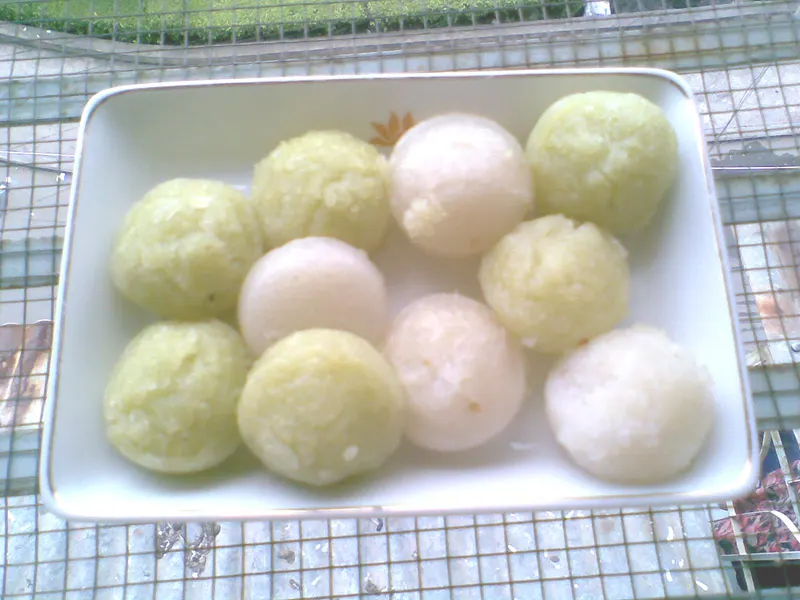
Bánh bò hấpSmall steamed cakes, white, green (pandan) or pink to pale purple.
Safety
In five cơm rượu samples sold in Cần Thơ, pH was 3.92–4.54 and total coliforms and E. coli were below 3 MPN/g; the paper notes that the low pH and high acidity help keep fermented rice safe to eat. This describes the traditional leaven, not the batter.