Side-by-side or overlay PDF diff driven by one engine that reads each file into a structured model — text, vector geometry, images, form fields, annotations — and compares the models. Moves show as moves, edits show only where they happened, and any PDF type works without picking a mode.
Open a STEP / STP part and it measures itself — volume, thinnest wall, draft and undercut checks on load, plus hole detection with a BOM. Measure, section, export STL. Rust + WASM B-rep kernel, runs in your browser.
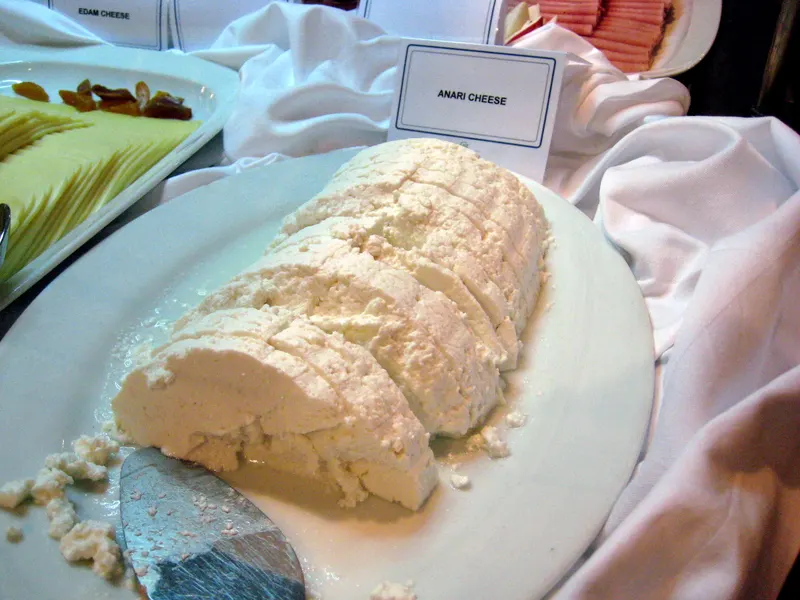
Anari is a boundary entry, set by heat, not by microbes. During halloumi making, the whey left after the curd is lifted out is heated, a small amount of fresh milk is added, and the whey proteins rise to the surface as soft curds when the whey nears the boil. It is sold as a soft fresh cheese, salted or unsalted, or salted and dried, and dried anari is grated.
No fixed amounts recordedIn a 1986 trial, the halloumi make from 20 kg of milk gave 0.99 kg of anari (sheep), 0.78 kg (goat), 0.85 kg (sheep and goat) and none from cow milk.
First whey from halloumi making
In a 1986 trial the whey of sheep, goat and mixed milk gave anari, and cow-milk whey gave none[economides1987]
Anari is sold fresh and salted, fresh and unsalted, or salted and dried[cy-gastronomy]
Starter
none; the curd is formed by heat
Total time across the recorded steps: 1 h
Start
Drag the bar or press Play
What changes:Starting material: the whey left after the halloumi curd is lifted out
Step 1 of 5
Keep the whey from halloumi
Time
Not documented
Temperature
Not documented
Salt
None given
Acidity
Not documented
After the halloumi curd is removed, the whey (noros) goes on being heated while it is stirred, so that leftover curd grains do not turn into lumps.
Flavour
Not documented
Texture
Not documented
Colour
Not documented
Microbes at work in this step
Not documented for this step.
Method
Measured measured in a studySet fixed by a specification or tested recipeReported one source reports itTypical a general value, not sourced for this fermentUnconfirmed not yet checked against a source
At a glance
Anari is a boundary entry, set by heat, not by microbes. During halloumi making, the whey left after the curd is lifted out is heated, a small amount of fresh milk is added, and the whey proteins rise to the surface as soft curds when the whey nears the boil. It is sold as a soft fresh cheese, salted or unsalted, or salted and dried, and dried anari is grated. Made in 5 steps over 1 h. The longest step, heat until the curds rise, takes 1 h (Economides S 1987) and runs at 70–80 °C (Economides S 1987).
Anari is the whey cheese made alongside halloumi, from the same whey, before the halloumi pieces are cooked in it. The Cyprus Department of Agriculture calls it a separate product from halloumi. In a 1986 trial, sheep and goat whey gave anari but cow-milk whey gave none.
Boundary
A whey cheese set by heat, not by microbes
Milk
Whey from halloumi making with a little fresh milk; in a 1986 trial cow milk gave no anari
Yield
About 1 kg from the halloumi make of 20 kg of sheep milk
Fresh anariSoft; served salted or unsalted, for example with honey as a dessert when unsalted
Dried anariSalted and dried under controlled conditions; grated over pasta
Safety
Fresh whey cheeses are a known Listeria risk. A 2022 study of the Greek whey cheese anthotyros says their high pH (above 6.0 to 6.8) and moisture (above 60 to 80 %) let Listeria monocytogenes grow if it reaches the curd after heating, and that they spoil quickly at abusive storage temperatures.
Hazards the sources name: Listeria monocytogenes, which grew in fresh anthotyros, a related Greek whey cheese, when added after heating.
Anari is made in Cyprus as a by-product of halloumi making and is linked to halloumi's history, yet the Cyprus Department of Agriculture calls it a separate product with its own place in daily life. It is tied to religious feasts such as the Tyrini cheese week before Tyrofagos Sunday, and Kyprianos (1788), Richter (1913) and Bevan (1919) wrote about it.