Side-by-side or overlay PDF diff driven by one engine that reads each file into a structured model — text, vector geometry, images, form fields, annotations — and compares the models. Moves show as moves, edits show only where they happened, and any PDF type works without picking a mode.
Open a STEP / STP part and it measures itself — volume, thinnest wall, draft and undercut checks on load, plus hole detection with a BOM. Measure, section, export STL. Rust + WASM B-rep kernel, runs in your browser.
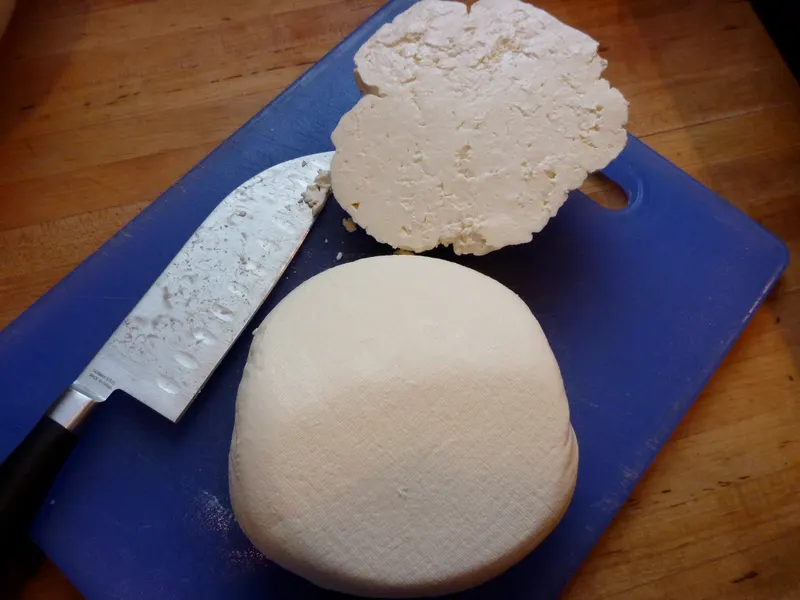
Myzithra is a traditional Greek whey cheese made from sheep and/or goat whey. In the study makes, about 10 % ovine milk is added to the whey. Whey cheeses in general are made by heating the whey above 80–95 °C, so its proteins clot and the curd gathers on the surface. Fresh myzithra is heat-set with no starter. A 2022 paper says heating leaves fresh whey cheeses practically free of native microbes, and handling then contaminates them; a dried form also exists.
none in fresh myzithra; one study fermented the whey first with Streptococcus thermophilus
Start
Drag the bar or press Play
What changes:Sheep or goat whey from cheesemaking goes into the vat, with a little milk
Step 1 of 5
Collect whey and add milk
Time
Not documented
Temperature
Not documented
Salt
None given
Acidity
Not documented
Output: whey with some milk.
Flavour
Not documented
Texture
Not documented
Colour
Not documented
Microbes at work in this step
Not documented for this step.
Method
Measured measured in a studySet fixed by a specification or tested recipeReported one source reports itTypical a general value, not sourced for this fermentUnconfirmed not yet checked against a source
At a glance
Myzithra is a traditional Greek whey cheese made from sheep and/or goat whey. In the study makes, about 10 % ovine milk is added to the whey. Whey cheeses in general are made by heating the whey above 80–95 °C, so its proteins clot and the curd gathers on the surface. Fresh myzithra is heat-set with no starter. A 2022 paper says heating leaves fresh whey cheeses practically free of native microbes, and handling then contaminates them; a dried form also exists.
Myzithra is made mostly from whey, with at most about 10 % milk in the studies, and is set by heat rather than rennet or bacteria, so the fresh cheese is hardly fermented at all. Its Cretan relative xynomyzithra is pressed for a week to raise its acidity and ripened for at least 2 months.
Composition
Fresh Myzithra at most 70 % moisture and at least 50 % fat in dry matter (Greek rules as cited)
Fresh myzithraSoft, at most 70 % moisture, and perishable; Greek whey cheeses in air are often limited to 5–7 days of shelf life.
Dried myzithraA salt-dried grating cheese (Wikipedia); a Greek plant monitored in 2016–2019 made both fresh and dried Myzithra.
XynomyzithraA Cretan whey cheese. The whey is heated to 90 °C, and up to 15 % full-cream milk is usually added at about 68–70 °C on the way up. It is pressed a week to raise its acidity and ripened at least 2 months; Xynomyzithra Kritis is PDO.
Safety
Heating the whey inactivates its native bacteria, so fresh myzithra spoils mainly from microbes that get in afterwards. Listeria monocytogenes has been isolated from it, and E. coli O157:H7 can grow in it at 12 °C; keep it cold. Cold alone is not enough. In a lab test, Listeria still grew in vacuum-packed fresh Anthotyros, a related whey cheese, in the first two weeks at 4 °C.
Hazards the sources name: Listeria monocytogenes, isolated from fresh and dried Myzithra and processing surfaces; Escherichia coli O157:H7 grew at 12 °C and survived at 2 °C in Myzithra.
The Cretan relative Xynomyzithra Kritis is in the EU register. Its 1994 application, from the cheesemakers' association of Rethymnos prefecture, says the cheese has a history of many centuries; it was registered as a PDO on 21 June 1996. Greek rules cited by Sameli and colleagues (2021) allow fresh Myzithra at most 70 % moisture and at least 50 % fat in dry matter. A 1996 study cited by Samelis and Sameli (2022) found that Myzithra, Anthotyros and Manouri all let Listeria grow at 5, 12 and 22 °C.