Side-by-side or overlay PDF diff driven by one engine that reads each file into a structured model — text, vector geometry, images, form fields, annotations — and compares the models. Moves show as moves, edits show only where they happened, and any PDF type works without picking a mode.
Open a STEP / STP part and it measures itself — volume, thinnest wall, draft and undercut checks on load, plus hole detection with a BOM. Measure, section, export STL. Rust + WASM B-rep kernel, runs in your browser.
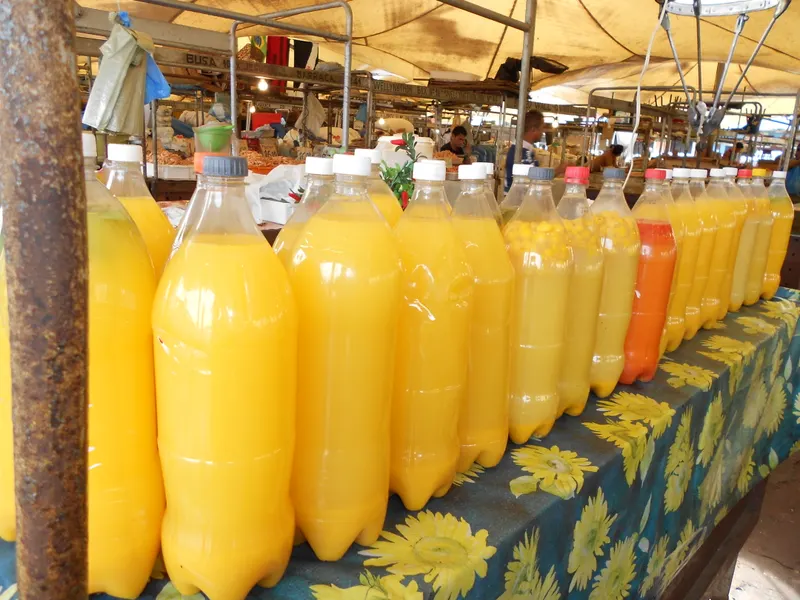
The yellow juice pressed from grated bitter cassava is left to settle out its starch, then the liquid sours for about half a day to a day while lactic bacteria take over and part of the cyanide escapes. Boiling with garlic, herbs and salt drives off most of the rest and gives a sour, savoury yellow broth.
Fully documentedSauces and condiments29 h – 2.8 days
Amounts from a sourceThe seasoning amounts are the shares used in the Embrapa pilot process (Campos et al. 2019), given as percent of the fermented juice. One family workshop in Vigia de Nazaré makes about 1440 L of tucupi a month.
Manipueira
The juice pressed from grated yellow-fleshed bitter cassava; about 300 L comes from 1000 kg of roots[embrapa2013]
Total time across the recorded steps: 29 h – 2.8 days
Start
Drag the bar or press Play
What changes:Peeled bitter cassava roots soak in water before grating
Step 1 of 6
Peel, wash and soak the roots
Time
12 h
Reported
Temperature
Not documented
Salt
None given
Acidity
Not documented
Which microbes the steps name, step by step
Weissella
Lactobacillus fermentum
L. plantarum
Lactobacillus
Output: soaked, peeled bitter cassava.
Flavour
Not documented
Texture
Not documented
Colour
Not documented
Microbes at work in this step
Not documented for this step.
Method
Measured measured in a studySet fixed by a specification or tested recipeReported one source reports itTypical a general value, not sourced for this fermentUnconfirmed not yet checked against a source
At a glance
The yellow juice pressed from grated bitter cassava is left to settle out its starch, then the liquid sours for about half a day to a day while lactic bacteria take over and part of the cyanide escapes. Boiling with garlic, herbs and salt drives off most of the rest and gives a sour, savoury yellow broth. Made in 6 steps over 29 h – 2.8 days. The longest step, let the liquid ferment, takes 12 h – 2 days (Embrapa Amazônia Oriental 2022) and runs at 24–33 °C (Campos A.P.R 2016). Lactobacillus fermentum and Weissella do most of the fermenting.
Tucupi is made from the juice, not the pulp, of bitter cassava. It ferments for only about a day and then must be boiled, while gari and fufu ferment the grated or soaked root itself for days.
Tucupi powderSpray-dried with maltodextrin; the optimised trial used 214 °C inlet air and 27 % maltodextrin.
Starter-culture tucupiJuice inoculated with Pediococcus acidilactici kept Lactobacillus dominant and cut Bacillus and Enterococcus in a 24 h trial.
Safety
Bitter cassava juice releases hydrogen cyanide, a poison. Do not taste or drink it raw or only fermented. Two Embrapa batches still held 71 and 114 mg HCN/L after 24 h of fermentation, and juice only brought to the boil held 66 mg HCN/L. Embrapa chose 24 h of fermentation and 40 min of boiling, which gave 6.97 mg HCN/L. A 10 min boil gave about 6 mg HCN/L in one Embrapa batch, but a study Embrapa cites measured 37 mg HCN/L after 10 min, so do not rely on a short boil. Fresh juice held 154 and 358 mg HCN/L in two batches, so the roots matter too. This page records how Pará producers and Embrapa make tucupi; it is not a tested home recipe. In 22 market samples in Belém, total HCN was 8.87–114.66 mg/L and histamine reached 66.85 mg/L. Boiling does not remove histamine. Pará's standard (ADEPARÁ Normative Instruction 1/2008) sets pH 3.5–4.3 and 0.1–0.8 g lactic acid per 100 mL, and requires the absence of Salmonella, coagulase-positive staphylococci and Bacillus cereus.
Hazards the sources name: Bacillus cereus, Salmonella and coagulase-positive Staphylococcus (the Pará standard requires their absence; none were found in the Embrapa product); Hydrogen cyanide and the cassava compounds that release it, 8.87–114.66 mg/L total HCN in 22 market samples in Belém; Histamine, 1.00–66.85 mg/L where found in the same samples; boiling does not remove it.
Tucupi is a staple of Pará cooking and a by-product of farinha making; families and small agroindustries in Pará bottle it for markets such as Ver-o-Peso, and demand roughly doubles prices during the Círio de Nazaré in October.
[brito2019] do Carmo Brito B.N., Chisté R.C., Lopes A.S., Gloria M.B.A., Pena R.S. 2019, Influence of spontaneous fermentation of manipueira on bioactive amine and carotenoid profiles during tucupi production, Food Research International 120:209–216, doi:10.1016/j.foodres.2019.02.040 (abstract)paper