Side-by-side or overlay PDF diff driven by one engine that reads each file into a structured model — text, vector geometry, images, form fields, annotations — and compares the models. Moves show as moves, edits show only where they happened, and any PDF type works without picking a mode.
Open a STEP / STP part and it measures itself — volume, thinnest wall, draft and undercut checks on load, plus hole detection with a BOM. Measure, section, export STL. Rust + WASM B-rep kernel, runs in your browser.
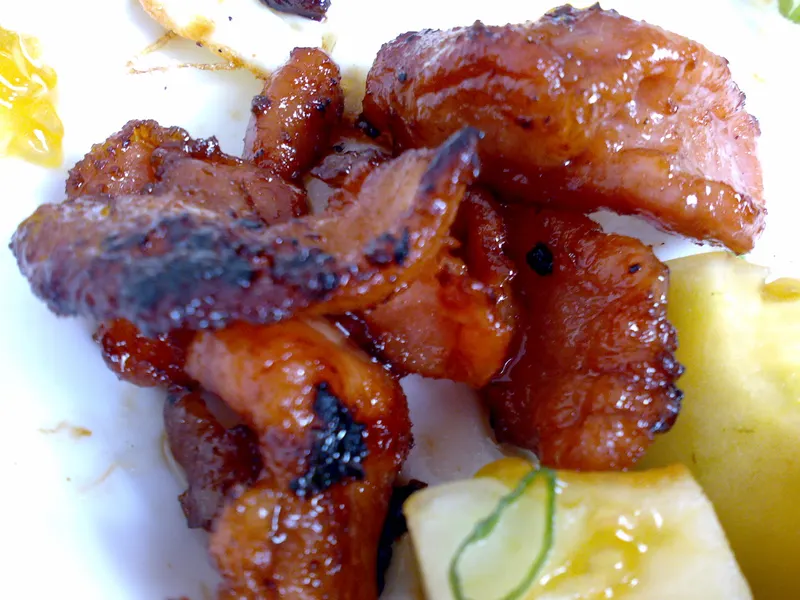
Thin slices of pork are mixed with salt, curing salt, a lot of sugar, anise wine, garlic and often pineapple juice and red colouring, then cured for a day or two in the fridge before frying; the government sheet also allows hours at room temperature, which is the riskier choice. It is a sweet cure, not a true ferment, though lactic bacteria have been reported in it.
Amounts from a sourceAmounts are for 1 kg of pork in the pure tocino recipe of the Bureau of Animal Industry's Animal Products Development Center, as reproduced by the Department of Agriculture's Agricultural Training Institute; it yields 1.25 kg.
Pork ham (pigue) or picnic (kasim), or cuts with some fat1000 g
About 2 g. The sheet prints 20 g here, which looks like a misprint, because its sausage recipes give 2.0 g for the same ½ teaspoon. Do not use 20 g; curing salt contains nitrite, which is poisonous in excess.[ati-bai]
Total time across the recorded steps: 7.3 days – 4.1 months
Start
Drag the bar or press Play
What changes:The pork is trimmed and cut into thin slices
Step 1 of 4
Trim and slice the pork
Time
Not documented
Temperature
Not documented
Salt
None given
Acidity
Not documented
Output: thin pork slices.
Flavour
Not documented
Texture
Not documented
Colour
Not documented
Microbes at work in this step
Not documented for this step.
Method
Measured measured in a studySet fixed by a specification or tested recipeReported one source reports itTypical a general value, not sourced for this fermentUnconfirmed not yet checked against a source
At a glance
Thin slices of pork are mixed with salt, curing salt, a lot of sugar, anise wine, garlic and often pineapple juice and red colouring, then cured for a day or two in the fridge before frying; the government sheet also allows hours at room temperature, which is the riskier choice. It is a sweet cure, not a true ferment, though lactic bacteria have been reported in it. Made in 4 steps over 7.3 days – 4.1 months. The longest step, pack and keep cold, takes 7 days – 4 months (Department of Agriculture). Salt is 1.2 % (Department of Agriculture).
Tocino is cured with a lot of sugar for only hours to a couple of days and then fried, so it is a sweet cure rather than a ferment. Longganisa is a Filipino pork sausage.
Tocino is cooked before eating, but cooking does not undo every mistake in the cure. The government sheet allows 8–10 hours at room temperature or 1–2 days in the fridge. Use the fridge. CDC says never to leave perishable food out for more than 2 hours, or 1 hour above 32 °C, because bacteria multiply quickly. Staphylococcus aureus can make a toxin in held food, and cooking does not destroy that toxin. Curing salt is also dangerous when overused, because too much nitrite stops the blood carrying oxygen and can kill. The sheet prints 20 g of curing salt for this recipe, while its other recipes give 2.0 g for the same ½ teaspoon, and it does not say how strong its curing salt is. After curing, keep the pork in the fridge for up to a week or frozen for 2–4 months.