Side-by-side or overlay PDF diff driven by one engine that reads each file into a structured model — text, vector geometry, images, form fields, annotations — and compares the models. Moves show as moves, edits show only where they happened, and any PDF type works without picking a mode.
Open a STEP / STP part and it measures itself — volume, thinnest wall, draft and undercut checks on load, plus hole detection with a BOM. Measure, section, export STL. Rust + WASM B-rep kernel, runs in your browser.
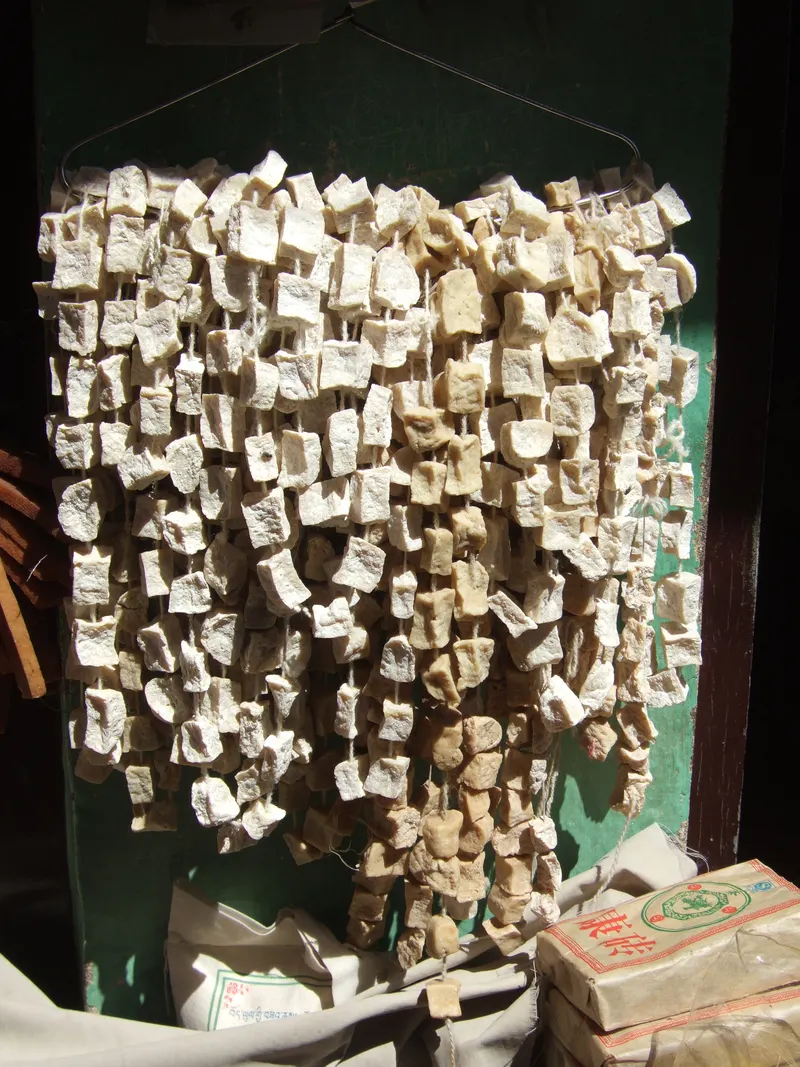
After yak milk is soured and churned for butter, the buttermilk or skim milk is warmed with a little sour milk until curd forms, and the curd is drained in a basket or cloth bag. Eaten fresh and soft it is chura loenpa; shaped into pieces and dried hard in the sun and wind it becomes chura kampo, a herders' snack that keeps a long time.
No fixed amounts recordedHerders' practice with no fixed recipe or amounts.
Buttermilk or skimmed yak milk
Left after the butter is churned; occasionally whole milk[fao-yak2003]
Sour milk
A little is added to the warm milk to make it curdle[fao-yak2003]
Starter
a little sour milk is added to the warm milk
Total time across the recorded steps: 1 h – 4 h
Start
Drag the bar or press Play
What changes:Churning splits the soured milk into butter and buttermilk
Step 1 of 5
Churn the soured milk for butter
Time
1–4 h
Reported
Temperature
Not documented
Salt
None given
Acidity
Not documented
The butter is the main product; the buttermilk or skimmed milk left over makes the chura. Output: butter and buttermilk.
Flavour
Not documented
Texture
Not documented
Colour
Not documented
Microbes at work in this step
Not documented for this step.
Method
Measured measured in a studySet fixed by a specification or tested recipeReported one source reports itTypical a general value, not sourced for this fermentUnconfirmed not yet checked against a source
At a glance
After yak milk is soured and churned for butter, the buttermilk or skim milk is warmed with a little sour milk until curd forms, and the curd is drained in a basket or cloth bag. Eaten fresh and soft it is chura loenpa; shaped into pieces and dried hard in the sun and wind it becomes chura kampo, a herders' snack that keeps a long time. Made in 5 steps over 1 h – 4 h. The longest step, churn the soured milk for butter, takes 1–4 h (Wiener G 2003). Lactococcus, Lactobacillus and Acetobacter, the dominant bacteria in Tibetan qula samples and Lactobacillus, Acetobacter and Lactococcus, the dominant genera in qula from Gannan, Gansu do most of the fermenting.
Chura is made from what is left after butter making, so it is lean, and it sets by souring and gentle heat instead of rennet. Tibetans keep both a soft fresh form and a rock-hard dried form; an FAO survey notes that Tibet makes a pliable form besides the hard chhurpi of Nepal and Bhutan.
Milk
Buttermilk or skimmed milk of yak, sometimes whole milk
Forms
Chura loenpa (fresh, soft) and chura kampo (dried, hard)
Composition
Dried residue about 55 % protein and 21 % lactose (FAO); half-dried residue 20–30 % water, sometimes 40 %
Chura loenpaThe fresh, soft curd, eaten like cottage cheese or cooked in dishes.
Chura kampoThe dried, hard form.
Whole-milk churaMade from whole milk; dries yellow and brittle instead of white and hard.
Safety
Drying is the preservation step; hard dried pieces keep because little water is left. An FAO survey says soft Himalayan curd keeps only 2–3 days in warm weather, or up to 2 weeks in the cold, so fresh chura should be eaten soon or dried.
In China, butter is the principal product of yak milk. The FAO survey says herdsmen make milk residue from the skimmed milk left over, keep the half-dried residue as a ration when they are out with their animals, and mix the dried residue with butter to make zanba, also called tsampa.