Side-by-side or overlay PDF diff driven by one engine that reads each file into a structured model — text, vector geometry, images, form fields, annotations — and compares the models. Moves show as moves, edits show only where they happened, and any PDF type works without picking a mode.
Open a STEP / STP part and it measures itself — volume, thinnest wall, draft and undercut checks on load, plus hole detection with a BOM. Measure, section, export STL. Rust + WASM B-rep kernel, runs in your browser.
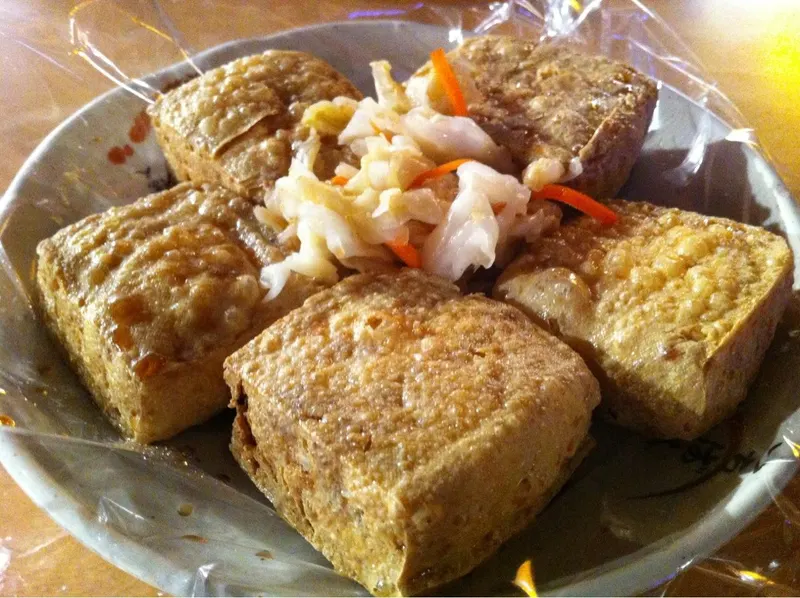
Fresh tofu is soaked for minutes to hours in a brine of vegetables and other ingredients that has fermented for months to years, and takes on its strong smell. It is then deep-fried, steamed or stewed and served with a chilli or garlic dip.
No fixed amounts recordedTraditional process with no fixed batch size or brine formula in the sources; the Changsha brine is fermented for a year or more and the Shanghai brine for nearly a year.
Fresh white tofu
In Changsha, blocks 5 × 5 cm and 1 cm thick, made from plump, moist northeastern soybeans[ich1522]
Fermented brine
Shanghai: amaranth and spices fermented for nearly a year. Changsha: fresh winter bamboo shoots, shiitake, perilla and Liuyang douchi simmered in winter water, with qu liquor added[tian2023st][ich1522]
The tofu is soaked in a vegetable brine that has fermented naturally for months to years.
Total time across the recorded steps: 12 months
Start
Drag the bar or press Play
What changes:Vegetables ferment for a year or more into a pungent brine
Step 1 of 5
Make and keep the brine
Time
at least 12 months
Reported
Temperature
Not documented
Salt
None given
Acidity
Not documented
Which microbes the steps name, step by step
Enterococcus
Lactobacillus
Lactococcus
Leuconostoc
The Changsha brine is best made in winter. Output: stinky brine.
Flavour
Not documented
Texture
Not documented
Colour
Not documented
Microbes at work in this step
microorganisms in the vegetable mix make proteases and lipases whose products give the smell
Method
Measured measured in a studySet fixed by a specification or tested recipeReported one source reports itTypical a general value, not sourced for this fermentUnconfirmed not yet checked against a source
At a glance
Fresh tofu is soaked for minutes to hours in a brine of vegetables and other ingredients that has fermented for months to years, and takes on its strong smell. It is then deep-fried, steamed or stewed and served with a chilli or garlic dip. Made in 5 steps over 12 months. The longest step, make and keep the brine, takes at least 12 months (China national intangible cultural heritage l…). Enterococcus, Lactobacillus, Lactococcus and Leuconostoc, reported as the core microbes of the brine does most of the fermenting.
Stinky tofu is plain tofu flavoured by soaking in an old fermented brine, so the tofu itself ferments only briefly. Furu and hairy tofu, by contrast, grow mould on the tofu.
Changsha black stinky tofu (Huogongdian)Brine made in winter from fresh winter bamboo shoots, shiitake, perilla and Liuyang douchi, simmered, mixed with qu liquor and fermented in pools for a year or more; white tofu 5 × 5 × 1 cm soaks 2–6 h, is fried in tea-seed oil and served with a chilli-garlic dip. Ink-black outside, white inside. National intangible heritage item 1522 (2021).
Shaoxing stinky tofuBrine from mouldy amaranth stalks; fried.
Taiwanese stinky tofu (fried, steamed, grilled, mala hot pot)Fried is the most common form and is considered less pungent than other varieties; steamed is the most pungent.
Sichuan mala stinky tofuStewed in mala broth, not fried.
Safety
Stinky tofu was the food in 24 of the 80 foodborne botulism outbreaks recorded in China from 2004 to 2020, and the paper ties home-prepared traditional stinky tofu to households in Xinjiang. Of the 24, 12 were attributed to improper processing and 9 to improper storage [li2022bot]. The paper says related home soybean ferments, kept warm in airtight containers, likely let the toxin form. CDC says the toxin cannot be seen, smelled or tasted, so the strong smell tells you nothing about safety, and it says not to eat food if you do not know whether it was safely fermented [cdc-prev].
Hazards the sources name: Clostridium botulinum in home-made traditional stinky tofu (24 of 80 botulism outbreaks in China, 2004–2020).
Changsha's Huogongdian stinky tofu was first made by a tofu-making Jiang family of Xiangyin in the Tongzhi era of the Qing dynasty; a Jiang descendant began selling it at Huogongdian in 1908.
Temperature, salt and pH
The sources we found give no temperature, salt or pH figure for any of its steps.